


The security landscape is undergoing a profound transformation, as evidenced by the innovations showcased at the ISC West Expo 2026. From dismantling of silos between physical and digital security to the ongoing transition to cloud and hybrid platforms, much of the discussion on the show floor was familiar, if somehow more urgent than ever. Clearly the industry is moving toward unified, cloud-native, and highly automated ecosystems.
In a series of deep-dive meetings and demonstrations at the recent show, I got a first-hand glimpse of the future of the physical security marketplace. Spoiler alert: The future is now!
HID Global: Tearing down the silos
HID Global is addressing the long-requested convergence of physical and digital security. Recognising that the industry has historically operated in silos, HID is now leading with a combined implementation team to leverage the power of both sides. HID is supporting the transition by combining its logical and physical security teams to help end users design secure, end-to-end journeys for their employees.
By leveraging its massive existing footprint in physical access, HID is uniquely positioned to help organisations upgrade their cybersecurity posture without a total "rip and replace" of their hardware. HID is seeing a surge in demand for converged credentials that unite building access with digital identity. On the digital front, HID has implemented FIDO (Fast Identity Online) and passkeys to replace traditional passwords with more secure, biometric-backed authentication methods.
Acre Security: Bridging the gap to the cloud
Acre Security previewed a cloud-native video solution, reinforcing its cloud-first security strategyAcre Security is currently consolidating brands, bringing established names like Feenics and AccessIt under a single corporate umbrella. A primary theme for the company at ISC West is the migration of legacy systems to modern infrastructure. To facilitate the transition, they are launching "The Bridge," a technology designed to help on-premise customers transition to the cloud at a pace that suits their operational needs.
The company is also expanding its portfolio into video. Attendees at the show received a preview of a new cloud-native video solution slated for release later this year, signaling Acre’s commitment to a holistic, cloud-first security suite.
Acoem: Real-time acoustic threat detection
With a 35-year foundation in vibration and acoustics—including military sniper detection—Acoem is providing gunshot detection through edge processing. Unlike systems that rely on the cloud and may suffer from latency, Acoem’s technology processes data at the sensor level for instant alerts. Their sensors are engineered for massive outdoor spaces, covering a 500-foot radius (roughly 11 football fields) and can detect high-powered rifle shots from up to half a mile away.
The system provides critical intelligence by distinguishing between muzzle blasts and "mach noise" from bullet travel, delivering an audio file to the end-user that maps the location and direction of the threat. They use AI to filter out environmental false positives, such as skateboards hitting metal rails.
Alarm.com: The all-in-one dealer ecosystem
Beyond hardware, Alarm.com is leveraging AI to streamline the sales process
Alarm.com is doubling down on "giving tools to dealers to help them be successful," with a focus on unified commercial solutions. A highlight at ISC West is their new fire communicator, which integrates fire monitoring into their single app, completing what they call the "fourth leg of the stool." The product allows fire systems to benefit from the same real-time customer engagement and push notifications that have long been available for intrusion and video. The key products, such as commercial-grade hardware, are now available for immediate purchase.
Beyond hardware, Alarm.com is leveraging AI to streamline the sales process. Their new AI Proposal Builder uses customer meeting notes to automatically generate customised, value-driven sales proposals for dealers.
Allegion: A global shift in credentialing
Following the acquisition of ELATEC, Allegion is adopting a more global market approach and expanding its OEM business. The company is involved in the development of Aliro, the newly unveiled mobile credentialing standard. Allegion’s strategy is built on versatility: While Aliro serves the burgeoning mobile market, they also offer PKOC for plastic cards, allowing them to provide solutions regardless of the user's preferred credential type. The ELATEC acquisition has effectively filled previous gaps in their use-case portfolio, positioning them as a comprehensive provider for both physical and digital access needs.
AtlasIED: Engineering for life safety
Transitioning from audio to a fully automated threat detection company, AtlasIED showcased its new IPX line at ISC West. This modular platform uses a single PoE++ port to power various "plug-and-play" modules, allowing for easy system upgrades. Their gun detection technology achieves a 99% confidence rating by "stacking" AI models; it cross-references audio data with infrared signatures to detect muzzle flashes and air quality sensors for particulates. With systems already running in 80% of U.S. international airports, the company maintains 24/7 domestic engineering support to manage these "life-safety adjacent" environments.
Axis Communications: Unifying connectivity
Axis Communications is advancing network video with 4G/5G surveillance, reducing cabling needs
Axis Communications continues to lead in network video, with a new focus on offering surveillance through 4G and 5G networks to eliminate the need for extensive cabling in long-range applications. Axis also introduced several specialised hardware pieces, including the P1486-LE global shutter camera for high-speed traffic monitoring and the Q2802-TE, which integrates thermal and visual monitoring into a single unit.
To assist technicians, they launched a new installer app that uses Bluetooth for easier camera pairing and management directly from a mobile device.
Axon: De-escalation through enterprise wearables
Focusing on frontline safety, Axon is expanding from law enforcement into the enterprise sector with its retail and healthcare-focused body camera. Weighing only 0.25 lb, these cameras are designed to be less intimidating, using colorful designs and acting as a primary de-escalator for aggressive behavior.
A clear front display signals when recording is active, striking a balance between safety and a non-intimidating appearance. These devices feature live-streaming and panic alarms that connect workers to a Global Security Operations Center (GSOC). To ensure the footage is legally viable, Axon maintains a rigorous audit trail that authenticates every action recorded.
Genetec: The value of the unified platform
Genetec is advocating for unified platforms that reduce the time between incident detection and resolution. They argue that AI is becoming a commodity and that the true value lies in unified platforms that reduce the time from incident to resolution.
Their approach emphasises the "outcomes" customers need, such as allowing security teams to coalesce around an investigation quickly. Genetec remains a strong supporter of open systems for enterprise customers, ensuring they have the choice to integrate diverse technologies rather than being locked into a manufacturer’s “walled garden.” This flexibility is critical for high-end security environments that require tailored, responsive systems.
Johnson Controls: Large-scale enterprise solutions
Johnson Controls has made a significant push into the enterprise video market with C-Cure IQ, a standalone VMS designed for major hubs like airports and large campuses. Through a partnership with Scylla, they have integrated 11 advanced analytics—including facial recognition and weapons detection—directly into their cameras. They also showcased new multi-sensor panoramic cameras capable of "stitching" multiple images into a single 360-degree view.
While innovating in video, Johnson Controls also confirmed modern upgrades to their intrusion line, including their legacy DSC Neo line. The new DSC PowerSeries Neo 5, a high-end residential and commercial platform, features an all-new user interface and built-in PowerG+. They have also begun shipping the IQ5 family lineup, which is powered by a Qualcomm DragonWing processor.
ONVIF: Standardising the future of AI and cloud
ONVIF continues to lead the charge in establishing common languages for the security industry. A major focus is their new "Cloud Profile," which enables cameras to connect directly to the cloud through a standardised protocol. They are also expanding into audio standards to ensure IP-based speakers can seamlessly connect to Video Management Systems (VMS). To combat the rise of sophisticated digital manipulation, ONVIF is developing "video signing" standards.
ONVIF is actively seeking more diverse enterprise participation to help shape these emerging AI standardsThis feature protects the integrity of video for evidentiary purposes by embedding a digital signature and timestamp directly into the footage at the camera level. Additionally, the organisation has formed an AI Working Group to develop common communication methods for "AI agents" within physical security systems. ONVIF is actively seeking more diverse enterprise participation to help shape these emerging AI standards.
Roberto Licari is the new ONVIF Ambassador, seeking to attract new companies (even outside the security sector) to ONVIF as they look to expand their offerings.
SwiftConnect: Bridging digital and physical identity
SwiftConnect is redefining access control by shifting the focus from physical cards to digital identity. As a cloud-based "connected access network," the platform bridges the gap between IT identity providers (like Okta or Azure AD) and legacy physical access control systems.
At the show's Security Experience Center demonstrations, SwiftConnect showcased its ability to integrate mobile credentials within Apple and Google Wallets across multiple technology platforms. By aligning physical security with Zero Trust principles, they ensure that access is governed by the same rigorous standards as digital networks. Their software-centric approach allows for a more seamless employee experience while simplifying the management of complex, multi-site building security. This emphasises a future where the mobile device becomes the primary tool for navigating the physical workspace.
Wasabi Technologies: Redefining cloud storage economics
With cloud technology becoming a baseline requirement at every booth, Wasabi Technologies highlighted its "hot cloud storage" as a cost-effective alternative to major hyperscalers. Their model claims to be 80% less expensive than competitors, notably removing hidden fees. Wasabi is increasingly bundled at the "back end" of security solutions through partnerships with integrators and end users.
A key feature for law enforcement and high-security sectors is their "Object Lock" capability, which ensures that video evidence remains untampered with and immutable during defined retention periods. By providing high-performance storage without the unpredictable costs typically associated with the cloud, Wasabi is positioning itself as the foundational layer for data-heavy video surveillance applications that require long-term, secure retention.
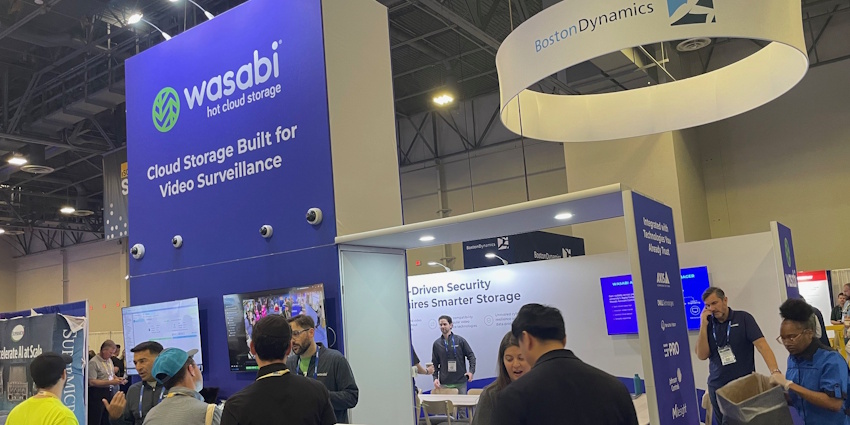 |
| Wasabi is positioning itself as the foundational layer for data-heavy video surveillance applications |
ZKTeco USA: Versatile and integrated access
ZKTeco USA showcased a range of integrated solutions, including turnstiles, visitor management, and access control. Their Atlas access control series offers versatility, supporting everything from traditional readers and keypads to QR codes and fingerprint scanning, with the flexibility to operate on-premise or in the cloud. For tight environments, they introduced the Mars 100 turnstile, which features a compact 2x3-foot footprint.
They also highlighted the Omni series, an all-in-one standalone reader-controller that manages access, intercom, and visitor functions in a single device. Innovation in portability was evident in their new walk-through metal detectors, which consist of two poles with an 8-hour battery life—ideal for schools and temporary events. While they offer their own Armatura readers, ZKTeco emphasised that their solutions can integrate with other industry leaders to fit diverse customer needs.

- Network / IP
- Shop security systems
- Physical security
- Mall security
- Healthcare security
- Shopping centre security
- Security cameras
- Covert cameras
- Security camera systems
- Facial recognition systems
- Metal detectors
- Building security
- Store security
- Store surveillance
- Network cameras
- Coastal surveillance
- ONVIF
- Green security
- Covert Surveillance
- Network Video Recorders
- Warning Devices
- PoE
- Video surveillance
- ISC West