

Qumulex is a new startup with a mission to provide physical security integrators a transition path to embrace the technology of the cloud and a subscription-based business model. Qumulex’s products seek to provide capabilities to embrace the cloud without an integrator having to turn their back completely on the ‘transactional revenue’ of installing new systems.
As the transition happens, Qumulex offers a product line that supports any mix of systems from on-premises to the cloud. The flexible deployment model – enabling a cloud installation, an on-premise installation or any combination – is one of the ways Qumulex seeks to differentiate itself in the market.
Installing fully on-premise system
The Qumulex cloud-based platform uses a gateway device located on-premises to which local cameras are connected
The system is designed so that an integrator can install a fully on-premise system and then later ‘flip a switch’ and transition to a cloud model, says Tom Buckley, VP Sales and Marketing. The Qumulex initial 1.0 system launch is currently entering its final beta test. Full commercial availability is expected in the first quarter of 2020, which the company will highlight in a bigger 20x20 booth at ISC West next year.
The Qumulex cloud-based platform uses a gateway device located on-premises to which local cameras are connected. Ensuring cybersecurity, the gateway provides a ‘firewall’ of sorts to avoid any cybersecurity threat from entering an enterprise through a vulnerable IP camera.
The system is designed to be ‘cloud-agnostic’ and to work with any public or private cloud, using Docker software and ‘containers,’ a standard unit of software that packages code and all its dependencies so an application runs quickly and reliably from one computing environment to another. At launch, the Qumulex system will use the Google cloud.
Greater situational awareness
The open platform approach will enable users to assemble best-of-breed solutions
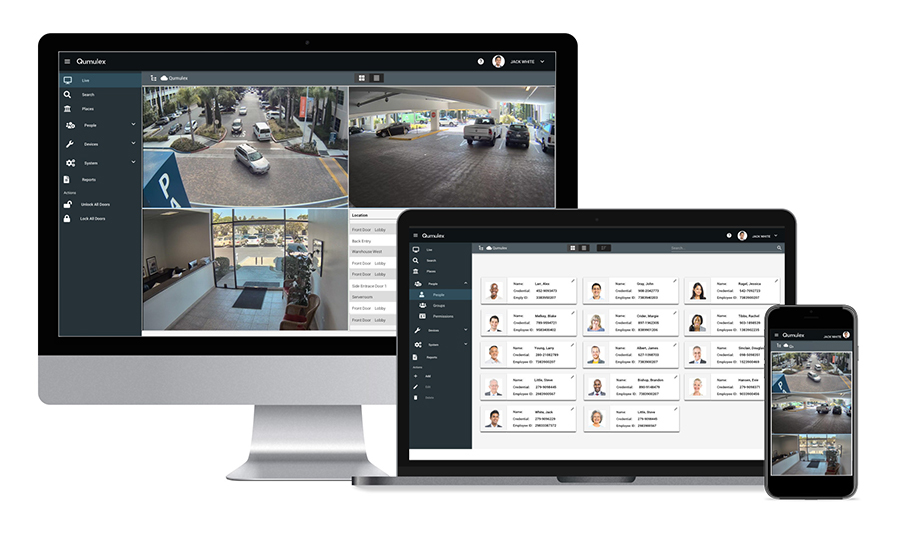
Another point of differentiation for the new platform is a unified access control and video surveillance environment – both are part of the same program. Access control can drive video events and vice versa for greater situational awareness. A unified system avoids having to integrate separate systems.
A big emphasis for Qumulex is ease of use. They have designed the user interface to be as simple and intuitive as possible, using consumer-oriented systems such as Nest and the Ring Doorbell as a model of simplicity. Finally, the open platform approach will enable users to assemble best-of-breed solutions. Keeping it simple, the system offers native integration with only the major camera manufacturers that represent most of the market: Axis, Hanwha, Arecont, Panasonic, Vivotek and Sony.
Longer-term storage
Other cameras can be included using the ONVIF interface. On the access control side, the system will initially be compatible with Axis door controllers, Allegion wireless door locks and ASSA ABLOY Aperio wireless door locks. Future versions of the software will seek to integrate HID Edge and Vertx and eventually Mercury panels.
The gateway device may incorporate only a solid-state drive (SSD) for buffering
Qumulex is taking a ‘mobile-first’ approach. The software is designed as a ‘progressive web app,’ which means is it is adaptable to – and fully functioning in – any smart phone, mobile device, laptop, or on a desktop computer with multiple monitors. The gateway device may incorporate only a solid-state drive (SSD) for buffering, or as many hard drives as the customer wants for storage. Short-term storage is available in the cloud, but local hard drives may be used for longer-term storage which can get expensive given the monthly fees of cloud storage.
Using third-party server
To manage the variety of scenarios, Qumulex will offer a line of gateways and recorders, or a customer can use a third-party server along with Qumulex, which is an open system. Qumulex will use a manufacturer’s representative sales model and has already signed up 11 rep firms covering the United States (the initial target of the launch).
The company has been spreading the word among integrators, too, first at the ISC West show last spring, when 98 integrators saw demonstrations of the system at a suite in the Palazzo. Another 48 integrators saw the system at ESX in Indianapolis in June. At the recent GSX show in Chicago, Qumulex had a booth on the show floor, where they scanned 450 badges that yielded 176 unique integrators.
Entering the physical security market
Qumulex just closed a second round of funding, which does not include any ‘institutional’ money
Buckley estimates there are around 10,000 total security integrators in the United States that sell products similar to theirs at their price point. They are working to build their database to reach out to those integrators. (Exacq had more than 4,500 dealer/integrators before it was sold to Tyco/Johnson Controls.)
Qumulex is the third company to enter the physical security market by the same team that launched two other successful startups in the last 20 years: Exacq Technologies (sold to Tyco in 2013) and Integral Technologies (sold to Andover Controls in 2000). Both previous companies were built around a need to help the integrator community transition to newer technologies.
Qumulex just closed a second round of funding, which does not include any ‘institutional’ money. The first round of investment involved only the founders, and the second round added some ‘angel’ investors to the mix. The funding allows more flexibility and control over the company’s timeline and the evolution of the product’s feature set, free of outside mandates, says Buckley.