

In mobile surveillance, remote sites, and environments with unstable networks, video recordings often suffer from "time gaps" due to network interruptions, a longstanding technical challenge for security systems. Under traditional architectures, central servers rely on real-time streams for storage.
Once the network connection is lost, the recording timeline experiences an irrecoverable interruption, leading to the loss of footage of critical events. This creates a fundamental flaw in post-event auditing, forensics, and operational analysis.
Recording Completion feature
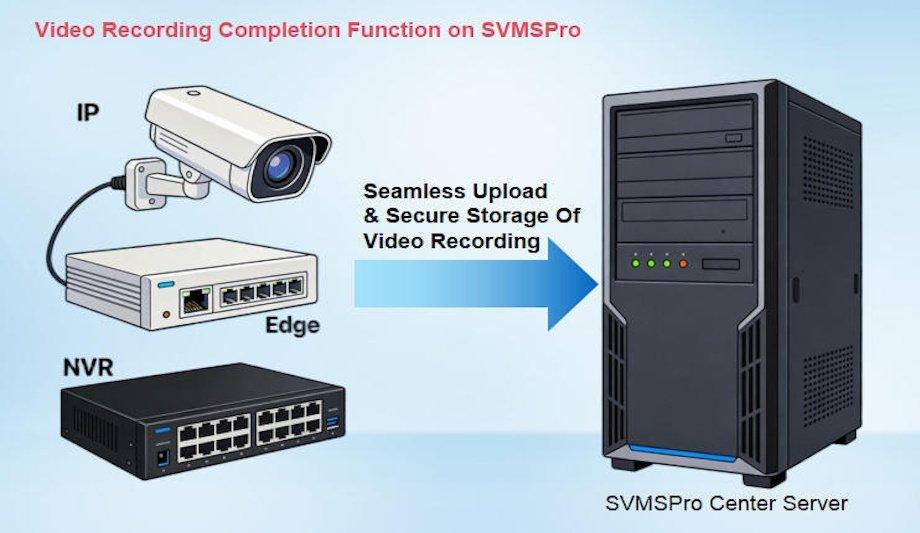
The "Recording Completion" feature was created precisely to address this deficiency. This feature aims to ensure the integrity of recordings by uploading locally stored video to the central server. Even during network instability or complete outages, video can first be stored on the local storage of front-end devices, such as the camera's SD card.
When the network is restored, these local recordings are uploaded to the central server, filling in the previously missing segments. This ensures that surveillance video remains complete and continuous in the central storage, thereby technically solving the problem of recording loss.
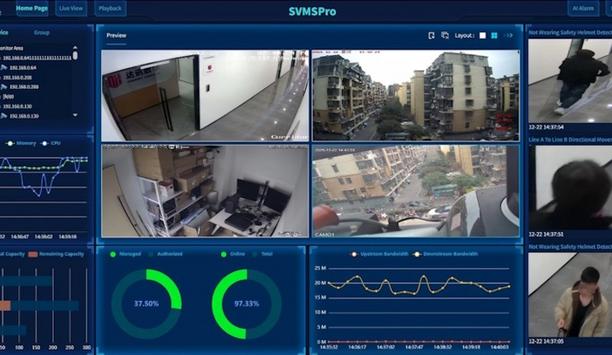
SVMSPro platform
Taking the SVMSPro platform as an example, its technical principles and workflow are as follows:
The core of this feature lies in the intelligent enhancement of the "Edge-Center" collaborative storage architecture:
Dual-Path Recording Guarantee: During normal network conditions, the video stream is simultaneously written to local storage on the edge device (e.g., the IPC's SD card, NVR/IVR's hard drive) and the central server.
Handling Network Outages: When the system detects a network interruption between the edge device and the central server, the real-time stream recording on the central server automatically pauses. However, the local recording on the edge device continues without any interruption. During the network outage, the front-end edge device continues to record video.
Gap-Filling Synchronisation: After the network connection is restored, the SVMSPro central platform proactively initiates a "handshake" communication with the edge device. It searches for the recordings on the edge device and then uploads the corresponding video files from the local storage of the edge device to the central server, inserting them into the correct timeline position.
 |
| During the network outage, the front-end edge device continues to record video |
Key Technical Advantages and Value: Ensures Data Integrity and Builds a Trustworthy Audit Trail: Fundamentally eliminates video loss caused by temporary network failures, ensuring an absolutely continuous and complete recording timeline from edge to center. This meets the stringent requirements of judicial forensics and compliance audits for data originality and continuity.
Enhances System Robustness in Harsh Network Environments: This feature is specifically designed for mobile scenarios (such as rail transit, patrol vehicles/vessels) and remote sites with weak network infrastructure (such as mines, oil fields, and mountainous base stations), freeing their surveillance systems from dependence on network availability.
Unifies Centralised Security Management with Local Reliability: All recorded evidence ultimately converges on the central platform, which is protected by physical and network security measures, facilitating unified management, analysis, and long-term archiving. Simultaneously, it reduces the risk of permanent data loss due to theft, damage, or tampering of edge devices.
Provides Flexibility in Deployment and Operation: Users can flexibly choose incremental or full synchronisation strategies based on actual business importance, network bandwidth costs, and storage planning, achieving an optimal balance between cost and benefit.
Typical Application Scenarios:
- Rail Transit: Ensures seamless indoor and outdoor surveillance footage on trains when entering/exiting tunnels or stations.
- Mobile Policing and Emergency Vehicles: Ensures the entire journey of车载 video is traceable during patrols or while en route to incident sites.
- Energy and Infrastructure: Overcomes the instability of public wireless connections (e.g., 4G/5G) at unattended remote sites such as transmission lines, pumping stations, and wind turbines.
- Temporary and Event Security: Addresses potential network congestion or temporary outages in temporary deployment scenarios like large-scale events or construction sites.
Conclusion
The introduction of the "Recording Completion" feature marks a new phase for video surveillance systems in facing uncontrollable network environments, transitioning from "passively tolerating interruptions" to "actively ensuring continuity." It is not merely the addition of a single function but represents a substantial reinforcement of the overall reliability and data trustworthiness architecture of surveillance systems.