Airports serve as hubs for millions of passengers and tonnes of cargo each day, rendering them susceptible to various security challenges. With threats ranging from perimeter breaches to cybersecurity risks, it is crucial to understand common security issues and methods for addressing them.
Preventing unauthorised access
Maintaining strict perimeter security is essential for airports to prevent unauthorised individuals from entering runways, taxiways, and airport buildings. A series of security breaches in late 2024 and early 2025 has highlighted the importance of robust perimeter protection, as breaches can endanger both passengers and staff, disrupt travel, and risk damage to aircraft and infrastructure.
In the U.S., airports are required to have perimeter fencing at least 10 feet tall with restricted access points. Implementing high-security gates, guard booths, and vehicle access controls are effective measures. Delta Scientific offers solutions such as the TT280 Linear Crash Rated Gate, which secures areas spanning from 12 to 30 feet.
Baggage screening enhancements
Challenges such as staff shortages and increased passenger numbers exacerbate the task
Over 4.5 million bags are screened daily by Transportation Security Administration (TSA) personnel, employing advanced technology alongside traditional methods.
Challenges such as staff shortages and increased passenger numbers exacerbate the task. Collaborating with the Department of Homeland Security, the TSA advances new technologies to enhance the detection of explosives and prohibited items.
Crowd management solutions
Large crowds at airports can create unique challenges, potentially obstructing emergency exits and delaying responses, while also leading to frustrated travellers bypassing security measures.
The use of physical barriers and advanced technologies aids the management of passenger flow, while biometrics and video analytics assist security personnel in monitoring large crowds effectively. These methods aim to facilitate smooth traffic movement through terminals and checkpoints.
Parking and vehicle flow controls
Video surveillance further aids security by allowing the identification of suspicious vehicles
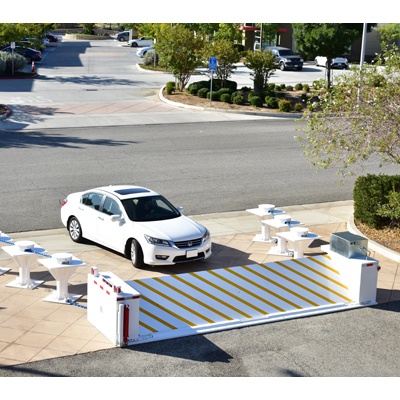
Managing thousands of vehicles daily is crucial to avoid congestion and maintain passenger and staff safety. Effective traffic controls, such as traffic teeth and wedge barricades, offer flexible access to designated areas while preventing unauthorised vehicle entry.
Video surveillance further aids security by allowing the identification of suspicious vehicles, while parking control measures help mitigate risks in congested areas. Secure transit shelters provide safe waiting zones for passengers en route to terminals and parking areas.
Ensuring pedestrian safety
With the movement of millions daily, pedestrian safety becomes a key focus within airport security. Security staff must ensure smooth pedestrian flow while restricting access to prohibited areas. Bollards, along with clear pavement markings and signage, delineate safe paths for foot traffic, distinguishing crosswalks and restricted zones.
Addressing cybersecurity threats
The increased reliance on technology leaves airports vulnerable to cybersecurity risks. Breaches can undermine trust and cause significant financial losses. Internal threats arise from employees and contractors with access to sensitive information. Mitigating these risks involves regular updates, staff training, microsegregation, and endpoint security.
Adapting to evolving threats
Airports operate under dynamic regulatory environments, continually adapting to new threats as malicious actors exploit vulnerabilities. This necessitates evolving security practices to anticipate and counter emerging risks effectively.
Airports are critical infrastructure, processing millions of passengers and tons of cargo daily.
This makes them vulnerable to growing security threats, from perimeter breaches to cybersecurity risks. Explore seven of the most common airport security challenges and strategies for overcoming them.
Preventing unauthorised individuals
Perimeter Security - What are some airport security challenges? Airports must maintain tight perimeter security to prevent unauthorised individuals from accessing buildings, runways, and taxiways. A spate of physical security breaches at airports in late 2024 and early 2025 have raised awareness of this critical issue. Perimeter breaches endanger staff and passengers and can cause travel disruptions. In some cases, they can cause significant damage to aircraft and airport buildings.
U.S. airports must have secure fencing at least 10 feet tall around their perimeters. The location of buildings, gates, obstructions to the fencing, and access through it are restricted. High-security gates, guard booths, and other vehicle access controls can help airports maintain an effective perimeter barrier. Delta Scientific offers several sliding gates, such as the TT280 Linear Crash Rated Gate to secure openings from 12 to 30 feet.
Other responsible agencies
Baggage Screening - Transportation Security Administration personnel screen more than 4.5 million bags daily. They use a combination of cutting-edge technology and old-fashioned physical searches to complete this monumental task. Staff shortages and an increase in air passenger volume add to the baggage screening challenges at airports.
The Department of Homeland Security works with the TSA and other responsible agencies to develop new technology that improves screening for explosives and other prohibited items.
Airport security challenges
Crowd Management - Crowds pose unique airport security challenges. When large groups of people gather in restricted spaces, it can cause bottlenecks that slow traffic flow. This can disrupt security screening procedures and potentially cause security personnel to take shortcuts. Some unique threats caused by excessive crowds in airports include:
- Obstructed emergency exits and delayed emergency responses
- Frustrated passengers attempting to bypass security measures
- Reduced visibility for security staff and surveillance systems
To manage this challenge, airports can use physical barriers to direct passengers through terminals and security checkpoints. Advanced technologies may improve screening times, allowing traffic to move more quickly. The use of biometrics and other video analytics systems can aid security personnel trying to scan large groups.
Access to designated areas
Parking Control and Vehicle Flows - Thousands of vehicles a day can cause significant traffic and flow problems, which can endanger the safety of passengers and staff.
Traffic controls are effective at limiting vehicle access to designated areas. Traffic teeth and wedge barricades provide access when retracted, but immediately stop cars and trucks when engaged. This flexibility helps keep traffic moving smoothly. Video surveillance is another useful tool for overcoming airport security challenges posed by high traffic flows. It allows security personnel to identify drivers and passengers linked to suspicious vehicles.
Parking security measures, such as ticket booths and parking control beams, help limit risks associated with congested parking areas. Transit shelters provide secure waiting areas for passengers traveling to terminals, parking lots, and rental car locations.
Dedicated pedestrian areas
Pedestrian Safety - Pedestrian safety is another airport security challenges. Airports move millions of people every day, making pedestrian safety a key priority. Security staff must monitor pedestrian traffic while providing safe avenues for movement. They also must have effective tools for limiting access to restricted areas.
In outdoor areas, bollards effectively keep cars and trucks out of dedicated pedestrian areas. Clear pavement markings and signage alert people to crosswalks, waiting or unloading areas, and traffic lanes.
Significant financial repercussions
Cybersecurity Attacks - The increasing use of technology at airports leaves them vulnerable to cybersecurity attacks. Data breaches can occur at airports and within specific airlines. They undermine passenger confidence in operators and can lead to significant financial repercussions.
Internal threats arise when employees and contractors have access to sensitive customer and system data. A simple mistake, such as failing to use a secure storage method, can expose this information to unvetted outside actors. Regular system updates, staff training, microsegregation, and securing endpoints help reduce cyber threats.
Evolving Threats - Airports operate in an environment with constantly changing regulations, which can lead to evolving threats. Malicious actors use novel approaches to bypass existing security protocols. As a result, airport security practices must also evolve to anticipate and stop potential threats.