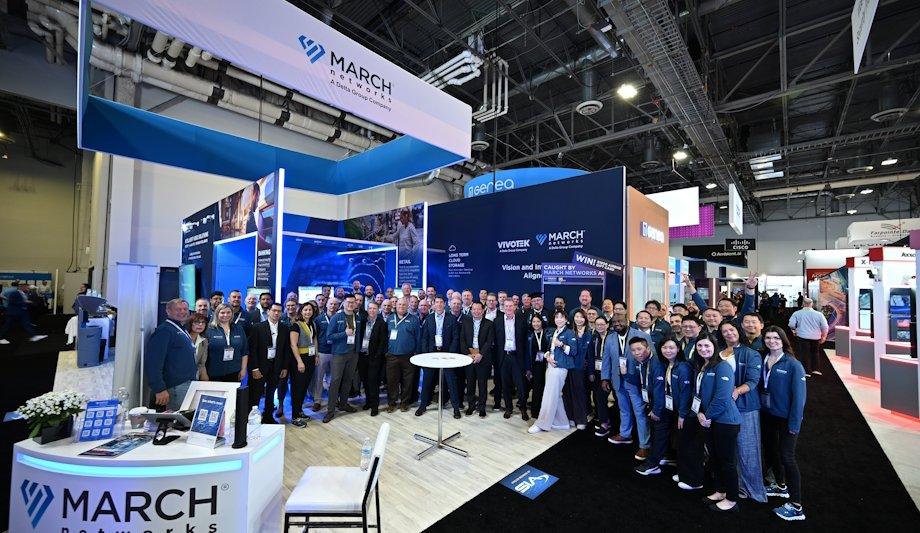


Combining VIVOTEK’s branded video security business with March Networks paves the way for the combined brands to meet customers’ increasing appetite for integrated solutions rather than individual components. The merger brings VIVOTEK's branded video security business together under one operating structure with March Networks’ enterprise-grade video surveillance, AI analytics, and cloud-managed security solutions.
Customers now have access to a broader, more integrated portfolio spanning enterprise video management, advanced cameras, edge artificial intelligence (AI), cloud services, recording platforms, and business intelligence, says Net Payne, Chief Sales & Marketing Officer at March Networks and VIVOTEK.
Distinct product strategies
Given the combined companies, product development, sales, marketing, and customer support can move in step rather than in parallel. March Networks and VIVOTEK were already both part of the Delta Electronics family, but they previously operated as separate businesses with distinct product strategies, teams, and routes to market. March Networks and VIVOTEK announced the merger of their branded video security businesses last spring following Delta Electronics' acquisition of remaining VIVOTEK shares.
“Aligning our complementary capabilities lets us innovate faster, simplify engagement, and respond more quickly to a market moving toward AI, cloud and intelligent video,” says Payne. This merger reflects a broader shift across the physical security industry, adds Payne. “Customers no longer see video purely as a tool for reviewing incidents after the fact,” he says. “They expect it to help identify risks earlier, simplify investigations, improve operations, and support better decisions across the organisation.”
Cloud video management
Meeting customer expectations requires more than bolting AI features onto existing systems
Meeting customer expectations requires more than bolting AI features onto existing systems. Rather, it requires cameras, edge intelligence, recording, software, cloud services, and business data working together as one coordinated platform.
“By bringing March Networks and VIVOTEK together, we combine deep expertise across the full video technology stack while preserving the relationships, sector knowledge and customer focus both companies have built over many years,” says Payne. “Our goal is to make intelligent video more integrated, scalable, and practical for customers and partners worldwide.”
Both entities bring strengths to the combined companies. March Networks brings experience in enterprise software, cloud video management and large-scale deployments; while VIVOTEK brings strength in imaging, camera technology and edge intelligence. Together they seek to ensure more choice when designing systems, a clearer path for future expansion, and technologies that work together more effectively without compromising the reliability, cybersecurity, and support customers expect from both companies.
Advantages for channel partners
Channel partners gain a broader portfolio to address a wider range of customer requirements, combining components as each deployment demands. Channel partners also benefit from expanded geographic reach, deeper technical expertise, and greater investment in training and enablement.
“Importantly, this is designed to be a seamless transition,” says Payne. “Partners keep working with the teams and relationships they already know, while gaining access to new capabilities and certification opportunities. Over time, that alignment should make it easier to design, deploy and support complete solutions.”
Because they are established and respected brands, March Networks and VIVOTEK branding will continue to be used. Rebranding is not a goal, and neither identity is being replaced by the other.
Coordinated decision-making
“The immediate priority is organisational alignment by making it easier for customers and partners to benefit from the combined portfolio,” says Payne. Product branding will continue to reflect the relevant portfolio and market context. As product roadmaps become more closely coordinated, customers can expect greater interoperability and a more cohesive experience, says Payne. Any future branding changes will be managed carefully and communicated clearly.
Combining the businesses reduces duplication and enables coordinated decision-making across product strategy, engineering, sales, marketing, operations, and customer support. “Instead of developing capabilities independently, teams can share their expertise, align roadmaps, and direct investment to where it has the greatest customer impact,” says Payne.
Combining specialised knowledge globally
The combined organisation operates across six continents and more than 75 countries
The combined organisation includes more than 300 research and development (R&D) engineers across four Centres of Excellence in Canada, Taiwan, Italy and Poland, thus bringing together a substantial base of specialist knowledge. The unified network also sharpens the ability to prioritise global opportunities, respond to regional needs and bring innovations to market faster.
The combined organisation operates across six continents and more than 75 countries, supported by more than 1,100 certified channel partners. That footprint provides greater capacity to support multinational customers while staying responsive to local market needs.
Looking ahead, future growth will increasingly come from helping customers turn video into useful, actionable intelligence. “The market is moving beyond conventional surveillance toward solutions combining AI, cloud services, edge processing, video management and operational data — and our new structure brings these together as one connected solution rather than several isolated technologies,” says Payne.
Broader technical expertise
There will also be closer collaboration among specialists in imaging, hardware, software, analytics, and cloud, which is important given how much customer infrastructure, regulatory, and deployment requirements vary. The companies can support cloud, hybrid, and on-premise environments, giving organisations a practical path toward more intelligent video.
More choice comes from bringing together complementary technologies across product groups. Greater scale is achieved through a larger engineering organisation, broader technical expertise and more capacity to invest in innovation.
Challenges for the industry at large
Looking to the future for the industry at large, the greatest challenge will be managing the rapid growth of AI
Looking to the future for the industry at large, the greatest challenge will be managing the rapid growth of AI responsibly, securely and at scale, says Payne. Video systems will generate more data and automate more decisions, but organisations must be able to trust how that intelligence is created, protected, and applied, he adds.
“Cybersecurity, privacy, data sovereignty, system interoperability and AI accuracy are more important than ever,” says Payne. Addressing these elements requires expertise across the entire technology stack: from camera and edge processing to recording, cloud infrastructure, video management and analytics.
“Together, March Networks and VIVOTEK can coordinate development across all these layers, giving customers flexible architectures that balance innovation with security, transparency and operational control,” says Payne.