SourceSecurity.com
  • Products
    CCTV
    • CCTV cameras
    • CCTV software
    • IP cameras
    • Digital video recorders (DVRs)
    • Dome cameras
    • Network video recorders (NVRs)
    • IP Dome cameras
    • CCTV camera lenses
    Access Control
    • Access control readers
    • Access control software
    • Access control controllers
    • Access control systems & kits
    • Audio, video or keypad entry
    • Electronic locking devices
    • Access control cards/ tags/ fobs
    • Access control system accessories
    Intruder Alarms
    • Intruder alarm system control panels & accessories
    • Intruder detectors
    • Intruder warning devices
    • Intruder alarm communicators
    • Intruder alarm accessories
    • Intruder alarm lighting systems
    Technology's role in securing banks and financial institutions
    Technology's role in securing banks and financial institutions
    Dahua APOLLO 4G Solar Security System

    Dahua APOLLO 4G Solar Security System

    Morse Watchmans KeyWatcher Touch Key Control Modules

    Morse Watchmans KeyWatcher Touch Key Control Modules

    Hikvision AX PRO Wireless Alarm Keyfob

    Hikvision AX PRO Wireless Alarm Keyfob

    Delta Scientific Rapid Deployment Portable Barrier

    Delta Scientific Rapid Deployment Portable Barrier

  • Companies
    Companies
    • Manufacturers
    • Distributors
    • Resellers / Dealers / Reps
    • Installers
    • Consultants
    • Systems integrators
    • Events / Training / Services
    • Manned guarding
    Companies by Product area
    • CCTV
    • Access control
    • Intruder alarm
    • IP networking products
    • Biometrics
    • Software
    • Digital video recording
    • Intercom systems
    Technology's role in securing banks and financial institutions
    Technology's role in securing banks and financial institutions
  • News
    News
    • Product news
    • Corporate news
    • Case studies
    • Events news
    Latest
    • Cellebrite expands The 101 for forensics experts
    • AI-integrated solutions at Secutech Vietnam 2026
    • Cyble partners with UAE cyber security council
    • Godel adopts AI-native approach in technology services
    Technology's role in securing banks and financial institutions
    Technology's role in securing banks and financial institutions
  • Insights
    Insights
    • Expert commentary
    • Security beat
    • Round table discussions
    • Round Table Expert Panel
    • eMagazines
    • Year in Review 2023
    • Year in Review 2022
    Featured
    • How are new technologies reshaping casino surveillance and security?
    • How can physical security technology promote better executive protection?
    • Responsible AI adoption starts with governance
    • How AI-enabled cameras are becoming operational sensors that power safety, automation, and business intelligence
    Technology's role in securing banks and financial institutions
    Technology's role in securing banks and financial institutions
  • Markets
    Markets
    • Airports & Ports
    • Banking & Finance
    • Education
    • Hotels, Leisure & Entertainment
    • Government & Public Services
    • Healthcare
    • Remote Monitoring
    • Retail
    • Transportation
    • Industrial & Commercial
    Technology's role in securing banks and financial institutions
    Technology's role in securing banks and financial institutions
    Morse Watchmans enhances Lincoln's Inn security systems

    Morse Watchmans enhances Lincoln's Inn security systems

    Hikvision solution boosts Muçum flood preparedness

    Hikvision solution boosts Muçum flood preparedness

    Carrefour Brazil: Enhanced security with Dahua solutions

    Carrefour Brazil: Enhanced security with Dahua solutions

    El Loa Aerodrome security with Dahua Technology

    El Loa Aerodrome security with Dahua Technology

  • Events
    Events
    • International security
    • Regional security
    • Vertical market
    • Technology areas
    • Conferences / seminars
    • Company sponsored
    Virtual events
    • Video Surveillance
    • Access Control
    • Video Analytics
    • Security Storage
    • Video Management Systems
    • Integrated Systems
    Technology's role in securing banks and financial institutions
    Technology's role in securing banks and financial institutions
    Securex Caspian 2026

    Securex Caspian 2026

    PACK EXPO Chicago 2026

    PACK EXPO Chicago 2026

    OFSEC - Oman Fire, Safety & Security Expo 2026

    OFSEC - Oman Fire, Safety & Security Expo 2026

    Milipol Qatar 2026

    Milipol Qatar 2026

  • White papers
    White papers
    • Video Surveillance
    • Access Control
    • Video Analytics
    • Video Compression
    • Security Storage
    White papers by company
    • HID
    • ASSA ABLOY Opening Solutions
    • Milestone Systems
    • Software House
    • Eagle Eye Networks
    Other Resources
    • eMagazines
    • Videos
    Technology's role in securing banks and financial institutions

    Technology's role in securing banks and financial institutions

    Integrated systems enable critical and compliant security for transportation

    Integrated systems enable critical and compliant security for transportation

    Modernising physical access control

    Modernising physical access control

    Access. Intrusion. One estate.

    Access. Intrusion. One estate.

About us Advertise
  • Securing financial institutions
  • AI special report
  • Cyber security special report
  • 6
Cyber security
  • Home
  • About
  • News
  • Expert commentary
  • Security beat
  • Case studies
  • Round table
  • Products
  • White papers
  • Videos

5 things to consider before moving your surveillance to cloud-based video storage

Dan Cremins
Dan Cremins
Contact company
Contact March Networks Corporation
icon Add as a preferred source Download PDF version
Quick Read
⌵
Summary is AI-generated, newsdesk-reviewed
  • Evaluate cloud storage impact on video surveillance bandwidth, cost, security, accessibility.
  • Most video remains unused; weigh storage needs and costs carefully before cloud transition.
  • Cybersecurity of video surveillance systems is critical to prevent data breaches, leaks.
Enterprises across all sectors are leveraging cloud technology to reduce IT costs and streamline management
Determining how the cloud can best support your business depends on five
factors: Bandwidth, storage, cost, security and accessibility

Until about a decade ago, most enterprises used their video surveillance systems primarily to view live video or review security incidents after the fact. Today, many are taking advantage of intelligent video solutions to reduce losses from theft and fraud, monitor and improve customer service, track commercial conversion rates and performance trends, and identify opportunities to strengthen their marketing, operations, compliance and sales strategies.

At the same time, enterprises across all sectors are leveraging technology solutions such as the cloud to reduce IT costs, streamline application management, and make their infrastructure more flexible and scalable. So it’s no surprise that these same companies are now turning their attention to emerging cloud applications for video surveillance.

Yet video surveillance solutions have some unique requirements that set them apart from other types of enterprise cloud applications. Video — especially high-definition video — demands much more bandwidth and storage than the consumer-oriented cloud services you may use at home. Security and privacy have to be considered, too, as regulations and corporate policies may all impose restrictions on the transport and storage of video footage. And the anticipated return on investment, of course, is always a consideration when evaluating any technology solution.

Ultimately, determining where and how the cloud can best support your business depends on a set of five primary requirements: bandwidth, storage, cost, security and accessibility. 


And while bandwidth speeds and accessibility will continue to improve, and therefore ease the barrier toward efficient video uploading to the cloud
Businesses should assess the advantages & disadvantages of the cloud solution
compared to the existing VMS with respect to bandwidth, storage, cost,
security & accessibility

1. It all begins with bandwidth

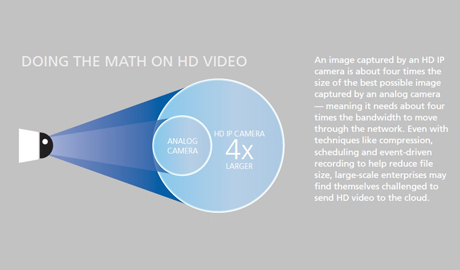
The total bandwidth required for a video stream varies depending on the number of frames or images being captured per second, as well as the quality of the images being captured. Given that most enterprises are now replacing some (or even all) of their older analogue cameras with new megapixel IP cameras, bandwidth becomes an even more important factor to examine. 

Many enterprises today, surprisingly, still do not have the bandwidth capacity to upload video captured by multiple IP cameras to the cloud. Even if they employ buffering, which can limit video streaming until a time when more bandwidth is available (such as after business hours), few organisations can access the required upload speeds consistently at all locations, especially those operating hundreds or thousands of sites.

And while bandwidth speeds and accessibility will continue to improve, and therefore ease the barrier toward efficient video uploading to the cloud, the trend toward multi-megapixel IP cameras may counteract that advantage.

Even the organisations that do enjoy high-speed, high-capacity upload connections across all of their locations may not be in a position to dedicate all (or even a sizeable portion) of their network resources to their video surveillance systems. In fact, it’s quite common for banks, retailers and other enterprises to restrict or ‘throttle’ the network capacity allotted to video to just 100–200 kb/s of their total bandwidth to ensure their corporate network has the capacity needed to transmit business-critical data.

Service provider caps on broadband services represent another constraint to sending and storing video in the cloud. Again, even locations with sufficient upload and download speeds may have limits on how much data they can push through the network. Exceeding the limit can incur additional — and often prohibitively high — costs. 

With video surveillance systems increasingly connected to the Internet, it is critical that they are secured against cyber risk and vulnerabilities
Even locations with sufficient upload and download speeds may have limits on
how much data they can push through the network

2. Making sense of storage

Before moving video surveillance to the cloud, enterprises also need to consider that the majority of collected video is never used — at least by organisations that are not yet leveraging their video’s broader business analysis capabilities — because only specific events will trigger follow-up action. It is therefore important to determine when it makes sense to transmit video data for storage over potentially expensive network links.

Assuming that a company has been able to overcome the bandwidth barrier, the cloud could provide ‘unlimited’ storage, the cost of which will presumably continue to decrease as technology improves. Even so, companies should determine how long they need to archive their video and how much redundancy they require, as both factors may add to the total cost of their cloud storage solution. 

3. Cybersecurity risks and vulnerabilities

With video surveillance systems increasingly connected to the Internet, it is critical that they receive the same level of attention to cybersecurity risk and vulnerabilities as traditional IT systems such as servers and workstations. Given the legal, financial and reputational risks associated with data breaches and leaked video, enterprises are intensely concerned about ensuring the integrity and security of their video networks.

Port forwarding, firewalls, network topology and video encryption can all have a significant impact on the security and protection of a cloud-based video surveillance system, requiring a greater degree of expertise and effort in these areas on the part of an organisation’s in-house IT support team.

At the same time, some companies have internal policies that strictly prohibit video data from leaving the corporate network or having it stored on a third-party server (even one run by a trusted and reputable provider); others prefer not to take the risk whether or not their formal policies preclude using the public cloud.

Even if video data is stored on a local server rather than in the cloud, security and privacy remain important concerns, with data protection and user authentication being two key considerations.


Enterprises are intensely concerned about the integrity and security of their video networks facing threats such as hacks and data leaks
Port forwarding, firewalls, network topology & video encryption can all
have an impact on the security & protection of a cloud-based video surveillance system

4. Local network access vs. third-party networks

Relying on a third-party network to upload or download video means any outage could cut your organisation off from its video assets. Uploads may fail, data may be lost and information may be unavailable until the service comes back online.

Consider how frustrating it would be to sit in a security control room knowing that all your cameras are recording, but not being able to view what they’re capturing because the external network is down. In the very worst case, a network outage could cause data loss. Packets that can’t leave the location might be overwritten or discarded, leaving no video record at all. This would be especially unfortunate if a robbery or violent incident was not recorded as a result. 

When video is stored on premises, there’s always the comfort of having local access and control. Most enterprise-class servers and network video recorders (NVRs), for example, include battery backups to ensure video recording continues in the event of a temporary network outage.

5. Assessing cloud service provider

Cloud-based video surveillance storage and management is an emerging approach with considerable potential. However, until the substantial bandwidth challenge can be overcome, it won’t offer a cost-effective alternative to today’s video surveillance solutions for most mid- and large-sized enterprises with multiple locations and more demanding video requirements.

As with most network technologies, the point of feasibility will be reached over time as new solutions emerge and build on previous technical capabilities. In the longer term, advances in video compression and faster, more affordable bandwidth services will help make cloud-based storage solutions a more viable option for many larger, multi-site enterprises.

When exploring the opportunities associated with the cloud, it is important to move beyond the hype and take the time to carefully consider the implications a cloud-based video solution may have on your business. This should include preparing an appropriate set of questions to ask of any potential cloud service provider so you can accurately assess the advantages and disadvantages of the solution compared to your existing video management system, especially with respect to bandwidth, storage, cost, security and accessibility.

Download PDF version Download PDF version
Google logo Add as a preferred source on Google
  • Network / IP
  • IP video surveillance
  • Security management
  • Video compression
  • HD CCTV
  • Cyber security
  • Video Management System
  • Data Security
  • Cloud security
  • Video surveillance
  • Related links
  • March Networks IP cameras
  • March Networks Video servers (IP transmission)
  • March Networks Network video recorders (NVRs)
  • Megapixel IP cameras
  • Real Time / Timelapse / Event Network video recorders (NVRs)
  • Articles by Dan Cremins
  • Related categories
  • IP cameras
  • Video servers (IP transmission)
  • Network video recorders (NVRs)
  • Storage
Related white papers
Technology's role in securing banks and financial institutions

Technology's role in securing banks and financial institutions

Download
Security technologies promote real-time awareness in K-12 schools

Security technologies promote real-time awareness in K-12 schools

Download
An end user's guide to physical security for data centres

An end user's guide to physical security for data centres

Download
Related articles
How physical security consultants ensure cybersecurity for end users

How physical security consultants ensure cybersecurity for end users

How managed detection and response enhances cybersecurity management in organisations

How managed detection and response enhances cybersecurity management in organisations

Drawbacks of PenTests and ethical hacking for the security industry

Drawbacks of PenTests and ethical hacking for the security industry

Follow us

Sections Products CCTV Access Control Intruder Alarms Companies News Insights Case studies Markets Events White papers Videos AI special report Cyber security special report RSS
Topics Artificial intelligence (AI) Mobile access Healthcare security Counter terror Cyber security Robotics Thermal imaging Intrusion detection Body worn video cameras
About us Advertise About us 10 guiding principles of editorial content FAQs eNewsletters Sitemap Terms & conditions Privacy policy and cookie policy
  1. Home
  2. Topics
  3. Cyber security
  4. News
  5. Expert commentary
About this page

Discover cloud-based video storage benefits: enhanced security, cost-effectiveness and remote accessibility for seamless surveillance solutions.

See this on SecurityInformed.com

Subscribe to our Newsletter

Stay updated with the latest trends and technologies in the security industry
Sign Up

DMA

SourceSecurity.com - Making the world a safer place
Copyright © Notting Hill Media Limited 2000 - 2026, all rights reserved

Our other sites:
SecurityInformed.com | TheBigRedGuide.com | HVACinformed.com | MaritimeInformed.com | ElectricalsInformed.com

Subscribe to our Newsletter


You might also like
Technology's role in securing banks and financial institutions
Integrated systems enable critical and compliant security for transportation
Modernising physical access control
Minimizing storage, maximizing focus
SourceSecurity.com
SecurityInformed.com

Browsing from the Americas? Looking for our US Edition?

View this content on SecurityInformed.com, our dedicated portal for our Americas audience.

US Edition International Edition
Sign up now for full access to SourceSecurity.com content
Download Datasheet
Download PDF Version
Download SourceSecurity.com product tech spec