

 |
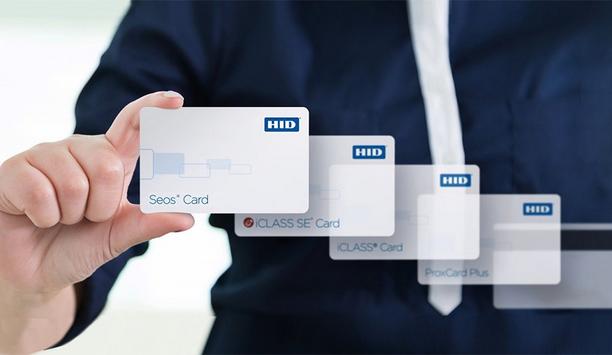
More and more commercial buildings today are replacing mechanical keyed locks with card access systems. The basic reason is familiar to security professionals: card systems, once installed, cost less to manage and maintain. “When people are let go, if you don’t get their keys back, you have to rekey the locks and give everyone new keys,” says Brett St. Pierre, director, education solutions with Austin, Texas-based HID Global. “With a card system, all you have to do is deactivate the card.”
Smartphones better than access cards?
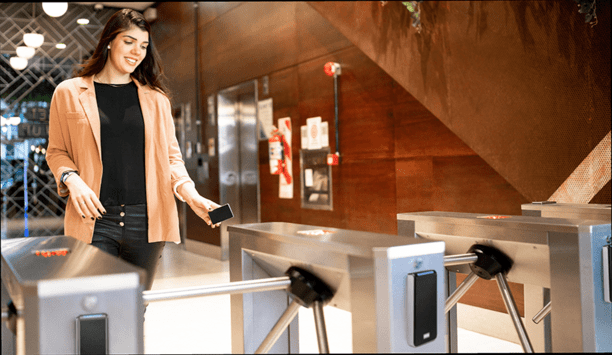
But smart phones and mobile devices are beginning to prove even more convenient than access cards, continues St. Pierre. “The big new trend, today, is mobile access control,” he says. “Employees store their credentials on smart phones. It has become very popular, especially in the business world of hoteling.”
Hoteling is an office assignment system used by consulting companies and other large firms where many executives spend months at a time on the road and away from their home office.
"Mobile access control makes identity and credentials management much easier than cards. You can activate and deactivate mobile phone IDs”, says Brett St. Pierre, director, education solutions with HID Global |
In those firms, executives not on the road use the offices of people that are on the road.
Smartphones simplify ID management
“Mobile access control makes identity and credentials management much easier than cards,” says St. Pierre. “You can activate and deactivate mobile phone IDs.”
So when a consultant hits the road, security can deactivate the credentials in his or her phone and activate the phone of another consultant who is returning to the office for a while. No one has to turn in a card or pick one up. It is security the way everyone wants security: security that doesn’t get in the way.
While hoteling firms may have pioneered the use of mobile credentialing, the idea has begun to spread throughout the access control world.
Mobile security and credentialing comes in two flavours: near field communication (NFC) and Bluetooth.
“Provisioning phones with access control credentials is easy. Emails bring in an app and can load identities into the phones. You can also send a command to deactivate a smart phone’s credentials”, adds St. Pierre |
NFC-based mobile access control
NFC is a radio frequency technology that makes it possible for electronic devices to communicate with each other for the purpose of carrying out a task. For instance, a user can play an NFC-enabled stereo system on an NFC-enabled mobile phone by holding the phone up to the stereo systems “touch point.”
Likewise, NFC can transmit credentials to access control readers.
As a near field communications device, a mobile phone must be placed very close to the reader – a distance of four centimetres or less.
Then again, NFC was originally designed as an electronic means of submitting credit card information. The short reading distance helps to keep the data being transmitted safe — but the short-distance read feature actually makes it less convenient for access control applications.
Bluetooth for access control
Bluetooth is a wireless technology designed to facilitate wireless connections between electronic devices. Unlike NFC, however, Bluetooth technology communicates over longer distances — up to 10 meters. It can be adjusted to suit a user’s preferences — perhaps 12 inches or so for access control applications.
Mobile access control is security the way everyone wants security: security that doesn’t get in the way |
“Not all phones have been enabled to use NFC, either,” adds St. Pierre. “But virtually all smart phones have Bluetooth, which is being widely used for access control thanks to its longer range.
“Provisioning phones with access control credentials is easy. Emails bring in an app and can load identities into the phones. You can also send a command to deactivate a smart phone’s credentials.”
Overall, ID management is easier with mobile devices. HID literature observes, “Using a mobile device to access a building is about merging security with convenience.”