ASSA ABLOY - Aperio

ASSA ABLOY - Aperio Overview:
Aperio® – Wireless access control technology
Available on the global marketplace, ASSA ABLOY’s Aperio® Technology enables a wide range of access control providers to cost effectively integrate non-wired doors with mechanical locks into new and existing access control systems.
Doors will merely need to be equipped with battery-powered Aperio® locks with RFID readers and linked to the access control system via a communications hub for online integration, or via update on card for offline integration.
As a result, security and facility managers now have greater control, can easily respond to organisational changes and will only need to monitor a single security system, while users will only require a single RFID access control card.
ASSA ABLOY - Aperio news

Security at healthcare premises has never been higher on the agenda. Patients expect safety and privacy. Yet many medical locations must be open and accessible around the clock. The protection of drugs, vaccines, equipment and data makes it critical to know who accesses where, and when. Mechanical lock-and-key security was not designed to meet these challenges. Wireless locking devices provide the easiest upgrade or replacement for any access system based on mechanical or magnetic locks. Smartcards, programmable keys or secure mobile keys stored on a smartphone can replace cumbersome physical keys. Online locking systems When access control extends throughout a hospital, healthcare professionals waste less of their valuable time searching for the right key. A personalised credential is pre-programmed to open every door, lock or store they need to access. A personalised credential is pre-programmed to open every door, lock or store they need to access For building managers and healthcare agencies, wireless devices make it cost-effective to add electronic control to many more areas of a building. With online locking systems, facility managers monitor and manage premises in real-time, viewing the status of doors, medicine cupboards and server racks from one software interface. Physical key management Example #1: Upgrading to intelligent physical keys - Physical key management can hinder patient care, as pharmacy nurses at the UK’s Queen Elizabeth Hospital, Birmingham discovered. An older, mechanical system made it difficult to find who held the right keys for medicine stores. Nurses were wasting valuable time searching. Managers identified a better solution: CLIQ® electromechanical locks. With CLIQ, power to each access control lock is supplied by a standard battery inside every key. No wires are required, so this is an easy retrofit solution for doors, cabinets and drug trolleys. Each employee carries one programmable key to open all authorised locks. “The message from nursing staff is that patients are getting medicines much easier and in a more timely fashion,” says Inderjit Singh, Chief Pharmacist at QE Birmingham. “For us, the key return on investment is the quality of service we’re providing.” Swapping mechanical lock The hospital added secure doors without excessive installation or operating costs Example #2: Integrating hardware to extend access control - Swapping a mechanical lock for a battery-powered device can link another door to an existing access control system. It instantly upgrades security for sensitive offices and drug stores. At the Haute Savoie region’s new hospital, managers selected Aperio locking integrated online with an ARD security system. Because Aperio locks are wireless and integrate easily with any access system, the hospital added secure doors without excessive installation or operating costs. Staff no longer waste time hunting down keys. “Having just a single badge — and not having to carry around heavy keys — has been a major advantage,” says Béatrice Dequidt, Health Executive at CHMS. “We have implemented internal HR management procedures, creating badges that are automatically integrated into ARD's operating software,” adds Alain Gestin, CHMS’s IT Systems Architect. Access control system Example #3: Mobile keys to reducing shared touchpoints - Multiple key systems; varied openings including fire doors, glass doors, offices, pharmacies, car parks and lifts; hundreds of workers and contractors whose access permissions constantly change. Faced with these challenges, Hospital MAZ, in Zaragoza, upgraded their mechanical locking to a new SMARTair Wireless Online electronic access control system. Because SMARTair Wireless Online updates in real-time via communications hubs, security managers handle everything from the central system. Staff and contractors carry a single smartcard ID, programmed with individual permissions Staff and contractors carry a single smartcard ID, programmed with individual permissions. At any time, hospital managers can upgrade to SMARTair Openow mobile access without changing lock hardware. This option offers contactless entry for employees, who keep mobile keys updated on their own smartphones. "We have achieved all our objectives with the installation of the system,” says Miguel Angel Hernández Jerez at Hospital MAZ. Electronic PIN lock Example #4: Door security without software - In any busy medical facility, it is easy to leave a door unlocked. With expensive equipment or controlled drugs on the other side, any opening invites opportunists. Installing a Code Handle® electronic PIN lock takes the worry away — without the need for any complex installation or software activation. In Spain’s Basque Country, Fylab chose this simple solution for three consulting-room doors. “I am no artist or handyman, but I managed to fit the handles within 10 minutes,” says Fylab founder, Borja Saldias Retegui. Their Code Handle devices secure both wooden and glass doors, keeping equipment and personal belongings safe.
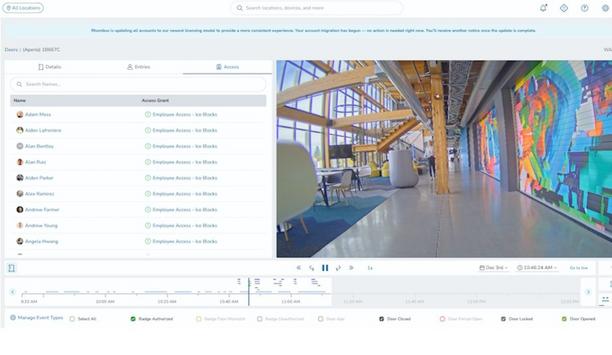
ASSA ABLOY Opening Solutions completed the integration of its Aperio® wireless lock technology with access control from Rhombus, an open, cloud-managed physical security platform that brings security cameras, access control, sensors, alarm monitoring, and software integrations together under a single pane of glass. Aperio wireless locks “With this integration, customers can now extend the power of Rhombus into doors and areas where wired access control simply isn’t practical. Pairing ASSA ABLOY’s industry-pioneering Aperio wireless locks with the Rhombus cloud platform gives a flexible, scalable, and truly unified approach to security." "From schools to hospitals, manufacturers to enterprises, this partnership is further enabling organisations to manage access, video, sensors, and AI-driven intelligence through a single, cloud-based experience; no on-prem servers or complex deployments required,” said Brandon Salzberg, Chief Technology Officer at Rhombus. New and existing access control installations The Aperio integration offers Rhombus customers an easy way to connect additional openings to both new and existing access control installations. Aperio is a global wireless platform that works with extensive locking hardware options from ASSA ABLOY Group brands, offering the flexibility to address a variety of applications throughout any facility. The platform uses wireless communication (IEEE 802.15.4) between the lock and an Aperio hub to provide real-time communication with the access control system, simplifying installation and reducing costs. Rhombus access control suite The Rhombus access control suite is a sophisticated enterprise solution that pairs seamlessly with Rhombus cameras, sensors, and alarms creating a complete ecosystem for managing building security - helping drive faster, smarter investigations, increase security visibility and reduce threats. Rhombus Console then becomes the central nervous system of your physical security; a user-friendly, cloud video management system designed to unify and streamline camera, access control, and live monitoring applications, easily scaled to unlimited cameras, doors, users, devices, and locations. Cloud-native approach “Rhombus brings a modern, cloud-native approach that makes it easier for organisations to unify and manage security across their entire environment,” said Angelo Faenza, Head of Access Control Solutions at ASSA ABLOY. “Through this integration, customers can experience the flexibility of Aperio locks alongside the simplicity and scalability of the Rhombus platform—removing the barriers of traditional access control and enabling smarter, more connected facilities.”

As a provider of future-oriented business education, The Camp sought an access control solution as forward-thinking as their courses. Their campus site near Aix-en-Provence is diverse, with offices, event spaces, kitchens and two accommodation blocks totalling 170 units. The Camp must remain open around the clock, all week, while maintaining security for staff and visitors. Aperio wireless locks Meeting rooms, server rooms, living spaces and kitchens are secured with Aperio wireless locks Aperio provided locking devices tailored to every door type — interior and exterior. So far, The Camp has integrated 221 Aperio Wireless Escutcheons, 42 Aperio Wireless Cylinders and 10 Aperio Wireless Handles within a TIL Technologies security system. Integrated online with the central system and controlled from the same interface, these Aperio devices effortlessly handle daily staff traffic of around 250 people. Meeting rooms, server rooms, living spaces and kitchens are secured with Aperio wireless locks. Aperio visitor access system Up to 2,000 external visitors arrive on-site when The Camp stages an event — and each must also have credentials issued and access filtered through the site. Aperio makes it straightforward to enable visitor access. “Many credentials get lost and Aperio enables us to handle this efficiently,” says Benjamin Ciotto, Head of Information Technology at The Camp. A few clicks are all it takes to cancel a lost key card and issue a replacement. Real-time and future-proofed Security staff at The Camp ensure only authorised users enter offices where expensive video projectors and screens are stored. Their TIL integration enables real-time management of the whole site, with specific profiles created to segment individuals who need fine-grained access to specific areas. “Online mode is very important because (access) rights are very often updated for the constantly shifting campus population,” explains Benjamin Ciotto, adding “We can also program access to defined time slots, which is essential when we welcome 200 people for an all-day meeting, for example.” Aperio product ecosystem’s performance Aperio product ecosystem’s sustainability performance also fits The Camp’s ethos Aperio technology also met The Camp’s need for an aesthetically pleasing, wireless solution. They did not want to compromise their interior or exterior design. The Aperio product ecosystem’s sustainability performance also fits The Camp’s ethos. Because Aperio devices are wireless and battery-powered, they are much more energy efficient than traditional wired locking systems, which require an “always-on” mains connection. Multiple Aperio devices Multiple Aperio devices have independently assessed Environmental Product Declarations (EPDs). These detail the footprint of each device through its full life cycle, from production to disposal. “Aperio is a real comfort of use,” Benjamin Ciotto concludes. “And we handle the easy maintenance for ourselves.”

Technology's role in securing banks and financial institutions
Download
Security technologies promote real-time awareness in K-12 schools
Download
Integrated systems enable critical and compliant security for transportation
Download
Modernising physical access control
Download
Access. Intrusion. One estate.
Download