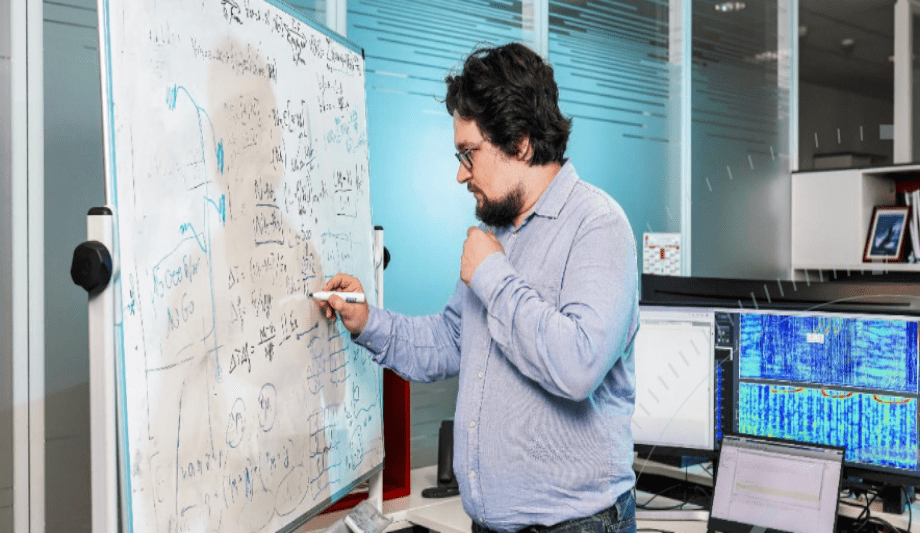
Alexandre serves as a Data Scientist at the Centre of Excellence for Information, Human Factors, and Signature Management (CEMIS) within Naval Group, focusing on the development of artificial intelligence algorithms for underwater acoustic recognition. His work involves designing systems that assist submarines in identifying underwater sounds, distinguishing noises like those from dolphins from that of merchant ships, a skill akin to that of a 'nose' in perfumery. This expertise is essential as newer generations of submarines possess more sensitive sonar systems, increasing the complexity of acoustic recognition tasks.
Role in Supporting Submarine Crews
Alexandre explains, "My job is precisely to design an AI algorithm, integrated into the ship’s system, that helps them sort sounds, from those that are most dangerous to those that are non-threatening." Despite the advanced technology, Alexandre emphasizes that these systems are designed to support human crews rather than replace them entirely. The work of Naval Group’s Raid Team, which promotes AI integration, has identified his role as a priority in advancing these supportive technologies.
Evolution from Engineer to Data Scientist
Beginning his career as a Computer Engineer with a Naval Group subcontractor, Alexandre transitioned into data science, drawn by the field's capability to extract valuable insights from data. With limited resources available at the time, he pursued online courses and distance learning at Stanford University to gain the necessary qualifications. His innovative approach led to his recruitment by Naval Group in 2019.
Balancing Science and Application
At the CEMIS, Alexandre collaborates with academic research to develop practical solutions tailored to operational needs. "Our algorithms originate from the academic world and allow us to recognise patterns in images and noises in sound signals," he notes. He values the intersection of project management and technical expertise, which allows him to bridge the gap between scientific innovation and real-world application. "I like the combination of academic research and applying it in a practical manner to the crew’s needs," he adds, highlighting his commitment to continuing in this field throughout his career.
Alexandre is a Data Scientist who specializes in underwater acoustic recognition based on artificial intelligence. He works at Naval Group’s Centre of Excellence for Information Human factors and Signature Management (CEMIS). He designs artificial intelligence (AI) algorithms to identify sounds that a submarine can hear underwater.
Capable of distinguishing blindly the sound of a dolphin from that of a merchant ship, ‘golden ears’ are to underwater acoustic analysis what a ‘nose’ is to traditional perfumery: a challenging trade that requires long training.
Moreover, each new generation of submarines widens the spectrum of audio phenomena captured by increasingly sensitive sonars. The need to accompany crews in this task of acoustic recognition is strong indeed.
Alexandre job
“My job is precisely to design an AI algorithm, integrated in the ship’s system, that helps them sort sounds, from those that are most dangerous to those that are non-threatening”, explains Alexandre.
“Supporting crews means relieving them of tasks that may be repetitive and handling those that are risk-free and reliable. But it does not mean replacing human beings completely”.
His work features among the priority use cases identified by Naval Group’s Raid Team, a team dedicated to facilitating the deployment of AI within the group.
Science and technique
Alexandre became a Data Scientist after gaining initial professional experience as a Computer Engineer
Alexandre became a Data Scientist after gaining initial professional experience as a Computer Engineer within one of Naval Group’s subcontracting service companies.
Drawn to this particular science of extracting value from a dataset (which is the actual role of the Data Scientist), he then educated himself on the subject with the means available to him.
There was hardly anything out there back then, so I took a few Moocs online and distance learning courses at Stanford University that earned me my certification, which was the best of the best at the time.
Science and operational need
Naval Group hired him in 2019 at the CEMIS. “Our algorithms originate from the academic world and allow us to recognise patterns in images and noises in sound signals.”
“I like the combination of academic research and applying it in a practical manner to the crew’s needs. A Data Scientist at Naval Group is not a mad researcher working in a lab, completely disconnected from reality.”
“We have to act as an interface between science and operational need. “This means we are at the crossroads of project management and technique, which is something I really appreciate because I want to continue using this discipline throughout my career.”