National Fire Protection Association (NFPA) - Experts & Thought Leaders



Latest National Fire Protection Association (NFPA) news & announcements

According to the National Fire Protection Association (NFPA), in 2023, an estimated 470,000 structure fires caused 3,070 civilian fire deaths; 11.790 civilian injuries; and $14.7 billion in direct property damage. For this reason alone, using an up-to-date, working fire alarm system should be considered an essential component of any business’s life safety and security program. NFPA 72, the National Fire Alarm and Signaling Code, is the standard for installing and maintaining fire alarm systems. The model building codes, such as the International Building Code (IBC), reference NFPA 72 be used as the installation standard. International Code Council IBC 2015 Model alarm codes mandate that the fire system be monitored by a supervising station, commonly referred to as the central station. For example, the International Code Council IBC 2015 requires fire alarm systems be monitored by an approved supervising station; this can be found in section 901.6.3. Some buildings may have sprinkler system monitoring but not a complete fire alarm system with occupant notification. Section 903.4.1 of the IBC requires a suppression system to be monitored by an approved supervising station. This white paper focuses mainly on communication pathways and the changing technologies that help to ensure signals from the fire alarm panel connect and communicate with a remote supervising station. A changing landscape Availability and reliability of POTS (plain old telephone service) By now it is widely known that, following a request by AT&T, the Federal Communications Commission (FCC) no longer requires the telecom industry to support copper telephone lines. As a result, AT&T has already started a phased sunsetting of plain old telephone line service (POTS). Analog technology is expensive to maintain in a digital world. Fewer customers and older infrastructure have led to increasing failures of POTS lines. When failure occurs, the providers often lean towards broadband alternatives with media converters installed at the customer premises. Traditional POTS lines were powered and switched directly, making them the reliable standard for decades. Newer technology installed at the customer premises has drawbacks for reliability, such as standby power and compatibility with digital alarm communicators (DACT) designed to work on an analog phone line. Newer phone technology As POTS technology becomes completely obsolete, there potentially may be thousands of alarm panels that are not being monitored; therefore, new technology must be implemented at a record pace. It is becoming dangerously common in the industry for phone lines to fail or be switched to another communications platform by the provider, and thereby unable to communicate with the remote supervising station. Digital Alarm Communicator Transmitters (DACT) provide communications between the Fire Alarm Control Panel and the monitoring central station over a telephone line and have been designed to run on analog POTS lines. Newer phone technology such as VoIP may initially experience issues with both communicating and maintaining proper supervision to the supervising station. DACT transmission methods One of the reasons for this is errors with data packet compression during transmission allowing for data to become corrupted or lost during the process. New cellular communicator replacements are tested by UL to ensure compatibility with existing DACT transmission methods of communication and supervision, making them ideal for a cost-effective conversion from POTS. As it relates to standby power, effective February 13, 2019, FCC rules increased the amount of backup power that providers must offer at the point-of-sale to a minimum of 24 hours. However, the issue here is that this is an optional feature and not always implemented. It is not uncommon to see a POTS replacement, such as a fiber-optic network terminal tied to DACT with a warning label on the plug that is plugged directly into an outlet with no battery backup. Cellular evolution The 3G network brought mobile internet to cellular in 1998, with a lifespan of 22 years before sunsetting in 2020. Although the 3G sunset was initially supposed to occur in 2020, AT&T retired the network in February of 2022. Verizon sunset occurred in December 2022. The most common communications standard is 4GLTE and is not expected to begin the sunsetting process until 2030. Originally, the 4G specification was to meet a minimum of 100 megabytes per second, up to a gigabyte. A majority of hardware in 2009 couldn’t support the original 4G network specs; therefore, the second generation of hardware known as long-term evolution, or LTE, was launched to meet the original network specification. In 2013, new cellular networks were the 4GLTE standard. Next on the horizon will be 5G, although it is not expected to be widely available until 2025. It is expected that most 5G devices will rely on the 4G backbone, especially in more rural areas. For critical systems, lower 4GLTE bands with moderate data can be a more reliable option because of the more extensive coverage area and higher signal penetration into the building materials. Cellular fire alarm communication Benefits of Cellular Communication Cellular radios have a supervision heartbeat; if communication is lost, the provider will send a trouble signal to the central station after an hour Phone lines only check in with the central station daily or every six hours in some cases The cellular communicator provides an equal standby battery to the fire alarm system Older POTS phones sourced power from the phone provider and did not rely on building power Newer phone technologies offer battery backup as an additional option at a cost to the customer — however, the battery backup is unsupervised, potentially making it unreliable when you need it Although a sole-path cellular communication uses a single technology with one physical connection to the fire alarm system, it provides multiple paths to the central station via a robust cellular network Newer phone technology, such as fiber-optic network terminals or ONTs, uses single fiber, even though two phone lines may be connected to the device During emergency weather or other natural disasters, the cellular communicator usually doesn't rely on local infrastructure that could be damaged It’s always important to verify the local model code standards; some jurisdictions do not follow model codes or have modified them (e.g. New York City). FDNY standard only allows cellular when used with another technology such as IP. Other more rural areas where you are unlikely to have two cell towers to meet single technology performance requirements may also require an additional path such as IP as primary, and cellular as a backup. How cellular communicators work The cellular communicator acts as a relay to the network operation center (NOC), retransmitting signal to the remote supervising station, also known as the central station. The DACT interfaces with the communicator the same way it would with a POTS. The DACT connects by dialing the central station; the communicator acknowledges—also known as a “handshake”—and the DACT then sends the data string for the alarm signal before receiving an acknowledgment that the process is complete. The data is immediately retransmitted to the central station with the same communication formats. Cellular communicators are fast, avoiding lengthy delays in retransmitting signals. Typically, two methods are used. The first is a primary IP, known as a Dialed Number Identification Service (DNIS), over the internet to the receiver, and the second could be a backup method, such as connecting a public switch telephone network to the receiver. One technology for physical connection to DACT Unlike POTS lines checking in with the central station once a day with a test signal, the cellular communicator sends a heartbeat data packet to the NOC. If the NOC loses communication for a defined period, defined by NFPA 72 for supervision, typically one hour or less, a trouble signal is generated and sent to the supervision station. Although with a single communication path per NFPA 72 26.6.3.3, it is possible to have the performance of two paths. The communicator uses one technology for physical connection to DACT, and multiple paths of reliability can be implemented for communication. For example, this can be accomplished by choosing the cellular provider with more than one tower in the area. The communicator connects to the tower with a stronger signal, and if the signal is lost, the communicator will use the alternative cellular tower. When it comes to reliability, phone lines and IP internet services can be interrupted by many conditions, such as power outages, downed utility poles, or damage from digging, to name a few. Cellular carriers are all about speed and reliability with extended standby power, fiber and microwave internet communication. When a disaster or failure occurs, cellular carriers are quick to set up mobile towers to swiftly improve coverage. Towers also operate as distributed antenna systems (DAS) to smaller towers known as microcells. Savings to customer Besides increased reliability, the savings and short-term return on investment can drive the decision-maker to invest in cellular communication. Although a cellular communicator’s lifespan could be as long as ten years, they will use five years as an example. Example: Commercial fire with legacy POTS costing $50 or more per line per month could be as high as $1,800 per year. After investing in equipment and labor, typically under $1,000, and average savings of $4,000 over five years including additional cellular service costs may be realized. Requirements for permit, notification and documentation Changing the communication technologies may be considered minor work and therefore may not require a formal permit, but always notify the local Authority Having Jurisdiction (AHJ), which in most cases would be the Fire Marshal’s office, for existing systems. Upgrade of an existing cellular communicator Upgrading an existing 3G cellular communicator to 4GLTE is usually considered regular service or minor work, not requiring a permit. Minor work is defined as replacing a like device with no modification to the fire alarm control unit. If changes are made, such as monitoring cancellation or lapses in monitoring, the current edition of NFPA 72 requires additional notification to the AHJ. Upgrade of POTS to a cellular communicator In some cases, the AHJ may have an all electronic review process in lieu of the full permit and inspection process. In those cases, the Fire Marshal might ask for the following instead of the formal permit or inspection: A letter from the licensed contractor with the scope of the communication path upgrade, including when it was installed and tested per the NFPA 72 standard that applies A product datasheet and battery calculation New monitoring trends In the past year, the fire alarm industry has seen an increased demand for two-way voice monitoring for both Areas of Refuge and elevators. The highest demand is originating from new construction where POTS lines are not available with tip and ring voltage to power the elevator phone. This demand is expected to increase as the POTS infrastructure fails for existing equipment. The existing technology for wireless interface to an Area of Refuge and elevator is still limited. However, technologies are evolving, making products available that can provide online supervision where POTS-driven phone lines don’t have the universal compatibility to work by using power from the provided phone line output. Conclusion While analog modes of communications, like POTS lines, are quickly becoming obsolete, even newer cellular methods are evolving just as quickly to more sophisticated methods as well. 3g, for example, has been completely phased out as of December 2022. Currently, 4GLTE is the most prevalent, but also on track to begin the sunsetting process by 2030. 4G is on track to serve as the backbone for the next cellular advancement on the horizon as 5G devices become more widely available by 2025. In many cases, fire alarm integrators are at the forefront in helping AHJs and businesses alike stay up to date on the latest trends in technologies and changes in life safety codes and standards. Properly monitored, supervised and maintained fire alarm and life safety systems can provide the earliest possible warning of an event and serve as the first line of defense against the risk businesses face from catastrophic loss due to fire. But fire alarm systems must have the most reliable communications pathways available so they can quickly alert authorities in emergency situations. New technology requirements Everon delivers industry-pioneering technology and solutions to the fire and life safety community through district offices across the country and its dedicated, industry-unique National Fire and Life Safety Team (NFLST). They utilise NICET Certified (National Institute of Certification in Engineering Technologies) technicians, installers and inspectors. The staff members also enrich their life safety knowledge with additional certifications and advanced courses in fire and life safety. The team is ready and available to help organisations ensure compliance with new regulations and adapt their current fire and life safety solutions to meet new technology requirements, whether they operate a single location or hundreds of facilities across the nation. Fire alarm systems must have the most reliable communications pathways available so they can quickly alert authorities in emergency situations.

National Fire Protection Association® (NFPA®) released survey results collected from over 170 industry professionals at the NFPA 2024 Conference & Expo®, the premier conference for fire, electrical, and life safety. The research findings reveal insights into trends and attitudes around digital tools, training and development, and AI implementation within the skilled trades industry. Mixed feelings about AI adoption Twenty-five percent of respondents believe AI should be used to help skilled trade workers streamline tasks during ongoing labour shortages. 19 percent of respondents indicated that either themselves or their organisations have begun experimenting with AI-powered solutions to simplify menial tasks. Additionally, one-third (31 percent) of respondents believe AI can spur industry growth by making the trades more attractive to a younger generation of workers. AI challenges AI to act as a “personal assistant” to field workers for hyper-personalised and on-the-go learning On the other hand, nearly one-half (47 percent) of respondents revealed they are not currently leveraging AI in their day-to-day work and are skeptical of it. Additionally, only 8 percent of respondents believe AI implementation won’t benefit the fire and life-safe industry at all. Respondents also cited utilising AI to act as a “personal assistant” to field workers for hyper-personalised and on-the-go learning (13 percent); streamline manual processes to save time (12 percent); and enhance learning and development initiatives, such as those delivered via virtual reality (8 percent). Digital tools are positively impacting training and development Eighty-two percent of respondents use digital tools daily to help streamline training and development programmes. The majority of respondents within this group recognise the diverse benefits that digital tools offer the skilled trades industry, including: Making training easier (98 percent). Saving time while training (94 percent). Streamlining the process of conducting training (95 percent). Challenges with digital tools However, respondents also noted challenges in leveraging digital tools within their day-to-day operations, despite an increase in the number of participants using five or more tools daily compared to the 2023 C&E Survey results. For example, 69 percent of respondents cited collaboration as a top challenge for 2024, a significant increase from 2023’s results (29 percent). The top-reported challenges teams face in leveraging digital tools include: Collaboration (69 percent). Inspection (51 percent). Complexity of projects (46 percent). Industry participation in NFPA programmes Eighty-five percent of respondents participate in at least one NFPA training and development programme a year and 18 percent of respondents participate in or offer training or programmes twice a year. The top NFPA products and solutions leveraged by skilled trade professionals include: NFPA print publications (66 percent). NFPA membership (61 percent). NFPA LiNK® (51 percent). Challenges persist when it comes to advancing training and development programmes, with a majority of respondents (70 percent) citing lack of time as the biggest barrier. Additional barriers include: Determining the right training (41 percent). Lack of access to qualified instructors (48 percent). Overwhelmed with options and/or a lack of time to vet training programmes (32 percent). Keeping track of which training is needed to maintain professional licenses (22 percent). Lack of technology to disseminate training to employee bases (18 percent). Inability to track and/or document training completions by employees (15 percent). Other (10 percent). Addressing the skilled labour gap 38% of respondents reported the skilled labour gap has negatively impacted the amount of time and money spent Nineteen percent of respondents noted the skilled labour gap has led to less time for career advancement opportunities through training and certifications. More than one-third (38 percent) of respondents reported the skilled labor gap has negatively impacted the amount of time and money spent on recruitment and retention, with 14 percent of respondents turning down projects due to a lack of qualified labour. Survey Methodology NFPA collected responses from 171 U.S. and international-based workers, 18 years and older, in the electrical, manufacturing, construction, engineering, architect/design, facility maintenance, fire service, and insurance/risk management fields to determine the findings of this industry research. The survey was conducted in person between June 17 - June 19, 2024, at the 2024 NFPA Conference & Expo®.

According to the National Fire Prevention Association (NFPA), smoke and toxic gases are the most significant factors in loss-of-life fires. Almost 70% of all building deaths are associated with smoke inhalation. The prompt and safe evacuation of building occupants and immediate notification of the fire department are the primary means to prevent loss of life, as well as loss of property. The principles for saving building occupants from a fire are delineated in NFPA 101, Life Safety Code, and NFPA 72 for fire alarm systems. Alarm and detection systems Working in tandem with the alarm and detection systems are sprinkler systems. When inspected and maintained properly, and ensured they haven’t been tampered with, sprinkler systems are designed to extinguish a fire. When a certain temperature is reached, a sprinkler head will activate and water will begin flowing, helping to put out the fire. NFPA 25 covers inspection requirements for sprinkler systems. Compliance helps maximize system integrity to avoid failure and ensure fast, effective response to a fire emergency. Another layer of protection is required, often referred to as “defend in place.” In the event that a life safety system fails, is tampered with, or in a situation in which occupants in a facility cannot be easily evacuated, as is the case for the ambulatory, elderly, incarcerated and others, passive fire protection can play a key role in saving lives. Types of fire doors and opening protectives This oft-neglected additional layer called Passive Fire Protection (PFP) can help compartmentalize a fire to its origin as well as help to slow the spread of fire and toxic gases to other areas of the building. The most commonly cited codes associated with passive fire protection are NFPA 80, 105 and 90A. NFPA 80 covers the installation, care and maintenance of many types of fire doors and opening protectives. More specifically, it requires that all fire door assemblies be inspected and tested yearly. While NFPA 90A provides fire duct installation requirements. Active Fire Protection As a matter of clarification, active fire protection (AFP) is comprised of systems that require a trigger to work efficiently in the event of a fire. Those triggers may be manually operated, as is the case with a pull station or fire extinguisher, or automatic, like a smoke detector, heat detector or fire sprinkler head, but all require some action to be performed to engage the systems. Passive Fire Protection Passive fire protection (PFP) are made up of systems or components that compartmentalize a building using fire-resistant rated walls, floors and ceilings. Compartmentalizing a building into smaller sections helps to slow or prevent the spread of fire or smoke from one room to the next. PFP helps to limit the amount of damage done to a building and provides its occupants more time for evacuation. In addition, it helps protect first responders who have a better chance of putting out a fire that is compartmentalized, versus the added danger of trying to put out a fire that swells to encompass an entire building. PFP components include fire/smoke dampers, fire doors and fire walls/floors. An Argument for Active Fire and Passive Fire Protection Systems While AFP systems are highly regulated and must conform to strict installation, maintenance and inspection guidelines established by the NFPA and enforced by the local AHJ, passive systems often take a back seat. There is a valid argument for both; active protection could fail due to a number of reasons, including low water pressure for sprinkler systems, or clogged or broken lines, while passive systems may allow occupants more time to flee, but do very little to stop the spread of the actual fire. The following sections outline the various components that make up a comprehensive fire protection plan for any facility including both active and passive solutions. Alarm and Detection: The First Line of Defense Coined “alarm and detection” by the industry, there are several key components of an active fire protection system that are necessary to initiate occupant action. They include: Fire Alarm Control Panels These are the brains of the system. They are highly regulated and require a minimum of one annual inspection to test the activation of audible and visual devices, relay outputs, annunciators, elevator recall, release of magnetic door holders and many other functions. In addition, the control panel batteries, an integral part of the system, are required to be replaced every five years from the date of manufacture. Smoke, Flame, and Heat Detectors These sensing devices are designed for early detection of smoke and fire. They require periodic inspections and functional testing, as well as smoke detector sensitivity testing. Note: Functional testing does not mean using a magnet, but rather using canned smoke or an equivalent. Audible and Visible Alarm Systems These include alarms (horns/bells/speakers) connected to the detection system and strobe lights. These components are tested as part of the annual inspection. Other Key Elements of the System Manually activated pull stations Voice communication systems Procedure and means for notifying the fire department, including the use of central station monitoring via DACTS (Digital Alarm Communication Transmitters) Evacuation Planning A written plan should include procedures for notifying all appropriate emergency services, creating an internal emergency response team and conducting regular drills. A plan for evacuation should include a means of egress that outlines adequate numbers of well-maintained routes of escape. The egress route maps should be posted in conspicuous locations available to all occupants. As part of the plan certain considerations need to be taken into account: From any point in the building, each occupant must have at least two routes of escape, clearly marked and readily accessible with no obstructions. Those routes must properly show direction of travel and use photo luminescent markings where required by the local AHJ. Plans must adhere to a maximum travel distance to an exit (100 feet in facilities not equipped with automatic fire suppression sprinklers; 150 feet in sprinkled facilities; and 75 feet in facilities with “high hazard” contents, including contents that will burn with extreme rapidity, or from which dense smoke, poisonous fumes or explosions are likely in a fire situation). The routes must contain flame-resistant interior finishes (e.g. carpets, draperies, upholstered furnishings). A designated safe relocation or muster area must also be identified and communicated to the building occupants. As an added safety measure, internal fire marshals should be appointed to take roll call at the muster stations to help account for all occupants. Sprinkler Systems: Another Crucial Piece of the Puzzle to Extinguish Fires The purpose of fire sprinkler systems is to provide an appropriate amount of water to extinguish fires before they can grow and spread. There are various types of sprinkler systems that can provide the right kind of protection for the specific kind of setting in which they are installed. The types of fire sprinkler systems include wet pipe, dry pipe, deluge, antifreeze and pre-action fire sprinkler systems. Following are a few statistics provided by AFSA (American Fire Sprinkler Association) to keep in mind: According to the National Fire Protection Agency, fire sprinklers are a highly effective and reliable part of a building’s fire protection system. They can help prevent the spreading of fires in their early stages—before they have the potential to cause severe injury to people and damage to property. When one fire sprinkler head goes off to fight a fire, the entire sprinkler system does NOT activate. Sprinklers react to temperatures in individual rooms. The chance of a fire sprinkler accidentally going off is extremely remote because sprinklers react to heat in individual rooms—according to NFSA (National Fire Sprinkler Association). Installation of fire sprinklers can result in discounts on insurance premiums, according to the NFSA. Fire sprinklers are designed to immediately respond to a fire while it is still small, help control the spread of deadly heat, flames and toxic smoke—whether or not the occupants have appropriately responded to the signaling smoke alarm. In this way, fire sprinklers can make up for human error, and may provide life-saving cushion for a time-consuming escape. Passive Fire Protection: The Final Layer Passive fire protection components consist of several items: Smoke, Fire, and Combination Dampers These devices must be inspected when a commercial building first opens, one year later, and then every four years for commercial buildings and every six years for hospitals according to NFPA 80 and 105 codes. Note that alarm contractors may not always perform required testing. In some cases, they may only test the alarm relay from the fire alarm panel and may not mechanically exercise the damper as required by codes. Fire Doors According to NFPA 80 code, swinging fire doors are required to be tested annually and there are 13 inspection points. Overhead, horizontal, and sliding fire doors are also required to be inspected annually and also have 13 inspection points. Firestopping A firestop is a fire protection system made of various components used to seal openings and joints in fire-resistant rated wall or floor assemblies. For penetrating cables, these can also be called Multi Cable Transits (MCTs). Firestops are designed to restore the continuous fire resistance of wall or floor assemblies, impeding the spread of fire by filling the openings in them with fire-resistant materials. Miscellaneous Components Emergency power, illumination and emergency lighting, including: Exit signs Exits Pathways to exits Changes in elevation Stairs (minimum level of illumination = 10 lux / 1 foot-candle) Routine monthly testing with an annual 90-minute load test is required, and should include verification that light beams are properly aimed, according to NFPA 101 Life Safety Code. Conclusion Life safety plans should be as comprehensive as possible, and must include alarm and detection, suppression and passive fire protection to truly be a comprehensive plan. Passive fire protection should be addressed by owners and facility managers alike, even if the local authority is not enforcing the codes. Together, these components are critical in helping to prevent loss of life and property, in the event that a fire does occur, and mitigate overall damage. The certified professionals at Everon can help develop, design, and deploy a comprehensive fire and life safety solution that addresses the risks and challenges you face—and helps protect your most valuable assets and resources.
Insights & Opinions from thought leaders at National Fire Protection Association (NFPA)

With the year 2025 stretched out before us, there are many techniques one could use to predict what will happen in the new year. You might analyse historical data and analyse future trends. Or you could try statistical or economic modelling. Or you could develop multiple scenarios based on various assumptions to explore potential outcomes. Or you could just check your email. At this time of year, my email is full of industry folks looking to predict what the future holds in 2025. Ranging from artificial intelligence (AI) to privacy, the retail market to drones, here is a sampling of forecasts for 2025 provided by various players in the security market, courtesy of my email messages. What’s Ahead for AI? From Faisal Pandit, VP & GM, Global Security Products, Johnson Controls (JCI): “The future of security operations includes customisable, scalable solutions where users can control if, when, and how they use AI to improve efficiency depending on the size and function of their organisation.” Says Kevin Woodworth, Vice President, Global Product Management, Intrusion, JCI: “Next year will see a growing focus from product developers on designing systems that streamline setup and configuration through increased AI integration. This reflects a broader trend of leveraging AI to simplify use and enhance adaptability as solutions evolve, rather simply employing it because it’s popular.” From Peter Evans, CEO of Xtract One Technologies: “AI algorithms will significantly advance in distinguishing between harmless, everyday items and potential threats. With this, we will see false alerts become even more rare.” Says JP Castellanos, Director of Threat Intelligence, Binary Defense: “Machine learning (ML)-powered anomaly detection will move beyond proof-of-concept to become mission-critical, enabling teams to uncover unknown threats and behavioural anomalies in real time – well before they escalate.” Evans of Xtract: “As AI becomes more advanced in threat detection, it will lead to more sophisticated protection of individual privacy. We can expect to see more AI techniques utilised for threat identification that do not capture personal data and are privacy-first.” Predictions on interoperability and compliance Woodworth of JCI: “New products added to singular systems must be interoperable. In 2025, organisations will need to embrace interoperability. AI will progress past reactive measures to achieve predictive capabilities.” Pandit of JCI: “With organisations increasing their focus on the regulatory environment, there will be an uptick in specialised certification programs to meet these needs. New security roles will emerge that will be focused on tracking and applying relevant regulatory changes.” Expanding capabilities for video cameras Woodworth of JCI: “Beyond capturing images, cameras will be able to detect potential threats and also mitigate them instantly, issuing vocal warnings, controlling access, or escalating issues without human intervention.” Looking ahead to retail developments Hansel Oh, Director of Product Marketing at Brivo: “Centralized, cloud-based security platforms will enhance credential management and monitor logistical operations to enable retailers to battle cargo theft.” Stephen Burd, Vice President, Essence Security: “With an increase in police response times, sophisticated crime, and smash and grabs, 2025 will see a huge demand for security solutions that go beyond simply notifying the police and will look to actively intervene and prevent damage or loss from occurring.” The role of drones and training Mary-Lou Smulders, CMO, Dedrone by Axon: “Drones will transition from being viewed as supplementary tools to becoming essential components of public safety operations. As departments recognise their effectiveness in various scenarios, the perception of drones will shift, and they will be integrated into core operational frameworks alongside traditional assets like patrol cars while replacing helicopters as a cost-effective and versatile alternative.” Erik Hohengasser, Electrical Technical Lead at NFPA: “As the skilled trades evolve, there will be an increasing demand for specialised and technical training. Predictive analytics, virtual simulations and hands-on experiential learning will become especially valuable due to allowing employees to gain real-world expertise in safe and controlled environments.”
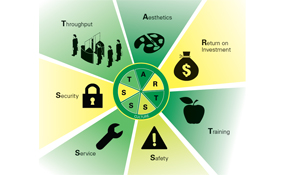
All seven decision factors contribute to an effective physical security solution Installation of an effective physical security solution can enable end users to avoid serious mistakes. This article presents a comprehensive and consultative decision methodology to help end users make the best decisions about security entrance products for the long term. The decision-making process is based on Boon Edam’s more than 100 years of experience in installing thousands of entry solutions and talking to end users worldwide. Seven key decision factors The entrance solution decision-making process can be divided into two parts. During the before installation phase, initial purchase decisions are often weighted towards the factors Security, Aesthetics and ROI. After installation, however, and once there is no going back, Throughput, Training, Service and Safety play a more prominent role. By understanding the importance of each of the decision factors and considering all of them in the context of the final product decision, end users stand a much better chance of having the best overall decision-making experience that meets all their needs. While initially Aesthetics or Security often naturally jump out as paramount in the decision process, all seven decision factors contribute to an effective physical security solution. Let’s take each factor and walk through a more comprehensive decision-making process. A process that is more internally focused, as opposed to one driven by a contractor talking solely about price or an architect more interested in entries that meet superior aesthetic qualities. 1. Security features Security is typically the top driver in the buying decision, but do compare security features closely to ensure you obtain the right solution for your needs. Does the proposed entry solution offer these security features? Tailgating/piggybacking prevention Anti-climb-over detection (waist high entrance) or prevention (full height barrier) Support for anti-passback feature in the access control system Integration with any access control system Minimal false rejection rates (3% or less) The decision-making methodology process is based on Boon Edam’s more than 100 years of experience in installing thousands of entry solutions Are you familiar with false rejection and the impact on the overall acceptance of daily users of the entry solution? If authorised users are rejected by a security entrance too frequently this can lead to complaints across the organisation. So, it is important you get data on false rejection rates. 2. Throughput requirements Throughput affects users directly on a daily basis. Before you commit to a particular kind of entrance solution, carefully calculate the peak throughput requirements for your building and entrances: Are there shifts that create heavy flows of traffic at certain times of day or evening? Do you need one-way or two-way traffic at certain locations? Where will you provide access for the disabled or for large items? Does the security entrance allow for card stacking to maximise throughput? Does the security entrance use automatic or manual operation? In measuring and evaluating throughput, it’s critical to manually count the number of people entering and leaving an entrance in a short period of time, such as five minutes, during a peak busy period. Do not rely on access control numbers especially if swing doors are present, as tailgating is likely to be occurring and your count could end up too low. 3. Aesthetic entrance solution Aesthetics are important initially, but they should not trump Security, Safety or Throughput. The winning solution should meet aesthetic requirements without sacrificing the other key decision factors. One’s entrance may be drop-dead gorgeous, but if you have a line of employees and guests stacking up at the entry doors, they won’t be marvelling at the aesthetic appeal for long. Important aesthetic features should include: Architectural finishes Glazing options to complement any design/facade Workmanship and finishing Numerous top cover options for optical turnstiles Wide variety of product dimensions Important: Do not let aesthetics be the driving decision factor. A factor? Certainly, but only one of seven that must all be considered. 4. Return on Investment (ROI) ROI involves far more than the initial cost of the product. ROI factors to consider: Does the entry solution replace or reduce manned security ($114,000/year at $13/hour, for one guard, 24/7/365 coverage* Robust construction = Long product life Certified MTBF (mean time between failures) cycle data Energy savings * US Bureau of Labour Statistics, 2011 The average life of a security entrance product is 10-15 years. By weighing all the above factors, you are able to more accurately consider the true cost of making the buying decision. 5. Installation and maintenance training Training usually isn’t considered a major factor when choosing an entry product. However, since most manufacturers do not directly install their products, technical training becomes critical in creating successful service providers for end users. It adds considerable value during installation and in maintenance over the life of the product. Ask potential entry solution providers: Are installation, service, planned maintenance, and post-installation technical training available for installers of the product? Do you provide a certification program for installers to keep them trained and up-to-date on new technologies? What training methods are used: Hands-on factory and field training, pre-scheduled monthly webinars or private custom webinars? What are the training costs and are they included in the overall solution or do they cost extra each time? A comprehensive technical training and maintenance program from the manufacturer is critical to the long-term success of the installation and customer satisfaction. 6. Service offering Service considerations typically come last, or not at all, when making a buying decision. Yet, during and after installation the level of service directly impacts continued operations and ROI. Security, Aesthetics, ROI, Throughput, Training, Service and Safety play a prominent role in selecting a security entrance solution Look for these features in a comprehensive service offering: Nationwide and global certified distribution partners Phone support: What is the percentage of same-day resolution? Parts: What is the percentage of same-day parts fulfilment? Are parts shipped from overseas? Is installation project management available? Preventative planned maintenance agreements Consider the impact of a delayed installation, unsatisfactory technical support and delayed parts availability. Problems in any of these areas could drag on for days or weeks, meanwhile your building is vulnerable while entrances are shut down and nobody is happy. All because service was left out of the decision-making process. 7. Safety compliance Safety, too, is rarely discussed during the bidding process. However, it is the one factor that could quickly and tragically undermine the effectiveness and success of the project. Does the provider offer these safety features? Code compliance Meets all NFPA fire egress codes Audible and visual communication for users Added sensors to protect users from moving components Speed/torque controls that can be adjusted to meet site operating conditions Instructional media to train new users Ensure all above criteria are met as they apply for the physical security products and applications you are considering. Company culture In addition to the seven crucial decision factors discussed so far, there is one more factor to consider. Entry solution providers must understand your company Culture, and help you communicate the best way for your culture to adapt to a new security entrance. Some culture factors include: How much exposure have your employees had to security entrances (other buildings, around town, previous employers, etc.)? How do you think employees will feel about your new security entrance? How will you plan to achieve buy-in from employees? When and how will you communicate the upcoming changes in security entrances? Are there any special needs — service animals, pets, elderly or disabled users, frequent deliveries in large carts — to be considered? Are all stakeholders involved in the decision process including the facility manager who will own the entrances once installed? Has the CEO been in on the decision-making process, is it possible he or she might decide the newly secure entryway is far from the image they wish to project? Security entrance project – outcome The success (or failure) of a security entrance project must start and end with a comprehensive, consultative process that takes into consideration the full range of factors for discussion and ultimate decision. The decision-making methodology outlined here is such a process. One that will help ensure that the buyer will be just as satisfied, and probably more so, years after installation and not just when you’ve cut the ribbon on day one.

January 5, 2015 is the deadline to suggest changes to the National Fire Protection Association’s (a US trade association) two documents that serve the security marketplace. Anyone can provide public input into the standards through the NFPA website. NFPA 731: Standard for the Installation of Electronic Premises Security Systems provides guidance on how to install, test and maintain electronic premise security systems and their components. Its specific requirements are written so that they can be easily incorporated into legal requirements by local jurisdictions that oversee building construction and compliance. NFPA 730: Guide for Premises Security is a “softer” standard. It’s not equipment-driven and not as specific but rather designed to offer guidance. Not intended to be incorporated into an enforceable law, NFPA 730 relies on an expectation of “reasonable care” related to aspects of construction, protection, occupancy, features and practices to reduce security vulnerability. These two standards were first issued in 2006, now in their third printing, and are among the 300 or so documents in the NFPA’s portfolio. NFPA, a standards-developing organisation with 75,000 members, creates standards covering all aspects of the building trades (not just fire). Almost all of NFPA’s standards are approved by the American National Standards Institute (ANSI). One of NFPA’s well-known standards is the National Electrical Code (NEC), which regulates electrical installations and has been adopted into law in thousands of jurisdictions and almost every state. In contrast, the enforceable standard relevant to the security market -- NFPA 731 – has only been adopted by a “handful” of local jurisdictions, according to Richard Roux, NFPA 730/731 staff liaison. Even if not adopted as law, elements of NFPA standards can be incorporated into contracts and/or requests for bids Even if not adopted as law, elements of NFPA standards can be incorporated into contracts and/or requests for bids. “There aren’t many laws that say you need a security system,” says Roux. “It’s owner-driven. Usually the installer or the engineer is cognizant of the standards.” Roux says NFPA sells quite a few of the documents from each printing, generally to installers, engineers, owners, insurance companies, governments and police departments. “I get a lot of calls,” he adds. While NFPA offers 300 documents, only a handful get actively promoted – and the security standards are not part of that handful. NFPA 731 incorporates references to existing standards from other organisations as it specifies suitable equipment for an installation. As examples, NFPA 731 refers to Security Industry Association (SIA) standards on control panels, false alarm reduction and passive-infrared motion detectors. Also mentioned within NFPA 731 are the FIPS 140-2 federal information processing standard and UL standards related to access control, key locks, combination locks, burglary-resistant electric lock mechanisms, and high security locks. A 26-member committee oversees revision of the security-related standards – one committee handles both documents. Members of the committee fall into nine categories – manufacturers, users, installers, maintainers, labour, laboratory testing agencies, enforcing authorities, insurance agencies and consumers. The committee decides whether to accept or reject any suggested changes, and the resulting revised document goes through an extensive review process before being adopted. “There’s a whole bunch of checks and balances NFPA goes through,” says Roux. “The requirements are valid and real and come about because of public input and knowledge. When the committee thinks it’s done, they call it a draft and put it up for comment. NFPA doesn’t do these things in the dark. There’s a procedure to the balloting.”

Technology's role in securing banks and financial institutions
Download
Security technologies promote real-time awareness in K-12 schools
Download
Integrated systems enable critical and compliant security for transportation
Download
Modernising physical access control
Download
Access. Intrusion. One estate.
Download
