License plate recognition

Robox AI announced the Robox AI Video Intelligence Platform, a configurable AI-powered platform that transforms compatible existing camera infrastructure into real-time actionable intelligence for loss prevention, safety, security, compliance and business operations. Centralised intelligence layer Instead of requiring organisations to replace their existing camera infrastructure or deploy multiple single-purpose analytics products, Robox AI provides a centralised intelligence layer t...

HiveWatch, a physical security software company reimagining how organisations keep their people and assets safe, announced today that Dinesh Coca has joined the company as GM & SVP, Product & Engineering – along with a wave of new capabilities and integrations built around one idea: operators shouldn’t spend their shifts digging through noise. HiveWatch will showcase all of these during GSX 2026, Sept. 14-16, in Atlanta, at booth #4459. Meet Dinesh Coca joins...

Iluminar, Inc., a pioneer in infrared and white light illuminator manufacturing, is alerting organisations to time-limited federal tax credits available for its Power Stack vertical solar poles. These benefits will expire for solar infrastructure builds not concluded by December 31, 2027, giving businesses, schools, non-profits, and municipalities a limited window to capture incentives before the deadline. Under the federal Clean Electricity Investment Credit (26 USC § 48E), Power Stack&rs...
The biggest return on investment from an AI-enabled camera might have nothing to do with security. Organisations are increasingly discovering that the same cameras installed to protect people and property can also improve safety, streamline operations, automate routine workflows, and generate valuable business intelligence. Security remains the primary mission, but it is increasingly only the first customer for the intelligence these systems produce. AI-enabled cameras are rapidly becoming dis...

Inner Range has released Integriti V26.0, the latest evolution of its flagship unified security platform. This release introduces a range of new capabilities designed to improve operational efficiency, strengthen security, and expand integration across access control, biometrics, and license plate recognition (LPR). Integriti V26.0 brings a major upgrade to how users interact with access control at the door level. With OSDP Reader Text Support, operators can display real-time, contextual messag...

The developers of The Cortile have announced that they have completed the installation of an advanced, integrated security system designed to protect residents, visitors and property assets as the apartment community in Syracuse’s Valley neighbourhood prepares to open its first building for leasing at the end of July 2026. The security infrastructure has been installed across the 3.5-acre redevelopment, which will ultimately comprise four residential buildings containing 140 apartments. T...
News

Hytera, a global provider of critical communications technologies and solutions, unveils the SC700 Smart 4G Body Camera, available from 16th June 2026. “Body cameras are increasingly expected to do more than record evidence,” said Leslie Li, Deputy General Manager of BWC Business Unit, Hytera. “Agencies need devices that can support operational awareness and frontline coordination while remaining reliable throughout extended deployments. The SC700 combines up to 15 hours of continuous recording with real-time communications and intelligent capabilities to help users stay connected and ready when it matters most.” Detecting abnormal situations In fast-moving public safety incidents, a single body camera often captures only part of what is happening, which can limit how clearly the situation and surrounding environment are understood during response and review. With Team Sync Recording, the SC700 automatically activates nearby body cameras when one device starts recording, helping ensure the same incident is captured from multiple perspectives and environments, providing a more complete view for command teams and investigators. Officers often operate in unpredictable and high-risk environments where changes in personnel status or device condition may not be immediately visible to command teams. Intelligent Scene Awareness helps address this gap by automatically detecting abnormal situations such as man-down events, prolonged inactivity, camera obstruction, or device tampering, and alerting dispatch centers to support faster response and timely assistance for frontline personnel. Supporting clear communication Clear communication in the field is often challenged by high noise-level conditions. The SC700 supports more reliable voice communication through AI-based noise cancellation, howling suppression, and a powerful 2W speaker, supporting clear communication in challenging environments. Beyond voice communication, future software updates are expected to extend the SC700’s AI capabilities to support more complex operational scenarios, including real-time language translation for multilingual environments and visual intelligence features such as facial and license plate recognition. These enhancements are designed to further support frontline officers by improving communication efficiency, situational understanding, and the ability to process information in real time during operations. Improved operational coordination Public safety operations require continuous coordination between field personnel and command centres. The SC700 enables real-time transmission of HD video and accurate GPS data from the field to command centres, providing live visibility into ongoing situations. This supports faster situational assessment, more efficient resource allocation, and improved operational coordination across both routine and critical incidents. Communication between field teams and command centres is further supported through Hytera HyTalk PoC capability, enabling interoperability between broadband and PMR networks to ensure consistent coordination across different users and systems. Complete incident documentation Critical incidents often unfold in fast-changing environments where visibility is limited and key details can be easily missed. The SC700 is designed to capture reliable visual and audio evidence in the field, featuring a 160° ultra-wide field of view and Starlight night vision to support consistent recording across day and night operations. A built-in microphone array with up to 12-meter voice pickup further helps ensure clear audio capture alongside video for more complete incident documentation. Equally important is operational usability. The SC700 offers a 1.1-inch top display for quick status checks, a large front recording button for intuitive operation in high-pressure situations, and multiple mounting options to support flexible deployment across different operational scenarios. To support field durability, the device is IP68-rated, drop-resistant up to 1.5 meters, and operates reliably from -20°C to +60°C.

Brivo, the AI innovator and global pioneer in cloud-native physical security solutions, announces that the Brivo Security Platform API is now fully AI-friendly and capable, empowering developers and systems integrators to deploy business and security solutions faster than ever. The Brivo Security Platform API significantly reduces development costs, making custom integration viable for a wide range of use cases and corporate workflows, including those previously deemed too costly or complex to pursue. Physical security industry Enhancements to the Brivo Security Platform API include agent-friendly documentation, management tools, and resources for all AI agents to build, integrate, and scale with Brivo. “Agentic AI is upending systems integration in the physical security industry, enabling anyone to build apps on our platform leveraging video, access control, alarms and third-party technologies within hours, not months, and at a fraction of the cost,” said Dean Drako, CEO of Brivo. “The Brivo Security Platform API makes this possible with AI-optimised documentation–machine-readable llms.txt and skill files–that provide AI agents everything they need to build diverse applications.” Intrusion detection product Collin Trimble, CEO of Houston-based security integration firm Alarm Masters, used OpenClaw and the Brivo Security Platform API to integrate Brivo’s access control platform with a third-party intrusion detection product. “We’re now at the age where your ability to develop an integration is only limited by your imagination. I described the outcome I wanted in natural language, and OpenClaw built it,” Trimble said. “The biggest benefit for security integrators is that they are no longer beholden to a manufacturer’s roadmap. Security integrators can build their own integrations without hiring a developer, waiting years, or spending tens of thousands of dollars.” AI-optimised documentation Trimble noted that not all APIs are AI-friendly, and hopes manufacturers will follow Brivo’s lead in developing “An open and robust AI-friendly API that has great documentation, helpful examples, and all of the endpoints you need.’" Benefits of the Brivo Security Platform API include: Accelerated Development: Enables AI agents to complete complex integration requests instantly instead of in months through AI-optimised documentation. Natural Language Integrations: Allows developers and integrators to build custom solutions using simple, natural language commands. LLM Agnostic: Supports AI models including Gemini, Claude, and OpenAI’s GPT, as well as agentic coding platforms like Codex and Cursor. Competitive Differentiation: Helps security systems integrators quickly deploy tailored solutions, expand service offerings, and create meaningful market advantages. Unifying Access and Video: Lets agents build a single application using access and video API endpoints. Manual key management New Brivo Security Platform API integrations include: A coworking space automated membership-based door access to eliminate manual key management for 24/7 locations. A gym franchise synced its member database with Brivo to instantly grant or revoke facility access based on payment status. A property rental group built self-guided property tours to text temporary digital keys to prospective renters. A variety of warehouses, office buildings and apartment building managers deployed license plate-based gate entry to keep delivery trucks moving without manual check-ins. A commercial office building integrated license plate recognition/parking gate opening with the tenant management system for added convenience and security. A daycare provider added secure video sharing to the daycare management app to give parents a real-time window into their child’s day. Since its founding, Brivo has been committed to an open platform with a comprehensive RESTful API accessible by all, with extensive support for access control and video. Brivo merged with Eagle Eye Networks in December 2025. The Brivo Security Platform API combines the Eagle Eye Video API Platform and the Brivo API Platform.

Verkada, a pioneer in AI-powered physical security technology, today announced a broad range of hardware and software updates across its platform, including: new generations of bullet cameras and access control units, expanded AI-powered alerting capabilities, and enhanced visitor management for healthcare. "Every update we make to Verkada's platform is focused on giving security teams the right tools for the right situations," said Brandon Davito, Senior Vice President of Product and Operations at Verkada. "Whether it's identifying operational issues with AI-powered alerts or customising emergency response protocols, we're building a platform that brings all of the functionality required for complex enterprise security operations with the simplicity and ease of a modern, cloud-based platform." Advanced AI capabilities Verkada is adding to its camera lineup with new third-generation bullet camera models, available in both wide-angle and telephoto configurations in 5MP and 4K resolution. The latest generation delivers improved video quality and performance in the field and like previous generations, supports Verkada's most advanced AI capabilities, including: AI-powered unified timeline, AI-powered activity detection, and license plate recognition. Verkada also introduced new optional IR and white light illuminator attachments for its bullet camera series to optimise image capture in low-light and nighttime conditions. Identifying operational issues Verkada continues to expand its AI-powered alerts and detections with a new inactivity detection, which alerts security teams when people or vehicles are absent from a defined area for a set period of time. Unlike traditional motion-based alerts that trigger on activity, inactivity detection helps organisations identify operational issues, whether it's a security guard who appears to no longer be manning a door, or retail employees who seem to have closed a store early. Like all Verkada alerts, these can be configured across specific camera regions, multiple cameras, or an entire site. Verkada also introduced vehicle line-crossing detection, enabling organisations to raise an alarm the moment a vehicle enters a site. In addition, Verkada also now supports line-crossing and loitering triggers on third-party cameras via Command Connector, allowing organisations to extend Verkada's AI-powered detection capabilities across existing hardware investments. Cellular backup connectivity Verkada meaningfully enhanced its emergency response functionality in Command with new door lock and unlock configurations that align with the "I Love U Guys" Foundation's Standard Response Protocol (SRP) scenarios: Hold, Secure, Lockdown, Evacuate, and Shelter. These standards and protocols are used across more than 78,000 schools, law enforcement agencies, and organisations around the world. Verkada introduced its next-generation four-door controller, AC43, with redesigned circuitry for enhanced reliability and built-in support for cellular backup connectivity, giving organisations the ability to maintain connectivity even when primary networks go down. For organisations with elevated compliance requirements, Verkada is also introducing a government-grade version, AC43-G, with FIPS-validated encryption. With the AC43-G, government agencies and contractors now have access to a fully managed, compliant access control solution from Verkada across one-, four-, and sixteen-door controllers. Multi-technology reader Verkada's AF64 Access Station Pro is now generally available, enabling seamless, secure access from a single device that brings together a multi-technology reader, 5MP wide-angle camera, single-door controller, and interactive touchscreen. Verkada continues to invest in building customised features and functionality for healthcare organisations, with new enhancements to Verkada Guest that will enable them to deploy distinct check-in workflows for adults and minors within Verkada Guest, including custom questionnaires, integrated document signing, and automatic screen translation.

Amid rapid international digitalisation and evolving risk environments, Secutech 2026 brought the industry’s latest advancements to the forefront at the Taipei Nangang Exhibition Centre from 22 – 24 April 2026. Concluding its 27th edition, the fair drew 396 exhibitors from nine countries and regions, presenting advanced security, fire protection, rescue, and AloT products and solutions to 14,069 visitors from 37 countries and regions including India, Indonesia, Japan, Korea, Malaysia, Philippines, Singapore and the US. Over three days, the exhibition reflected sustained regional investment in intelligent protection systems, bridging innovators, policymakers, and buyers seeking future-ready, standards-compliant infrastructure solutions. Advanced fire protection systems Throughout the exhibition, clear momentum was visible across both AI-enabled security technologies and advanced fire protection systems, underscoring the industry’s shift toward more integrated and intelligence-driven approaches to safety. “This year’s edition reflects the significant shifts taking place across Asia’s security and fire protection industries. We are seeing stronger demand for deployable AI systems, intelligent building solutions, advanced fire detection, and specialised safety equipment. At the same time, stricter regulatory requirements and infrastructure expansion are shaping purchasing priorities across the region and worldwide. Secutech brings together technology developers, public authorities, and infrastructure operators in a focused setting where practical solutions can be evaluated, partnerships formed, and new standards of safety performance advanced,” said Ms Regina Tsai, General Manager of Messe Frankfurt (HK) Ltd – Taiwan Branch. Aspirating smoke detectors This year’s highlights included AI decision platforms designed to enhance operational response, weather-proof electromagnetic locks engineered for demanding outdoor environments, palm vein door detectors for secure access control, and aspirating smoke detectors designed for data centres needing highly sensitive early fire detection. Across seven key zones covering AIoT security, smart buildings, industrial safety, fire prevention, and disaster response, the fair demonstrated the convergence of software intelligence, hardware engineering, and frontline protection. Public infrastructure development As AI driven analytics and edge computing move into broader deployment, exhibitors at Secutech highlighted the increasing focus on system integration, cost efficiency, and regional collaboration within the industry: “We continue to attract strong interest from government representatives and major contractors involved in public infrastructure development. This year, we also welcomed buyers from Southeast Asia, including Indonesia, Singapore and Thailand, reflecting growing regional demand for advanced integrated solutions. We also benefit from the organiser’s international outreach, which supports our engagement with partners beyond the local market. Looking ahead, we expect AI development to drive a gradual shift from centralised cloud infrastructure toward edge computing, as intelligent processing moves closer to the endpoint.” Mr Jefferey Lee, General Manager, 3S System Tech Inc. Actionable insight for businesses “Video systems were once viewed primarily as surveillance tools, but advances in AI and distributed computing have significantly expanded their role within organisations. Today, video has moved beyond simple monitoring and become a source of actionable insight for businesses. In response, we have evolved into an enterprise operating system that unifies streams and enables AI driven analytics through open integration. Having participated in Secutech for more than a decade, we value the exhibition as a concentrated platform for engaging system integrators, partners and decision makers, and this year we further strengthened our regional connections across Asia Pacific.” - Mr Jason Lee, Platform Manager, Network Optix APAC. While digital transformation continues to accelerate, rising regulatory expectations and stricter safety requirements are driving demand for advanced fire detection systems and specialised rescue equipment across public infrastructure and industrial environments: Enhancing safety standards “Our focus is entirely on breathing apparatus for firefighters and rescue professionals. Most visitors to our booth are government agencies, particularly fire departments and national authorities, and this year we also welcomed international representatives from markets such as Japan and the Philippines. As some of our equipment is deployed by high level units, distribution and service support must be handled with precision and professionalism. Secutech provides us with an important opportunity to demonstrate our technology directly and connect with the right partners in a focused industry setting.”- Mr Tony Chou, Chief Technology Officer, Interspiro. “The fire detection and early warning market continues to grow steadily as application scenarios expand across different industries. Secutech brings together a highly concentrated and professional audience, making it an effective venue for engaging with partners and customers. It also allows us to promote greater awareness of early warning technologies and demonstrate how these systems can be implemented across various environments to enhance safety standards. Through continued dialogue with industry stakeholders, we aim to support broader adoption in Taiwan and overseas.” - Mr Jim Chen, General Manager, AVA Prevent. Urban security development Beyond exhibitor participation, international buyers emphasised the exhibition’s role in facilitating direct engagement with technology providers, particularly in areas such as AI deployment, regulatory compliance, and urban security development. For many, Secutech offered a focused setting to identify qualified partners and evaluate solutions aligned with their domestic market needs: “Thailand continues to see strong demand for security solutions, particularly in urban safety and infrastructure protection. We visited Taiwan to identify advanced technologies that can support tourism security, smart city development, and integrated urban systems. At Secutech, we have been impressed by the quality and R&D capabilities of Taiwanese companies, especially in AI driven analytics, edge computing, and cloud-based management platforms. We have already held productive discussions with several exhibitors and identified potential partners for future collaboration. As Southeast Asia continues to expand, we see significant opportunities for closer cooperation between Taiwanese manufacturers and our market.” - Mr Taweechai Yang, President, Thai Security Association. Showcasing essential technologies “India’s new Standardisation Testing & Quality Certification (STQC) Directorate, which came into effect in April, mandates strict source code disclosure, quality testing, and regulatory compliance. I am attending Secutech specifically to identify Taiwan manufacturers who can meet these requirements. I have already held fruitful meetings with CCTV suppliers committed to delivering compliant solutions. Other exhibitors are also showcasing essential technologies such as AI analytics and machine to machine solutions, which are critical in India where continuous manual CCTV monitoring is not always feasible. Products such as E-vehicle fire detection systems also align well with our market needs.” - Mr Shiv Charan Yadav, Past President, Asian Professional Security Association, India. “Smart technology is definitely an emerging trend at the show, with many exhibitors integrating AI into their solutions for more intelligent industrial applications. We are seeing practical benefits such as license plate recognition, crowd analysis for railway safety, smoke detection, and unattended bag alerts, making surveillance more proactive and efficient. Secutech has been one of the best platforms I have experienced in Taiwan for security, surveillance, and monitoring. We have already connected with promising vendors for railway surveillance and solar applications, and we are looking forward to building partnerships to bring these solutions to market soon.” - Mr Bunardi, Director, PT Alvasta Teknologi, Indonesia. Discussing practical strategies In addition to the product showcases, Secutech 2026 presented 133 seminars and forums that examined new approaches to AI driven security, fire safety, and disaster prevention. Sessions united experts from industry and academia to discuss practical strategies for resilience planning and sustainable infrastructure, reinforcing the fair’s dual role as both a technology marketplace and a knowledge sharing hub. Secutech is organised by Messe Frankfurt (HK) Ltd – Taiwan Branch and is part of a global network of Safety Security and Fire trade fairs. The next edition will be held from 21 – 23 April 2027. Safety and security are increasingly important basic needs and, therefore, stand for a growing global market. With thirteen trade fairs, congresses and forums around the world, Messe Frankfurt brings together demand and supply worldwide with progressive, connected products, applications and services focusing on commercial security and the protection of buildings, spaces and people. The Safety, Security & Fire business cluster offers access to the dynamic markets of the Arabian Peninsula, Asia, Europe and South America.

Totem, operator of one of Latin America’s largest and most advanced video monitoring operations, today announced its continued expansion into the North American security market, offering monitoring centres in the U.S., Canada and Mexico a verified, cost-effective solution for 24/7 remote video monitoring a scalable operations support. As U.S. monitoring centres face growing pressure to expand coverage while managing labour costs, Totem provides a trusted extension of their operations staffed by trained security operators, powered by advanced video analytics, and backed by redundant infrastructure supporting over 10,000 cameras across commercial and industrial environments. AI-driven physical security “U.S. monitoring centres need partners they can trust to deliver consistent, high-quality service, not just lower costs,” said Luis Fernando Uribe Blum, CEO of Totem. “Totem has built a proven infrastructure and trained operations team that functions as a seamless extension of any central station. Our goal is to help North American providers scale confidently without compromising the level of service their clients expect.” Brivo, a pioneer in cloud-native AI-driven physical security and recognized as one of the most widely deployed cloud video surveillance platforms in North America, uses Totem as a verified monitoring partner. Through this partnership, Totem’s operators support remote video monitoring services integrated directly into the Brivo Security Suite, providing human verification of AI-flagged events to reduce false alarms and ensure rapid, accurate incident response. This collaboration reflects Totem’s ability to integrate with leading U.S. security technology platforms and meet the operational standards required by enterprise-grade providers. Reducing false dispatches Totem’s monitoring operations are designed to integrate directly with U.S. monitoring centers, offering flexible service that complements existing teams and workflows. Core support includes: Video Alarm Verification: Dedicated operators verify alarms using live video and AI analytics to confirm incidents, reducing false dispatches and improving response. Remote Video Monitoring: Continuous and event-based monitoring, extending coverage around the clock without increasing headcount. Scalable Capacity: Totem’s infrastructure supports rapid onboarding and seamless scaling as monitoring centres grow their camera deployments and customer base. Vertical Expertise: Operators are experienced across retail, logistics, healthcare, and more, understanding the specific risk and response protocols each vertical demands. Access control integration Totem combines trained human operators with a suite of advanced monitoring technologies, including AI-assisted video analytics, license plate recognition, facial recognition, perimeter detection, occupancy monitoring, and access control integration. This layered approach enables faster event detection, fewer false alarms, and more reliable incident escalation, the exact outcomes U.S. monitoring centres need to deliver for their clients. Totem’s operations centre is built with redundant connectivity and systems designed for continuous uptime, ensuring U.S. partners can rely on consistent, uninterrupted service. Totem is familiar with video monitoring software such as Immix, CHeKT, Sentinel, Patriot Systems, Sitasys, Bold Group, and SoftGuard.

Genetec Inc., the pioneer in enterprise physical security software, today released public safety-specific findings from its 2026 State of Physical Security Report, based on a survey of physical security end users, channel partners, systems integrators, and consultants worldwide. Responses from North American public safety professionals show a strong focus on officer safety, increased situational awareness, and faster response times, as agencies work to address rising demands with limited staffing. Increased situational awareness Public safety agencies are primarily using physical security data to support frontline safety and real-time operations. Nearly nine in ten respondents said they use security data to help keep officers safe, while 81% rely on it to improve real-time situational awareness and collaboration between agencies. Responding to public safety emergencies was also cited as a top application (81%), highlighting the need for integrated data during time-critical situations. Collecting and sharing digital evidence remains a core use case, with 78% of respondents saying it helps save time during investigations. Together, these findings point to a shift toward more connected, intelligence-driven public safety operations. Automating routine tasks “Public safety agencies are under increasing pressure to do more with fewer resources,” said Phil Malenscik, Vertical Account Manager, Public Sector at Genetec Inc. “By bringing together physical security data from multiple systems, officers can see the full picture more quickly, respond faster, and stay safer on the job. At the same time, automating routine tasks gives teams more time to focus on protecting their communities and making decisions that really matter.” When asked which metrics justify physical security investments, increased officer safety ranked highest, cited by 63% of respondents. Faster response times (52%) and improved situational awareness (48%) followed closely, highlighting how agencies value a results-driven approach to security investments. Physical security investments Acceleration of investigations (41%) and shorter time to incident resolution (44%) were also noted, reflecting the importance of streamlined workflows and faster access to critical information during and after incidents. Workforce limitations remain the biggest challenge facing public safety organisations. 44% of respondents cited lack of staff and the need to do more with less as their primary concern. Other challenges included keeping officers safe (16%) and conducting effective investigations using automatic license plate recognition (ALPR) and video jointly (12%). These constraints are driving interest in solutions that reduce investigative workload, improve information sharing, and enable agencies to operate more efficiently without compromising safety.

Expert commentary

A security camera installed today has more AI processing power than the systems that guided early autonomous vehicle prototypes. And yet the operator who mounts that camera on a wall will, in all likelihood, never use most of that capability. Industry surveys bear this out: a wide gap persists between the number of security professionals who believe AI can improve outcomes and the much smaller share who have adopted it operationally. The reason has nothing to do with the silicon and everything to do with how the industry has asked people to configure these systems. The problem is not that the industry lacks algorithms. The problem is that physical security has never found a scalable way to personalise systems for each site. The personalisation dilemma hiding in plain sight The problem is that physical security has never found a scalable way to personalise systems for each site A surveillance deployment at an airport, a retail chain, a school campus, and a logistics yard can look strikingly similar in hardware terms. Each installation uses image sensors, edge processors, network connectivity, and a management layer. What changes is what the operator cares about. At a school entrance, the priority might be perimeter approach after hours and controlled access during the day. At a loading dock, the concern is tailgating, vehicle dwell time, and safety incidents near forklifts. At an airport, the operator may need queue-flow analytics one moment, unattended-item detection the next, and then a search for a specific person of interest carrying a particular bag. At a retail store, loss prevention teams want to correlate customer flow patterns with point-of-sale data and identify suspicious behaviour near high-value merchandise. This range of needs forces a reality that the industry has acknowledged in principle but never resolved in practice: the application pool across the market is vast, yet each individual site typically requires only a narrow set of outcomes. Each deployment needs personalisation once, at commissioning, and then again whenever the environment or the risk profile shifts. The app store that never became a market For the better part of a decade, the industry’s most visible answer to the personalisation problem was the “app store” model. The logic was straightforward: curate a marketplace of trained neural network algorithms, let integrators browse a catalogue, and download the right analytic for each job. Queue counting for a passport control hall. License plate recognition for a parking structure. Occupancy monitoring for a conference room. The concept borrowed directly from the consumer smartphone approach. In practice, it never matched physical security’s purchasing and operating rhythm. A phone owner discovers and downloads new apps continuously. A physical security deployment selects one or two analytics functions at installation and rarely revisits them. Another maintenance burden A queue-counting algorithm trained on airport data is excellent at queue counting The economic incentive to maintain, curate, and update a broad catalogue across a fragmented ecosystem of camera OEMs, VMS platforms, and system integrators never materialised when the average buyer drew from only a thin slice of it. And the question of who would operate such a marketplace across that fragmented landscape was never satisfactorily answered. The deeper issue is that distribution was not the hard part. Personalisation was. A queue-counting algorithm trained on airport data is excellent at queue counting. It does not naturally become a general-purpose security tool for whatever the operator needs next. Once a model is trained for a narrow task, adaptation requires another project, another integration cycle, and another maintenance burden. AI-enabled cameras The examples that do exist are instructive. Schiphol Airport in the Netherlands has used trained camera systems for over a decade to measure queue length at passport control and alert staff when additional counters should open. Rome trailed AI-enabled cameras to track pedestrian wait times at crosswalks, measure bus queue length, and monitor parking occupancy to support active transport and reduce vehicle emissions. These are effective, well-regarded deployments. They also illustrate the limitation: each required its own trained model, its own integration effort, and its own maintenance cycle. The queue-counting camera at Schiphol cannot be redeployed to detect an abandoned bag. That is a separate algorithm, a separate procurement, and a separate project. What changes with agentic AI Applied to physical security, this translates into a simpler commissioning experience Agentic AI points to a fundamentally different approach. An agentic system can receive goals expressed in natural language, determine the appropriate actions to fulfil those goals, execute those actions using available tools, and verify the results. Applied to physical security, this translates into a simpler commissioning experience: the operator expresses intent in plain language, and the system configures itself to achieve that intent. Consider the practical implications. An installer commissioning cameras at a retail location could type or speak a set of instructions: “Alert the manager if more than five people are waiting at checkout for longer than two minutes.” A facilities director could ask the system to “Track vehicles that enter the east parking lot after 9 p.m. and flag any that remain for more than 30 minutes.” A school security coordinator might specify: “Notify campus police if anyone approaches the perimeter fence between midnight and 5 a.m.” Appropriate perception capabilities None of these instructions require the operator to select a specific analytic from a catalogue, configure a detection model, or define pixel-level zones in a complex VMS interface. The system interprets the intent, selects the appropriate perception capabilities, configures thresholds and context, and validates behaviour over time. When the operator’s needs change, a new instruction replaces the old one. The camera hardware stays the same. The AI adapts. This is the core of the shift: minimal user input, maximum flexibility, and a security system that personalises itself without requiring the operator to navigate the traditional customise-certify-deploy cycle. Vision language models make it practical A conventional neural network trained for people counting can count people The enabling technology is the vision language model, or VLM. A VLM combines visual encoders with language reasoning, allowing it to interpret images or video in the context of natural language prompts. This is a qualitative leap beyond traditional convolutional neural networks, which classify or detect predefined objects and have no mechanism for open-ended interpretation. A conventional neural network trained for people counting can count people. It cannot distinguish between a crowd of commuters exiting a train station and a crowd assembling in protest. A VLM, by integrating contextual reasoning with visual analysis, can draw inferences that a task-specific model cannot. It can assess behavioural patterns, interpret spatial relationships, and respond to queries about scenes it has never been explicitly trained to analyse. Where a neural network might register two people carrying objects, a VLM could infer whether the scene suggests travellers with luggage or workers transporting equipment, provided the visual context supports that inference. Supporting multimodal input This matters in physical security because operational questions are rarely phrased as taxonomy labels. Operators want to express outcomes. They want to say “show me anything unusual near the loading bay after hours,” and the system should be able to reason about what “unusual” means given the site context. VLMs also support multimodal input. Audio cues such as a raised voice, a scream, an alarm, or breaking glass can contribute to scene interpretation when paired with video. In security applications, where events routinely unfold across both visual and auditory channels, this capability adds a meaningful layer of situational awareness. The edge constraint that forces discipline Large language models in the cloud use hundreds of billions of parameters and consume hundreds of watts None of this works if the architecture assumes data centre conditions. Most surveillance cameras operate under strict power and thermal limits. Power over Ethernet (PoE), the standard delivery mechanism, typically provides between 15 and 30 watts depending on the PoE class, and only a fraction of that budget is available for AI processing after the sensor, ISP, video encoder, and network stack have taken their share. In many installations, the AI workload must fit within a few watts. Large language models in the cloud use hundreds of billions of parameters and consume hundreds of watts. That scale does not translate to a camera mounted on a pole or embedded in a ceiling tile. For agentic AI to work at the edge of a physical security network, the models must be compact, efficient, and designed for the purpose. Neural network acceleration This is where smaller, domain-specific VLMs become essential. Models trained on industry-relevant image and text datasets, combined with techniques such as pruning, quantisation, and parameter-efficient fine-tuning, can deliver meaningful visual reasoning within the compute and memory constraints of an edge processor. The result is a VLM that fits inside a camera’s power budget and still responds to natural language instructions with useful accuracy. Ambarella’s CVflow AI architecture, now in its third generation, was designed for this class of workload. The architecture integrates advanced neural network acceleration with high-resolution image signal processing and video encoding on a single system-on-chip, allowing cameras to run complex AI inference alongside their core imaging functions without exceeding the thermal and power boundaries that define edge deployments. The company's latest addition to its portfolio, the 4-nanometer CV7, runs CNNs and vision language models concurrently across multiple video streams while consuming 20 percent less power than its predecessor. For infrastructure and robotic applications requiring heavier models, the 5-nanometer N1 family supports multimodal LLMs in multi-camera configurations. Distributing intelligence across far edge, near edge, and cloud This tier must respond in milliseconds and operate within a fixed power envelope A workable agentic architecture for physical security distributes intelligence across three tiers, each matched to the processing demands and latency requirements of its role. At the far edge, inside the camera itself, the processor handles real-time perception: object detection, tracking, zone logic, and initial event classification. This tier must respond in milliseconds and operate within a fixed power envelope. At the near edge, on a local gateway or network video recorder, a more capable processor orchestrates across multiple cameras, maintains state, correlates events, retrieves site-specific policies and procedures, and classifies incidents requiring more context than any single camera provides. At the cloud/server tier, available when connectivity permits, the system accesses heavier models for forensic analysis, fleet-wide analytics, model updates, and long-horizon reporting. Periodic cloud access This tiered approach keeps the most time-sensitive decisions local, where latency is lowest and data privacy is strongest. It also means agentic capabilities can scale incrementally. A small installation might run entirely at the far edge with periodic cloud access. A large campus might employ all three tiers, with near-edge orchestration coordinating PTZ patrol patterns across dozens of cameras while the cloud generates shift summaries and updates models based on fleet-wide telemetry. In practice, a security workflow built on this pattern often combines real-time detection at the far edge, behaviour-tree orchestration at the near edge for multi-camera coordination, local retrieval over site playbooks, and conservative safe-mode escalation when system confidence is low. The discipline of deterministic guardrails and structured verification loops is essential in security operations, where unpredictable system behaviour is not acceptable. A hybrid future, with VLMs orchestrating specialist models The transition to agentic AI does not eliminate specialised neural networks The transition to agentic AI does not eliminate specialised neural networks. Purpose-trained models will continue to deliver superior accuracy for well-defined, high-frequency tasks such as license plate recognition, face matching, and fire and smoke detection. In a mature agentic system, the VLM acts as an orchestrator. It handles open-ended perception and natural language interaction while routing to specialised models when a task demands their precision. A PTZ camera at a transportation hub might receive the instruction “monitor the west concourse for unattended items.” The VLM interprets the request, manages the interface, and reasons over broader scene context. Real-time video processing When it identifies a candidate object, it routes to a dedicated abandoned-item classifier optimised for that specific validation step. The VLM orchestrates. The specialist model validates. The operator receives a refined, actionable alert. That hybrid pattern places specific demands on the silicon. The processor must support both traditional CNN inference and generative AI workloads simultaneously while maintaining real-time video processing within the same power envelope. The value of a tightly integrated SoC, one that combines an advanced ISP, a deep learning accelerator, and a video encoder on a single die, is that it eliminates the multi-chip complexity and power overhead that would otherwise make this approach impractical at the edge. Making agentic AI deployable for the ecosystem Ambarella’s Developer Zone, launched at CES 2026, provides a centralised portal of tools Physical security is built on a broad ecosystem of camera OEMs, VMS providers, independent software vendors, module builders, and system integrators. For agentic AI to reach the market at scale, these participants need model-ready tooling, reference workflows, and a practical path from prototype to production. This is where developer ecosystems become part of the story. Ambarella’s Developer Zone, launched at CES 2026, provides a centralised portal of tools, optimised AI models, agentic blueprints, low-code templates, and documentation aimed at accelerating edge AI application development on Ambarella’s SoCs. Common software stack ISVs and integrators can evaluate models, prototype applications, and deploy using a common software stack that spans the company’s CV7 and N1 SoC families through the Cooper development platform. That consistency across the product range reduces per-project engineering cost and accelerates time-to-market for partners building perception and analytics solutions. The point is broader than any single portal: agentic systems require components that have already been tested and optimised for edge deployment, so that integrators can focus on solving their customers' problems rather than rebuilding the AI pipeline from scratch. The ecosystem participants who lead the transition to agentic AI in physical security will be the ones with access to tooling that fits into their existing development and deployment processes. What comes next Physical security has searched for years for a scalable answer to personalisation Physical security has searched for years for a scalable answer to personalisation. The app store model did not provide it. Manual configuration, while functional on a per-site basis, scales poorly across large portfolios of cameras and changing operational requirements. Agentic AI offers a credible path forward because it aligns with how operators actually think. They express outcomes, not model specifications. They want systems that adapt to new requirements without repeated engineering cycles. Traditional neural networks With VLMs as the interface layer, smaller domain-specific models at the far edge, orchestration at the near edge, and disciplined verification loops throughout, personalisation can become a standard part of deployment rather than a custom project. The building blocks are now in place. Power-efficient edge AI processors can run VLMs and traditional neural networks simultaneously. Developer ecosystems are maturing to support rapid prototyping and deployment. Reference architectures for distributing intelligence across far-edge, near-edge, and cloud tiers are solidifying. For an industry that already installs vast numbers of AI-capable cameras each year, the opportunity is to make the intelligence already embedded in those endpoints genuinely usable for the people who rely on them every day.

Artificial Intelligence isn’t just a buzzword anymore. It has become part of our lives, and its uses and applications are growing every other day. Even the public sector, which usually is a late adopter of new technologies, has come onboard this new train. Law enforcement, in particular, has seen the advantages different AI technologies can offer to their work and has started to integrate them into their workflow and daily routines. But there is much more to come. Task automation: AI as a workhorse Due to the increasing importance of media files in police investigations, current police cases have an increasing amount of digital files to be analysed. Videos from mobile phones, computer files, sound recordings, voice messages from chat applications…the list is almost endless. But, in contrast to other types of digital files, like documents or PDFs, it is not possible to search directly a certain information in a video. It has to be watched by someone. And that takes an inordinate amount of time for a human being, as there can be hundreds of videos in a case. This is one of the areas where artificial intelligence shines. Modern analytics systems are able to find almost any kind of information in media files due to the improvement of artificial vision, object recognition and face biometrics. It is simply a matter of feeding the hundreds or thousands of media files to a AI analyser, which will work through them and find specific sounds, words, faces, cars, etc. Case of law enforcement On top of that, an analyser does not tire after long work hours and does not make errors What is more, unlike human officers, these systems can work 24/7 which speeds up investigations considerably, as more evidence is found in less time. On top of that, an analyser does not tire after long work hours and does not make errors. This is why police work can be helped greatly by AI Analytics, as it frees police officers to do high value work, instead of endlessly watching videos on a computer of listening to audio recordings, in search of evidence. As soon as the system finds what the officer has specified (a face, name, number plate, object, etc.) it sends an alarm to the officers’ phone, so he or she can take a look and decide what to do with that information. Despite AI being touted as a danger to many workplaces, in the case of law enforcement, it is a valuable tool to help police do more, with more accuracy, and in less time, freeing officers from the repetitive and boring work of checking mountains of evidence in search of clues. The AI Analyser landscape The field of AI analytics is expanding constantly and new types of analysis are being discovered that may be helpful to police or intelligence. The most used analysers today are probably Automatic Licence Plate Recognition (ALPR), object and face recognition. But OCR is equally useful not just for reading documents, but also signs and logos that may appear in pictures or videos, to help identify a location. And for audio (as in interception or surveillance recordings) there is speech-to-text (S2T), translation, Speaker ID, audio fingerprinting (AFP) and natural language processing (NLP) which is able to extract sentiment from what is said. All of these have their application in daily police work and can save time in investigations or make them possible in the first place. But looming on the horizon are new possibilities, which we will discuss later and that are even more powerful. So the field of AI Analytics is, by no means, a closed one. Generative AI in law enforcement LLMs will be an important part in all those tasks related to investigate large sets of documents For the past year, the term “Generative AI” has become part of our general vocabulary, although most of the time we just say ChatGTP, Copilot o similar. The large language models (LLM) use Deep Learning and different AI strategies to, amongst other things, analyse and summarise vast amounts of information, in order to generate a short report with the highlights. This can be of use for Law Enforcement in all those cases that have great amounts of documents that may contain evidence. Again, this is a case like the above, where AI helps speed up operations by doing the grunt work much quicker than any person could. The difference is in the Deep Learning part. The model can be tuned to specific needs (like financial crimes, for example) and will get better over time when dealing with specific sets of documents. Thus, LLMs will be an important part in all those tasks related to investigate large sets of documents during a case. What the future holds As with all technology, it is virtually impossible to predict what the future will hold. Because any breakthrough can upend complete sectors, as demonstrated by ChatGPT not that long ago. However, there are several promising AI technologies in the pipeline, some of which are already being tested and perfect around the world: Behaviour analysis: as facial recognition systems get better and better, they are not only able to recognise faces, but also facial expressions. This means that AI systems could be assisting during interrogations, to evaluate the truthfulness of what is being said. Combined with the analysis of small voice inflections, they can be a non-invasive “lie detector”. Robotics: already in use by many police forces around the world, robots are going to be ever so important. Particularly the autonomous kind, which is able to do missions on its own, without a human behind the controls. This, combined with swarm technology, could be an incredible help in disaster areas, where time is of the essence in locating victims. Predictive policing: thanks to pattern analysis, predictive policing, which has been to the test several times already, will be an important part of police work, to figure out where to send units or concentrate surveillance efforts. In short, AI has much more to offer, and we are going to see and incredible evolution of this technology applied to law enforcement, over the next years.

In the past, security and IT teams operated independently, but today collaboration is critical. Modern security systems rely on various devices and systems that are linked to internal and external networks. Without IT involvement, physical security can become a weak point for cybersecurity. Although these groups have made headway in partnering up to ensure the successful implementation of new solutions, often there’s still a disconnect. Differing skills, priorities, and unique ways of thinking have contributed to siloed ways of working. Unified security technologies Thankfully, solutions do exist to help improve coordination between teams and departments Other factors can also make collaboration more difficult. Budget limitations and staff turnover may result in a lack of specialised security training among operators, who don’t know which stakeholders to engage or when. Staff may be willing to collaborate, but do they know who should be alerted when there’s an event? If everyone is alerted to everything, those who don’t need that information will eventually start to tune out. Thankfully, solutions do exist to help improve coordination between teams and departments. Unified security technologies can enhance collaboration, streamline communication, and improve response times. This enables cross-functional teams to respond faster, make better decisions, and work together to enhance overall security. IT and physical security teams Physical security teams are experts at identifying and mitigating physical threats to the organisation. IT teams know the ins and outs of keeping systems and networks secure. Both roles and skill sets are critical to securing the enterprise, but siloed operations create barriers to effective collaboration. Because IT and physical security teams have different mandates, meeting the needs of both can be tricky. In some organisations, different departments or specialties also have their own reporting structure and may have different ways of working. Silos may even exist within departments. Overcoming challenges to collaboration Addressing these challenges is the first step toward improving collaboration For example, floor security, dispatchers, investigators, and loss prevention specialists may be used to operating independently in their day-to-day routines. They may not always share data or involve each other in decision-making. Pioneers of these departments are used to being in charge of their domains and may resist initiatives that appear to threaten this independence. Addressing these challenges is the first step toward improving collaboration. Organisations need effective tools to filter out the noise and ensure that the right people get the information that’s relevant to them every time. There are tools available to help teams collaborate effectively, stay accountable for completing tasks, and keep track of what’s been done while maintaining departmental goals and objectives. The right technology can help break down silos The first step to improve collaboration is to break down silos between your security systems. Choosing a unified security platform creates a solid foundation for cross-functional collaboration. It ensures that your physical security and IT teams are reading from the same database. Everyone can see potential risks across both digital systems and physical sites. Unified security solutions centralise monitoring, alarm management, and reporting in a single interface. This helps security teams manage incidents, run investigations, and oversee all security policies. Risks of real-time cybersecurity Data from security systems can be useful to analyse and improve operations and customer experience Within the same platform, IT experts can have a comprehensive view of real-time cybersecurity risks. They can also implement a single data protection and privacy strategy across all locations. Built-in cybersecurity tools help to standardise encryptions, multi-factor authentications, user privileges, and more across the enterprise. In many organisations, colleagues from other departments also find great value in having access to this information. Data from security systems can be useful to analyse and improve operations, customer experience, facilities management, and more. There are many ways to collaborate using a unified security system. Depending on your goals and operating procedures, you have different ways to go about it. The starting point is always to simply get everyone on the same page. Leveraging technology for more effective collaboration A unified security software platform can not only manage your video surveillance, access control, automatic licence plate recognition (ALPR), and other physical security systems, but also data from many other kinds of IoT devices and databases. The volume of data is immense, but thankfully these systems can offer ways to filter out the noise and keep operators focused on the most relevant data for their work. Being able to quickly gather, analyse, and share data with other team members can make or break an emergency response. In one case, an attack at a convention centre was thwarted after a team member monitoring social media mentions of an event noticed threats published online. When security operators were alerted, they were able to use video analytics to identify the suspect at the event. Using a unified security platform, the operators were able to send the camera view to other team members near the suspect. In the end, they were able to stop the attack through multi-departmental collaboration. Right security platform The right security platform can also help you drive more effective and proactive operational decision-making The right security platform can also help you drive more effective and proactive operational decision-making. When bringing datasets from disparate systems together, it's easier to discover relationships and make changes to business operations. For example, in a retail environment, combining access control, heat maps, and point of sale (POS) data can provide insights into customer activity. This kind of data may be used for things like loss prevention, but it can also be helpful to improve customer experience by improving traffic flow or directing staff toward the busiest areas of the store. The importance of automation One of the most important ways a unified security platform can optimise operations and encourage collaboration is to leverage automation to prioritise and triage alerts. This reduces false alarms and streamlines emergency responses. The reality today is that security operators aren’t always specialists. In K-12 school campuses, for example, the person monitoring the system is often an administrator or teacher. A non-specialist operator may be comfortable using the system in their day-to-day routine, but what about when the unexpected happens? If they don’t know what to do in an emergency, precious time may be wasted while they look up written instructions or call a colleague to help. Instead of keeping your SOPs in a paper binder, you can digitise them so that your security platform guides operators. They immediately have the steps to follow in an emergency. The system can even automatically alert internal or external stakeholders if certain conditions are met. Pros of automation Automation may also reduce false alarms. Nuisance alerts are a real problem for many organisations because they pull resources away from important tasks. When there are many false alarms, operators can also become desensitised to them, which slows response in a real emergency. Nuisance alerts are a real issue for many corps because they pull help away from vital tasks There are several ways that a unified security platform reduces false alarms. When data from multiple systems is brought into the same platform, a door-forced-open event can be cross-referenced with footage from nearby cameras or motion sensors. The system is programmed to do this automatically and issue a priority alert if there’s both a door forced open and motion detected in a restricted zone. Or, when a door open alert happens, the system can direct operators to first check nearby cameras and then decide whether or not to send a security guard to investigate. Every organisation is unique and automations will reflect that. Stadiums or public transit may want to automate notifications to stakeholders’ phones, change the message on a digital marquee, or broadcast a public announcement when there’s something to communicate. In a school context, perhaps there is a panic button under the front desk, which triggers a threat alert. When the button is pressed, all classroom doors are locked from the outside. Teachers can get a text message notification warning them about the threat, and local police are alerted instantly. Practical steps for building a collaborative security environment As exciting as it can be to explore the possibilities of new technologies, it’s important to have realistic expectations. Start with small steps and simplify as much as possible. Operators require time and training to adapt to new systems, and teams that have been working independently may need time to develop rapport and trust with each other. When adopting new technologies, a phased approach is often best to avoid overwhelming staff. If staff are resistant to change, focus on understanding their perspective: what are they trying to accomplish? What motivates them? What are they afraid of? Once you understand what’s driving their objections, you can come up with solutions to work through concerns. In today's rapidly evolving security landscape, fostering collaboration between physical security and IT teams is no longer a luxury—it's a necessity. By breaking down silos, leveraging integrated security technologies, and embracing data-driven decision-making, organisations can significantly enhance their operational efficiency and response capabilities.
Security beat
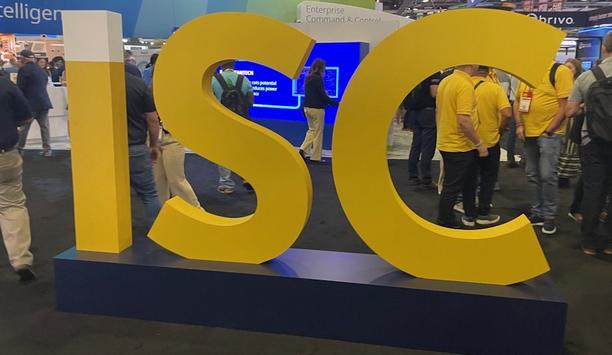
Artificial Intelligence (AI) had a major presence at the ISC West 2026 show in Las Vegas. Almost every booth offered some variation on AI and how intelligence is transforming the physical security industry. Several industry leaders led the way, showcasing how they are tackling complex security challenges with smarter, more efficient solutions. Obviously, the security industry will never be the same. Milestone Systems: Responsible AI and open platforms Milestone has declared 2026 the "year of delivery” on previously announced developments and enhancements. A standout feature is their new natural language AI search, which is being integrated across XProtect, Arcules, and Briefcam platforms to simplify how users interact with vast amounts of video data. A core pillar of their strategy is responsible AI development, which prioritises using licensed data over "scraped" data. They have introduced new anonymisation tools that protect privacy by replacing faces with AI-generated characteristics like hair color while keeping the person unrecognisable. Furthermore, Milestone is moving workloads to Linux to reduce costs, transitioning toward an app marketplace, and has partnered with NVIDIA for the "Hafnia" project to ensure high-quality data to train AI models. Ambarella: Powering the edge with AI chips With their presence at ISC West in a meeting room near the trade show floor, Ambarella is the "engine" behind many high-performance intelligent video products, specialising in low-power AI chips like the N1 and CV7 families. Their technology is moving beyond cameras, where they provide systems-on-chips [SOCs] to many manufacturers. They have expanded into "AI boxes" that can process 64+ video channels simultaneously. A standout feature is the Natural Language technology, which allows users to search for specific objects or abstract scenes using simple prompts. To address modern security concerns, Ambarella has implemented "agentic" programming for a no-code development of automated workflows and media signing to combat AI-generated deepfakes by verifying video integrity through metadata. Motorola Solutions: Simplifying intelligence Motorola Solutions shows physical security evolving into a real-time enterprise intelligence layer Motorola Solutions is prioritising user accessibility by integrating natural language processing into its system configuration. Motorola's portfolio demonstrates how physical security technology is evolving into a real-time operational intelligence layer across the enterprise. Instead of requiring custom coding, operators can now use simple commands—like asking the system to "show me when someone fell down"—to set up advanced analytics and search parameters. The company is also deploying AI agents designed to aggregate data and automatically flag safety or compliance risks, such as perimeter breaches or blocked fire exits. To ensure maximum utility of the hardware, Motorola Solutions’ system can ingest massive, complex physical manuals and automatically generate monitoring rules based on those standard operating procedures. Furthermore, Motorola is focusing on interoperability, using industry-standard interfaces to ingest data from various hardware brands and networks. This approach aims to provide operators with clear, recommended next steps during critical events, streamlining the decision-making process in high-pressure environments. i-PRO: Putting generative AI at the edge i-PRO is bringing generative AI directly to the edge with a new fisheye camera i-PRO is bringing generative AI directly to the edge with a new fisheye camera, which processes complex analytics locally rather than relying solely on the cloud. These cameras, on display at ISC West, have moved beyond simple attribute-based tracking to identify complex behaviors like aggression, fighting, and slip-and-fall incidents. By running on the latest Ambarella chips, i-PRO cameras can use generative AI to improve image quality and analyse scenes in real-time without external processing. This focus on edge-based intelligence ensures high-performance analytics are available even in environments where constant cloud connectivity might be a challenge. Brivo: The rise of agentic AI Brivo and Eagle Eye Networks have officially unified under the Brivo name, focusing on streamlining the experience for large integrators. They are pioneers in agentic AI, introducing features that allow users to talk to their mobile apps to initiate lockdowns or add users. Their Eagle Eye Video Assistant (EEVA) acts as a natural language AI agent that can monitor for specific threats, such as a brandished weapon or a specific vehicle, and automatically trigger access control responses. By treating access and video as a unified system, Brivo enables users to connect specific video skills—like detecting a red car or a brandished weapon—to automated access control actions. They are also using AI to achieve "zero-cost integration," linking disparate cloud systems using AI-generated instructions. Everon: Emphasis on video monitoring Everon is making a massive investment in active video monitoring, using AI-driven systems to deter crime even before it happens. “The market is ripe for it, and customers are demanding it,” says David Charney, Everon’s Sr. Vice President, Video Command Center. Employing virtual guards who can use voice commands, lights, and horns to "shoo away" unauthorised individuals. The company has implemented senior-level leadership that has facilitated more than 5,000 video-based apprehensions. Everon, specialising in integrated systems for multi-site businesses, uses a rigorous selection process to choose AI providers that can accurately filter alerts for specific applications, such as identifying when a fire door is blocked. As a "trusted advisor" to their 300,000 customers, the company focuses on delivering professional-level results that move beyond basic recording to proactive threat mitigation. Hanwha: New hybrid VMS combines cloud and on-prem Hanwha Vision highlighted the official public launch of Blaze, a hybrid video management system (VMS). The platform uses a hybrid architecture to manage on-premise and cloud-connected devices across multiple sites without complex port forwarding. Blaze features native AI capabilities, including semantic search that allows operators to find specific incidents using natural language queries, such as "person with a safety jacket." The AI security platform lets teams search surveillance footage the way they search Google. AI similarity detection allows operators to quickly trace a person’s movement and investigate incidents faster (useful in active shooter behavior, medical emergencies, or crowd panic scenarios, and more). The system also provides a "histogram" view of traffic patterns to help security professionals quickly identify anomalies in historical footage. OpenEye: Operational intelligence and shift to OpEx OpenEye unveiled AI-powered features such as visual chat and scene analysis OpenEye is redefining video surveillance by moving intelligence from the camera level to the cloud, significantly reducing the need for on-site server management. At ISC West, OpenEye introduced new AI-driven tools like visual chat and scene analysis. Beyond security, these tools provide valuable operational alerts, such as identifying overflowing dumpsters, dirty tables in restaurants, or vehicles blocking dock doors. The system also utilises natural language for search, allowing users to find specific attributes like "people wearing backpacks" within designated timeframes. OpenEye also highlighted an industry-wide shift toward operational expenditures (OpEx) billing models, as users increasingly prefer predictable monthly or yearly payments over large upfront capital expenditures (CapEx). This model aligns with their channel-based operations, meeting customers where they currently operate without the burden of high fees. IQSIGHT: New name, same mission for Bosch video Formerly Bosch Video, the newly named IQSIGHT seeks to maintain the “Bosch pedigree” under the new name. It’s the same engineering, manufacturing, etc. IQSIGHT also pledges to be "easier to do business with" by improving user interfaces and end-to-end user experiences. Despite the transition, the company has increased their pace of innovation and reinforced the open systems philosophy with enhanced integrations with Milestone, Genetec, and others. The major product release at the show is IVA Pro Context, which uses generative AI to provide human-level scene understanding. Through a partnership with Laelaps AI, a robotics startup, IQSIGHT is exploring autonomous dispatch and response. When a camera identifies a scene, it triggers a robot to provide a tailored response. Commercialisation is expected in 12 to 18 months. Verkada: How their system can solve a crime But how does AI operate in the real world? Verkada had a “themed” exhibit demonstrating how their system could solve a hypothetical theft at the Louvre museum in Paris. The exhibit took attendees through and showed how Verkada technologies (e.g., license plate recognition and search capabilities) could provide fast results to solve the crime. AI-powered tools, like their newest unified timeline, demonstrate value in the real world of investigations.
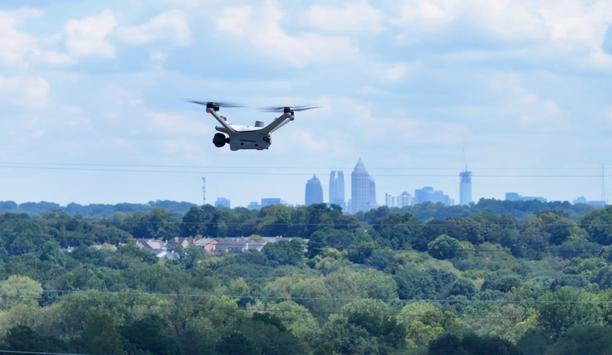
Drones are poised to fill long-standing gaps in physical security. Fixed cameras leave blind spots, and human guards cannot quickly cover large or complex properties during high-risk moments. Drones fill the gaps, providing a missing mobile layer, offering unmatched speed, broad aerial visibility, and proactive coverage that elevates security from reactive to truly responsive and deterrent. As an added element in security systems, drones complement fixed cameras, access control, and licence plate recognition (LPR) systems by serving as dynamic, rapid-response assets that reach areas other technologies cannot. Integrated with existing alarms and sensors, drones can auto-launch on triggers to deliver near-instant, real-time aerial video for accurate threat verification, giving security teams critical information before taking action. Drones as first responders Drones as first responders (DFR) are a new tool in Flock’s suite of security technologies “Drones are a natural fit for physical security because they provide teams with fast, flexible visibility that fixed cameras and human patrols cannot always deliver, especially on large properties,” says Keith Kauffman, Senior Director of DFR Strategy at Flock Safety. Drones as first responders (DFR) are a new tool in Flock’s suite of security technologies, which includes LPR, video surveillance, and gunshot detection systems. “Drones act as a force multiplier, improving coverage without increasing head count,” says Keith Kauffman, adding “Scaling is easy with the ability for one pilot to control multiple drones stationed at multiple locations.” Drones as a force multiplier Drones reduce manpower needs by offering wide-area coverage that would normally require several guards or patrol vehicles. Drones boost security team productivity and safety by automating the most dangerous and tedious tasks, such as alarm verification. Acting as a first responder, a drone can clear a significant portion of false alarms, allowing human guards to concentrate on high-priority roles, complex issues, or confirmed intrusions with real-time aerial intelligence. This improves personnel deployment and cuts down workload, risk, and costly overtime. Drones also significantly improve efficiency and safety for security personnel, says Kauffman. A drone system delivers real-time aerial intelligence in seconds, enabling guards to respond wisely and safely. Initial threat verification Some drone systems' yearly costs are similar to a single mid-level guard's salary Some drone systems' yearly costs are similar to a single mid-level guard's salary, but they can cover up to 38 square miles. This investment provides ROI by reducing large-scale losses and allowing human guards to focus on high-touch roles, while the drone handles initial threat verification. Flock Safety entered the drone space after acquiring Aerodome DFR in October 2024, with their private-sector drone as automated security (DAS) system rolling out in Q3 2025. And because the drones plug directly into FlockOS and work alongside other tools like licence plate recognition (LPR) and gunshot detection, they can launch automatically on alerts, creating a smarter, faster response workflow. Immediate intelligence to combat false alarms Drones fundamentally change false alarm management by providing security teams with immediate, real-time aerial intelligence. When an alarm triggers, the drone can be dispatched to the exact location in seconds, allowing operators to verify instantly the threat's legitimacy via a live HD or thermal video feed. This capability enables staff to safely clear or ignore false alarms remotely, preventing guards from wasting time and resources on unnecessary, lengthy, or potentially dangerous physical checks. This process can significantly reduce alarm fatigue and allow personnel to reallocate their time to genuine security threats. Emerging drone use cases enhance security operations Emerging drone use cases enhance security operations by integrating with existing systems and enabling novel applications. One key area is Post-Storm Damage Assessment, where drones provide rapid, safe aerial visuals of expansive sites, documenting damage for insurance claims far faster than ground inspections. Another area is Ecosystem Integration via platforms such as FlockOS, where the drone automatically launches in response to alerts from other security sensors (LPR, gunshot detection). This creates a powerful, automated workflow that unifies responses, enabling quicker incident interruption, better evidence capture, and a proactive security posture without increasing the number of human patrol staff. Evolving regulations expanding drone usage Evolving FAA regulations and corporate airspace policies impact the usage of drones Evolving Federal Aviation Administration (FAA) regulations and corporate airspace policies impact the usage of drones. Today, operating drones beyond the visual line of sight (BVLOS), at night, and over-people/roadway operations requires special FAA waivers. However, the trend — Remote ID, expanded FAA Part 107 allowances, and growing BVLOS exemptions proven in drones as first responders (DFR) — reduces overhead and allows more automation. Combined with enterprise standard operating procedures (SOPs), geofencing, and data governance, drone adopters can standardise flights, minimise risk, and integrate with other technologies. “In practice, that means automated dock-based dispatch on verified alerts, scheduled perimeter sweeps, and incident-to-incident coverage without on-site pilots,” says Kauffman. “The results are faster detection-to-dispatch, stronger evidentiary chains, and lower costs per incident — unlocking 24/7 remote operations across campuses, logistics, and sites.” Winning over public acceptance Public perception plays an important role in how communities embrace drone technology, which is why transparency and clear policy are essential. When employees and community members understand the drone’s purpose — responding to alarms, patrolling after hours, and deterring crime — they tend to view it much as they do security cameras or access control: a safety tool, not surveillance. Flock’s system is event-driven, privacy-minded, and used only by authorised personnel, and every flight is logged, documented, and fully audit-traceable for accountability. “With clear communication and responsible use, drones become a reassuring layer of protection rather than a cause for concern,” says Kauffman. Drones are extremely safe, actually reducing human risk by acting as a first responder to scout ahead of personnel. They come with layers of protection, such as geofencing, obstacle avoidance, precision landing, autonomous deconfliction with aircraft, and automated safety modes. Smartest approach For security teams considering adding drones, the smartest approach is to choose a system built specifically for 24/7 security operations. That usually means the drone provider handles FAA paperwork, writes clear procedures, develops sound policy, and trains customers’ staff so everything runs smoothly. “With the right partner, drones become a safe, compliant, and incredibly helpful part of your security toolkit,” says Kauffman. Flock ramps up drone production Flock Safety’s immediate focus is ramping production of its U.S.-designed and assembled Flock Alpha hardware, which is already NDAA-compliant and built to meet the growing demand for American-made drone solutions. At the same time, the next six to 12 months will centre on releasing key software updates, such as automated scheduled patrols. Together, increased hardware production and these software advancements will move the DAS product line toward full capability and broader commercial availability. Flock DAS Flock DAS essentially provides a guard’s vantage point from above, with the ability to instantly fly to any corner of a property. “And it doesn’t sleep on duty or call in sick,” says Kauffman. “Picture your traditional security measures: cameras are your static sentries; guards are your roaming patrollers. Now add Flock DAS: it’s your mobile, flying camera that can respond anywhere, anytime.” Just as a dispatcher coordinates police calls, Flock DAS serves as an aerial dispatcher for the security team, triaging alerts and providing eyes on the scene before anyone sets foot into potential danger. It gives the security team immediate, property-wide awareness so they can make safer, more informed decisions during any incident.

The speed, scale and sophistication of today's safety threats can outpace human capacity to keep up. The implementation of artificial intelligence (AI) is essential to keep people safer and must be designed and deployed transparently. The complexity of today’s AI applications is expanding in physical security, with more AI models leveraging data to tune performance and using third-party application programming interfaces (APIs). In this context, it can be difficult to find clear, consolidated, transparent information about AI’s use in enterprise security technologies. How AI is used across the company’s technologies Motorola Solutions is taking a layered approach to help users easily understand how AI is used Motorola Solutions is taking a layered approach to help users easily understand how AI is used across the company’s technologies, starting at a high level with AI labels affixed to products, and getting more granular with structured information about AI testing, assessments and more. “We are aiming to provide clarity to the user and those they help protect to increase trust and transparency in AI innovation,” says Hamish Dobson, Corporate Vice President, Avigilon and Pelco Products, Motorola Solutions. Importance of AI transparency The AI labels, which have been compared to nutrition labels used on consumer products, are designed to be clear and easy-to-read at a glance. Each label explains the type of AI used, who owns the data processed, human controls, and the purpose behind the product’s specific application of AI. AI labels are comparable to nutrition labels used on consumer products. “We regularly seek input from external stakeholders – including customers, partners, consultants, investors, policymakers, and community members – on many aspects of our business,” says Dobson. “We briefed select customers and industry groups on our AI labels initiative and received positive feedback.” He continues: “Like us, customers and industry groups understand the importance of AI transparency and are looking for ways to clarify AI usage in public safety and enterprise security.” AI transparency efforts AI transparency efforts have taken on a variety of forms such as model cards, transparency notes Across industry, AI transparency efforts have taken on a variety of forms such as model cards, transparency notes and, in Motorola’s case, AI labels. The company pledges to continue to engage with industry participants on efforts to advance the overall pace, adoption, and maturity of responsible innovation initiatives across the industry, says Dobson. The AI labels help to increase dialogue and understanding of AI’s use in the security technologies that help to keep people safer. Motorola Solutions is looking to inform customers about how AI is being used to automate mundane tasks and prioritise information that may be critical to performing their roles. Motorola’s L6Q licence plate recognition For example, a business using Motorola’s L6Q licence plate recognition camera in its parking lot could view the AI label and see that AI is used to help recognise licence plate characteristics of vehicles within its view. The label would also help the customer understand that they maintain ownership and control of the data AI can process and can determine the data retention period. The label would also help the customer understand that they maintain ownership. What type of AI is being used AI outputs should have human oversight, and a user should understand the sources of data “By providing knowledge of where and what type of AI is being used, our customers can better understand what they are deploying, configure settings appropriately and inform their constituents,” says Dobson. AI-assisted experiences should be designed to be accountable and transparent, according to Motorola Solutions. AI outputs should have human oversight, and a user should understand the sources of data from which suggestions were drawn. AI labels highlight that the data AI can access is customer-owned and controlled, helping to increase confidence that AI outputs are based on that customer's specific data. Responsible and ethical use of technologies The AI label’s “first or third party model” section explains the source of the AI model. A first-party model is developed in-house by Motorola Solutions. A third-party model is developed outside of Motorola Solutions and made available by a third-party vendor; however, it may be customised by Motorola Solutions. MTAC is a multidisciplinary group that advises the company on the reliable and ethical use of technologies “This section aims to foster dialogue with our customers around Motorola Solutions’ role in testing, training, and refining the AI model or models used in our products,” says Dobson. Helping to propel the AI Label initiative, the Motorola Solutions Technology Advisory Committee (MTAC) is a multidisciplinary group that advises the company on the responsible and ethical use of technologies, including data and AI. Industry trends in technology’s responsible design MTAC continuously explores new ways to enhance trust with customers and the communities they serve, while helping to keep Motorola Solutions a step ahead of industry trends in technology’s responsible design, development, and use, according to the company. The MTAC “Blueprint” sets out the core principles that drive the approach. “We’re excited by the opportunity to continue to lead in this area through additional innovation, thought leadership, and stakeholder engagement,” says Dobson. Human-centered design New capabilities specifically augment human skills and capacity with the goal of helping humans Rather than replacing human decision-making, AI technologies will, in fact, augment it. Human-centered design is a core principle of the responsible technology “Blueprint” Motorola Solutions is developing. New capabilities specifically augment human skills and capacity with the goal of helping humans spend time on what matters most during a safety or security incident, applying their unique judgement, knowledge, and oversight in high-stakes environments. AI’s recommendations “We purposefully deploy AI to augment human focus, effort and performance,” says Dobson. “We design AI to maximise human strengths like judgement and reasoning and to adapt to changing roles, tasks, risk levels, and cognitive states while keeping AI outputs traceable and transparent, whereby the user can easily see, check and override AI’s recommendations.”
Case studies
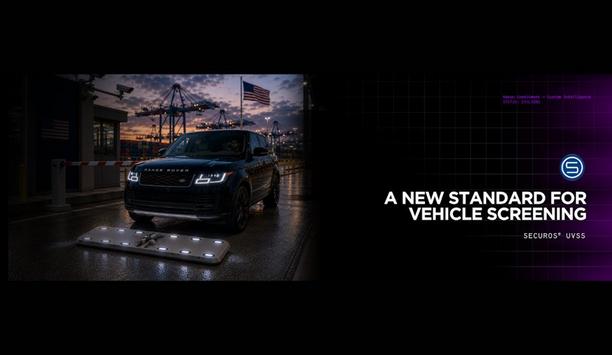
New York City’s vast public transportation network is the lifeblood of the region, serving millions of residents and visitors daily. To maintain and improve the daily commutes of riders across the system, a steady stream of innovation is required. The Transit Tech Lab, a public-private partnership created by the Metropolitan Transportation Authority (MTA) and the Partnership Fund for New York City, was established to accelerate the adoption of emerging technologies across the city’s transit systems. This initiative seeks to solve pressing challenges related to resilience, customer experience, and security. Increased operational costs For its highly competitive program, the Transit Tech Lab received 150 applications from companies around the globe. Only 18 were chosen as finalists to proceed to an eight-week proof-of-concept phase. Among this select group was Intelligent Security Systems (ISS), which was tasked with demonstrating how its technology could enhance security operations for key transit agencies, including the Port Authority of New York and New Jersey. The Challenge: Modernising Outdated Vehicle Screening Processes - Charged with protecting the city’s vital transportation hubs, the Port Authority was seeking a solution that could help them automate the vehicle screening process at one of the sites under their purview. Traditional methods of under-vehicle inspection — often involving manual checks with pole-mounted mirrors or bomb-sniffing canine units — can be slow, labour-intensive, and subject to human error or fatigue. These methods can also lead to bottlenecks, increased operational costs, and may not always provide the consistent, high-level scrutiny required. Vehicle screening challenges The Port Authority needed a solution that could not only detect potential threats with greater accuracy but also streamline the entire screening process, reducing congestion and improving operational efficiency without compromising safety. The goal was to find a technology that could provide fast, reliable, and detailed inspections while integrating into the existing security framework. “Being selected for the Transit Tech Lab initiative is a tremendous honour and a testament to our commitment to innovation and excellence,” said ISS CEO Aluisio Figueiredo. “This opportunity allowed us to demonstrate how our groundbreaking video intelligence solutions can address the unique vehicle screening challenges faced by high-security sites, enhancing both security and operational efficiency.” Automated visual inspection The Solution: Advanced Undercarriage Inspection with SecurOS® UVSS - To address these challenges, ISS proposed its SecurOS® UVSS (Under Vehicle Surveillance System) solution. For over two decades, ISS has been a pioneer in video intelligence and data awareness, holding over 30 patents and trademarks. With a global presence and a robust R&D team of over 200 engineers, ISS develops next-generation video analytics that solve complex security problems. The SecurOS® UVSS is a complete, enterprise-level solution for the automated visual inspection of vehicle undercarriages. It is designed to screen for explosives, illegal contraband, dangerous objects, and structural anomalies. The system consists of a rugged, IP68-rated scanning platform deployed on the roadway along with a powerful processing controller. Powerful processing controller As a vehicle drives over the platform, a high-resolution, area-scan machine vision camera captures detailed images of its undercarriage. The system can effectively scan vehicles moving at speeds up to 22 mph and even handles complete stops, ensuring image quality is never compromised. Patented de-warping technology corrects distortion and stitches together a complete, high-definition composite image in as little as three seconds, while the UVSS’ foreign object detection system automatically flags anomalies in the undercarriage that could pose a security risk. This image is then displayed for the operator on a user-friendly interface, alongside data from other native systems, including license plate recognition (LPR) software and optional driver-facing cameras. Forensic investigations and compliance This automated process offers significant advantages over manual inspections: Speed and Efficiency: A scan takes mere seconds, drastically reducing vehicle processing times and preventing congestion at checkpoints. Accuracy and Detail: The high-resolution camera captures clear images, allowing operators to spot anomalies that might be missed by the naked eye or a mirror. The system’s 3D-magnifier view enables detailed examination of suspicious areas, while foreign object detection highlights potential threats automatically. Consistency: The UVSS solution provides reliable, 24/7 performance, unaffected by human factors like fatigue or distraction. Data Integration: Each undercarriage image along with the respective vehicle’s colour, class, make and, model is saved and linked with license plate data, time of entry, and even the driver’s face (with optional cameras). This creates a comprehensive, searchable audit trail for forensic investigations and compliance. Simplified Installation: The UVSS does not require heavy construction to deploy and is available in several different models. An optional UVSS cleaning system that uses a dual air-fluid cleaning process to remove things like dirt, snow or ice ensures that system remains in optimal working condition, even in dusty or debris-prone environments. Average checkpoint passage times The Results: A Successful Pilot for the Port Authority - Beginning in May 2024 as part of the Transit Tech Lab’s proof-of-concept phase, the SecurOS® UVSS was used to scan the undercarriages of over 2,000 vehicles over a three-week period at the aforementioned site. The primary goal was to demonstrate how the technology could improve the existing screening process for vehicles entering the location. The results were immediate and impactful. The UVSS was integrated with the Port Authority’s security databases, helping to increase efficiencies in standard vehicle screening processes. The system provided real-time data on vehicle types, traffic flow, and average checkpoint passage times, giving the Port Authority valuable insights into its operations. Additionally, the UVSS cleaning system ensured the unit provided clear and accurate images regardless of the operating conditions. Vehicle security screening operation A senior engineer for major capital projects with the Port Authority noted the value of the pilot, stating, “ISS’ technology complemented our vehicle security screening operation, and the real-time data helped improve the visibility of several unknown everyday processing details that are super useful and present an efficiency opportunity.” The success of the initial trial led to ISS being selected to advance to the large-scale pilot phase of the initiative, further cementing the value of its technology. The application at the Port Authority site is one of many high-profile deployments for the SecurOS® UVSS. The system is trusted by governments, military organisations, and corporate enterprises around the world to protect critical infrastructure, airports, border crossings, state institutions, and public venues, like stadiums and arenas. Its proven reliability and advanced capabilities have made it a global standard for under-vehicle inspections. Robust vehicle screening process By automating the inspection process, the Port Authority was able to achieve a significantly higher level of threat detection and dramatically improve the overall efficiency of its checkpoints. The rich data provided by the UVSS has also proven instrumental in informing the Port Authority on the types of operational improvements that are needed to ensure a robust vehicle screening process at its secure facilities moving forward. “The challenge of securing a facility of this magnitude requires technology that is not only powerful but also intelligent and adaptable,” added Figueiredo. “The SecurOS® UVSS provides a scalable, integrated solution that transforms vehicle inspection from a manual chore into a streamlined, data-driven process, setting a new standard for modern security operations.”

Genetec Inc., the global pioneer in enterprise physical security software, announces that SoFi Stadium and Hollywood Park have unified their physical security operations using Genetec™ Security Center. Home to the Los Angeles Rams and Los Angeles Chargers, SoFi Stadium is the premier sports and entertainment destination located at Hollywood Park. The stadium has established itself as a world-class venue, hosting record-breaking concerts and global sporting events while consistently ranking among the top venues in the world. Global sporting events To support events of this scale, the organisation standardised on Security Center to unify video surveillance, access control, automatic license plate recognition (ALPR), and other physical security systems in the 3.1 million-square-foot venue and across the 300-acre Hollywood Park development. Operators manage more than 3,000 cameras, 700 readers, and numerous other systems and sensors from three security control rooms, helping teams maintain situational awareness while streamlining day-to-day operations. "Genetec Security Center has improved our response time efficiency by giving us all the information we need in one platform. We’re able to understand what's happening and make decisions quickly," said Nick Bermensolo, Vice President of Security and Safety at SoFi Stadium and Hollywood Park. Physical security systems Since deploying Security Center, the SoFi Stadium IT team has a reliable, scalable, and cybersecure platform that runs on an isolated network and connects back to centralised servers. During big events, they support security operations by monitoring system performance from the Network Operations Center, ensuring everything is working as it should. The security team can easily handle daily tasks, while IT keeps systems running smoothly on the backend. "The Genetec team doesn’t just understand physical security systems, but IT systems too. With their help, we’ve been able to deploy a reliable and high-performing security platform at scale," said Paul Maldonado, Vice President of IT Infrastructure and Operations at SoFi Stadium and Hollywood Park. AI-based tools Looking ahead, both teams are focused on getting more value out of Security Center, exploring AI-based tools and more automation. They know they have a flexible, scalable platform that can support evolving cybersecurity and network requirements. "Genetec has really helped us establish a technology standard. Security Center is reliable and cybersecure, integrates well with our network, and reduces overhead for both IT and security. That’s the type of technology we want to continue implementing across our business," said Maldonado.

Genetec Inc., the pioneer in enterprise physical security software, announces that the Fort Lee Police Department (FLPD) in New Jersey has modernised its city-wide public safety operations using Genetec™ Security Center, including video management, automatic license plate recognition (ALPR), and Clearance™ digital evidence management. Located at the foot of the George Washington Bridge, the borough of Fort Lee sees more than 300,000 vehicles cross into and out of Manhattan each day. The constant flow of traffic creates unique public safety challenges, including transient crime and time-sensitive incidents. To stay proactive, FLPD adopted an open, IP-based system designed to support fast response and seamless collaboration. IP-based system Years ago, FLPD implemented Genetec video management, unified with Security Center, to manage its growing network of cameras. Today, the department oversees more than 200 cameras across the borough. Using the Federation™ feature in Security Center, FLPD connects video systems from schools and a parking garage into its city-wide deployment, giving dispatchers and officers a broader operational view. To support vehicle-related investigations, the department deployed ALPR. When incidents occur, dispatchers can quickly access video and ALPR data from an interactive city map and relay intelligence to responding officers in real time. Managing digital evidence “With Genetec solutions, our dispatchers and officers are empowered to handle any situation quickly and effectively. We’ve seen huge efficiency gains across our operations,” said Captain Thomas Porto of the Fort Lee Police Department. For investigations, detectives centralise and manage digital evidence using Clearance. Video, interview recordings, and vehicle data are organised into case files that can be securely shared with authorised stakeholders. Broader operational view “Before, requesting video from witnesses or businesses was a challenge. Now, we can email a secure link, and the witness or business can upload the files. It automatically gets logged in the right case file. And since Clearance supports many different video codecs, we can view the video right away,” said Captain Porto. With a unified system in place, FLPD continues to expand its public safety initiatives at a pace that aligns with operational priorities and budget considerations. “We have a solid platform to keep expanding our city-wide initiatives, empowering our officers, and protecting the community we serve,” concluded Captain Porto.

Busy urban parking lots often need more than simple entry and exit booths. In Manila, one parking lot operator has discovered that Hikvision’s smart parking solution can transform the way they operate, collect revenue, and plan for growth. The challenge: manual processes and growing congestion In a business district in the Philippines capital, Manila, Professional Parking Management Corp (Pro-Parking) operates a public parking facility with space for 58 cars and 180 motorcycles. It’s an important site in the neighbourhood, playing a vital role in supporting nearby offices and commercial establishments. In recent years, as traffic volumes have steadily increased, the limitations of its single entrance and exit booth had become increasingly clear. Congestion had become a real problem, especially during busy periods when vehicles would frequently be forced to queue up along the road in order to get in. So, Pro-Parking decided to modernise its operations. Creating a parking environment Its vision was to create a parking environment that fully aligned with modern digital standards, to deliver a faster entrance and exit experience for drivers and which was easier to manage by staff. To achieve this, they wanted to introduce a system which would improve compliance and reporting accuracy by using registered Point of Sale (POS) capabilities. This would be more efficient as it would eliminate the need for manual receipt writing and double validation. They also wanted to find a solution that would help them improve the strategic management of the parking lot by giving them greater visibility of traffic patterns, revenue, and lane performance. Hikvision’s smart parking solution The company has used Hikvision’s smart parking system to meet all of these objectives. This is a fully integrated solution which enhances and optimises everything from vehicle flow to payment processing and centralised management. At the entrance and exit, two Hikvision All-in-One E&E Machines (DS-TMC407-EHR/3m fence/R/TCG400) serve as the primary access control points. Each of these is supported by a Trigger Radar and Anti-Fall Radar (DS-TMG034) for precise vehicle detection. Together, these units handle the full entry sequence automatically. They capture the vehicle license plate, issue a parking ticket, log the entry time, and raise the barrier. License plate recognition Because the high-speed barrier gate is designed to rise quickly and lower gradually, the solution ensures a steady flow of traffic even during peak periods. The 4MP ANPR camera, meanwhile, ensures clear license plate recognition even at night, supported by smart LED lighting that adjusts based on brightness conditions. What’s more, each E&E machine includes a 21.5-inch LCD display which can show advertisements or operational announcements. Built-in two-way audio allows drivers to speak directly with operators when they need assistance. Generating comprehensive reports For payment, an Automatic Payment Machine (DS-TPP427) is installed at the site office via a through-the-wall setup. Drivers insert their ticket, the machine computes the applicable fee, accepts payment in cards, bills, or coins, and updates the central system in real time. Rounding out the payment flow are an Entrance Ticket Station (DS-TMT201-D(LCD)) and an Exit Ticket Station (DS-TMT202-D(LCD)), the latter of which verifies paid status and cross-checks ticket data against captured plate information before allowing the vehicle to exit. All devices are unified under the HikCentral Professional platform. This enables the operations team to monitor vehicle activity, review entry and exit logs, handle exceptions and generate comprehensive reports—all from a single dashboard. Daily revenue summaries, peak-hour analytics, and sophisticated traffic flow reports are now accessible with just a few clicks. Smarter operations have improved revenue by 25% The benefits of the new system have not only been significant, but they were felt immediately. Entry and exit processing times have been reduced by between 30% and 50% during peak hours. Queue lengths are noticeably shorter, especially during busy periods. With payments settled at the central machine, congestion at the exit lane has been significantly minimised, improving both traffic flow and overall customer satisfaction. Operationally, the shift to centralised payment and automated validation has reduced manual intervention at both payment and exit points. Revenue reconciliation is faster and more accurate, supported by system-generated reports. Perhaps the most significant benefit, however, is that since the solution went live and thanks to improved enforcement rates and enhanced transaction transparency, monthly revenues have increased by roughly 25%. Key management information The system has also met the need to improve the strategic management of the parking lot by transforming the visibility of key management information. Traffic patterns, for example, are now backed by firm data rather than estimates, and the company can plan expansions and operational adjustments based on solid analytics. Darwin Pasco, Chief Transformation Officer at Pro-Parking, summed it up this way: "Before deploying the Hikvision solution, our operations were largely manual and dependent on people. Now, however, we have structured workflows, centralised control, and far better visibility into our revenue and traffic. The new system has enabled us to move from reactive operations to controlled, data-driven management." Digital transformation in parking management This implementation, then, is far more than a technology upgrade and represents a strategic step toward digital transformation in parking management. That’s why, with Hikvision’s smart parking solution as its foundation, Professional Parking Management Corp now plans to expand the deployment across additional sites that it operates, building toward a fully connected, data-driven parking network. Key benefits: 25% increase in monthly revenue 30–50% faster vehicle processing during peak hours Reduced congestion and shorter queues Improved operational efficiency and reporting accuracy

Artificial Intelligence Technology Solutions, Inc., a pioneer in AI-driven security and productivity solutions, along with its wholly owned subsidiary, Robotic Assistance Devices, Inc. (RAD), announced that it has received an order for ten ROSA™ units bundled with ten SARA™ (Speaking Autonomous Responsive Agent) licences for deployment inside a major sports venue in the United States. The new installations will support the arena’s security team with enhanced monitoring, rapid event detection and autonomous voice-driven response throughout interior zones. Evaluating modern security technologies The arena had been evaluating modern security technologies to address persistent trespassing, vandalism and other unauthorised activity across its interior spaces. This order follows a series of assessments in which RAD solutions demonstrated clear advantages in autonomous detection, operator support and rapid on-site response. The venue is also reviewing additional RAD offerings for broader facility coverage, including ROAMEO™ and RIO™ units for expanded indoor and outdoor protection. How venues can strengthen security “This is an ideal application for ROSA paired with SARA,” said Mark Folmer, CPP, PSP, President of RAD. “These deployments show how venues can strengthen security, improve response times and reduce operating costs with a solution that works around the clock without added staffing.” SARA’s real-time detections ROSA units equipped with SARA, the Company’s multiple award-winning agentic AI platform, will provide continuous event detection, verification and automated voice response, giving on-site staff and remote operators clearer insight into activity across the arena. SARA’s real-time detections and notifications help reduce operator workload, improve situational awareness and ensure that critical events receive immediate attention. This combination allows security teams to focus on higher-value tasks while maintaining consistent coverage. ROSA’s AI-driven security analytics ROSA is a multiple award-winning, compact, self-contained, portable, security and communication solution that can be installed and activated in about 15 minutes. ROSA’s AI-driven security analytics include human, firearm, vehicle detection, licence plate recognition, responsive digital signage and audio messaging, and complete integration with RAD’s software suite notification and autonomous response library. Two-way communication is optimised for cellular, including live video from ROSA’s high-resolution, full-color, always-on cameras. RAD has published seven Case Studies detailing how ROSA has helped eliminate instances of theft, trespassing and loitering at mobile home parks, retail centres, hospital campuses, multi-family communities, car rental locations and construction sites across the country.
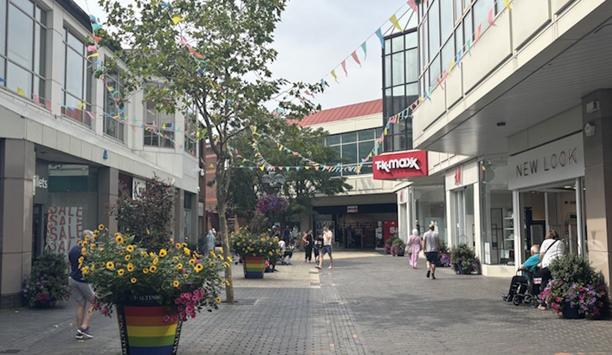
Amthal has delivered a complete security upgrade at The Maltings Shopping Centre, building on a partnership of more than three decades to transform the way the centre is monitored and managed. In supporting The Maltings since 2013 and taking on full management in 2017 Amthal could ensure the system remained effective through a dedicated maintenance programme until the time came for a complete upgrade. Integrated with the barrier system The new solution introduces 39 state-of-the-art Dahua cameras, including PTZ, 180-degree and AI-powered people-counting models, to provide full coverage across all seven entrances and car parks. Automatic number plate recognition has been integrated with the barrier system to improve vehicle access control, while people-counting technology now delivers reliable visitor data to track peaks and troughs. Active deterrent measures and signage strengthen site protection, supported by EMCS Sentry software to continuously monitor hardware performance and camera availability. Secure on-premises storage ensures all data remains under the centre’s direct control. Redesigned digital control desk Says Richard Marrett, Centre Director at The Maltings: “The new systems have changed the way we manage the centre. The cameras and control desk give us clearer oversight and together with features like people counting and vehicle access ensures we can identify incidents, respond quickly and review activity with confidence. Behind it all is the trust we have in Amthal, built over three decades of working together to keep The Maltings safe and welcoming.” A redesigned digital control desk now brings all live feeds, recordings and analytics together on a single platform, giving the security team clearer visuals and wider oversight than ever before. These features provide greater efficiency, faster response times and stronger protection. Management and security teams All installation work was carried out while the centre remained fully open. Amthal partnered with Dahua together with the management and security teams to plan the schedule so that tenants, staff and shoppers experienced no disruption. Kris Hallett, Business Development Director at Dahua Technology UK, added: “The upgraded cameras now capture detail even in low light, and features like auto-tracking reduce the need for constant manual monitoring. People-counting sensors give the team reliable data across key areas, while number plate recognition integrated with the car park barrier has streamlined vehicle access and reduced misuse." "All can be accessed at any time, even remotely. Working alongside Amthal, we were able to introduce all of this without disruption to the centre’s daily operations.” New requirements and advances in security technology The original system was first installed in 1995, marking the beginning of a long-term relationship that has seen Amthal support The Maltings in adapting to new requirements and advances in security technology. Paul Rosenthal, Amthal Group Business Development Director, concluded: “Our established partnership with The Maltings demonstrates how we work with clients over the long term. This complete upgrade with latest Dahua technology has delivered an integrated system that is straightforward for the team to use and manage via the new control centre. It ensures the centre remains safe, accessible and an enjoyable experience with complete peace of mind for tenants and shoppers alike.”
Products
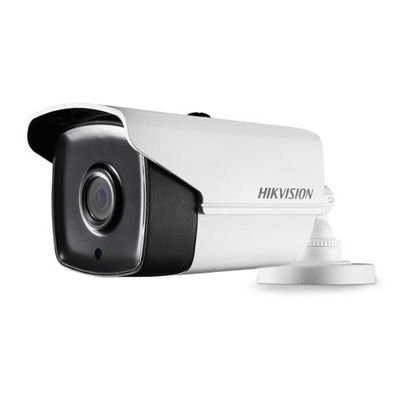

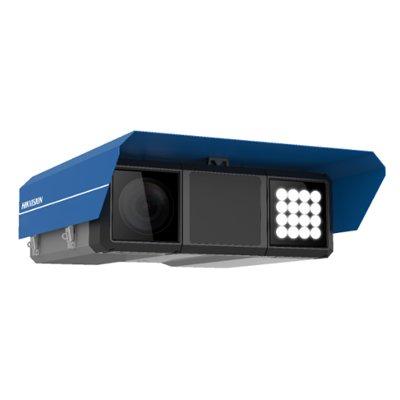


Round table discussion

As cutting-edge trends go, convergence has been around for at least two decades. The meaning has shifted over the years, and if anything, the idea of convergence has gotten even more aspirational. Unfortunately, the widespread use of the term has also paradoxically undermined its meaning and power. However, today's concept of convergence has matured to provide new levels of benefit for security professionals. We asked our Expert Panel Roundtable: How has the meaning of “convergence” evolved in the security market? How are systems today more converged than ever?
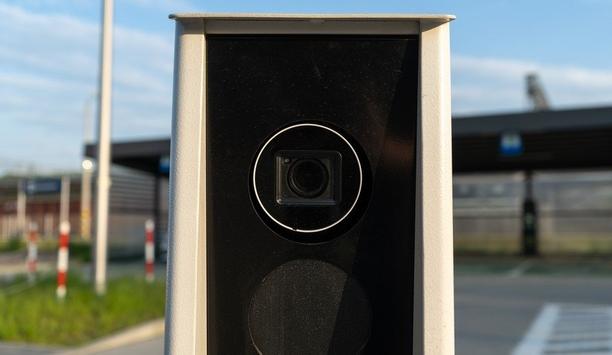
In the United States, they are called licence plate recognition (LPR) systems. In Europe, the more common term is automated licence number-plate recognition (ANPR). In either case, the systems provide capabilities that can benefit a range of applications from schools to municipalities to parking lots. Newer technologies can even identify vehicle colour, type, make and model. We asked this week’s Expert Panel Roundtable: What's new with licence plate recognition (LPR) and/or automated number-plate recognition (ANPR) systems?

As physical security technologies become more complex, it is incumbent on the dealer/integrator to have the skills and expertise needed to ensure that a system operates smoothly. The value of integrators increasingly rests on the skill sets they bring to bear when installing a system. If the skills are missing, there is a problem. We asked this week’s Expert Panel Roundtable: What missing skills among security integrators can cause problems for customers?

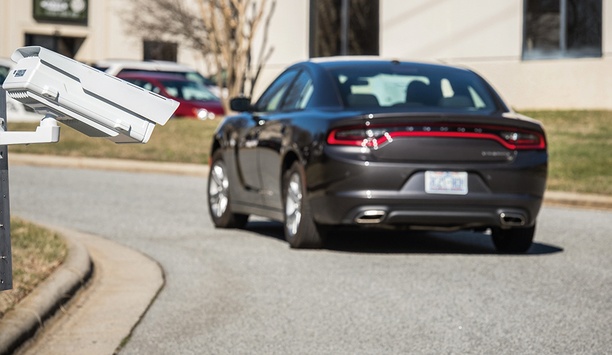
Videos


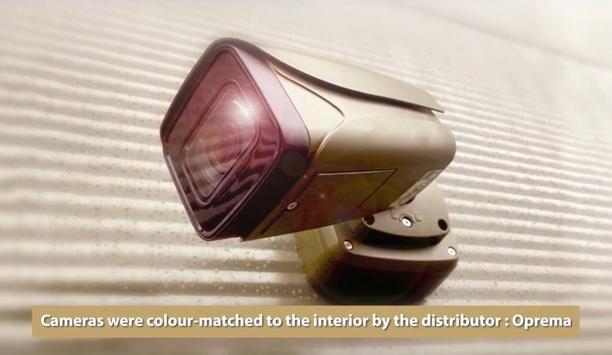
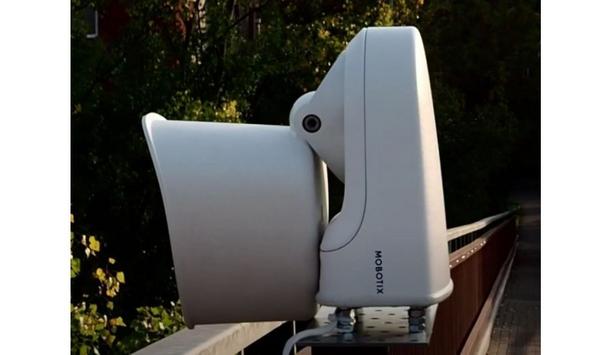
License plate recognition: Manufacturers & Suppliers

Security technologies promote real-time awareness in K-12 schools
Download
Technology's role in securing banks and financial institutions
Download
Integrated systems enable critical and compliant security for transportation
Download
Modernising physical access control
Download
Access. Intrusion. One estate.
Download