SRI International - Experts & Thought Leaders


Latest SRI International news & announcements

Virtual Security Showcase, the professional security industry’s first online multi-vendor educational tradeshow experience established in 2020, announces the launch of VSS Tech Talks, a series of monthly panel presentations featuring recognised industry experts from major security solution providers. The panel discussions will address the latest technology trends for specific vertical market applications including higher education, safe cities, cannabis, corporate campuses, healthcare, and data centres. VSS Tech Talk panelists The first VSS Tech Talk, Taking Higher Ed to a Higher Level of Safety, Security, and Efficiency, is scheduled for June 29th from 2-3 PM EST. Panelists include: Ronnie Pennington, Director of Sales for the Americas, Altronix John Centofanti, VP of Sales, Axxonsoft Tim Purpura, VP of Global Sales and Marketing, Morse Watchmans Karen Evans, CEO, Sielox Kyle Elliott, VP of Sales, Vector Flow Bud Broomhead, CEO, Viakoo This panel of experienced industry experts will be discussing a wide range of topics, challenges, and insights of interest to end users, systems integrators, and consultants focusing on how trending technology solutions are being applied at colleges and universities to enhance security and operations.

Princeton Identity Inc. is formerly a line of business of SRI International, marketed under the SRI Identity brand Princeton Identity Inc., an innovator in biometric technologies, announces that the company has been selected to receive the Outstanding Technology Development Company Award for 2016 by the New Jersey Tech Council. Outstanding Technology Development Award “New Jersey ranks in the top 5 States for innovation according to the 2016 Bloomberg Innovation Index, so we know we were up against very formidable competition,” said Mark Clifton, CEO, Princeton Identity. “We are thrilled with being named Outstanding Technology Development Company and with it, the recognition given our biometric technology and our goal of bringing innovative technology to the marketplace.” The Tech Council’s 20th annual Awards Celebration, scheduled for November 17, 2016 in Somerset, NJ, recognises and celebrates this year’s honourees for their accomplishments in leadership, collaboration and innovation. The NJ Tech Council is a non-profit membership organisation that provides business support, networking opportunities, education, advocacy, and recognition of tech and life science companies located in the State. Biometric technologies continue to gain traction as the best approach for addressing today’s security challenges – from unlocking smartphones to managing facility access. Iris recognition in particular is known to be a more stable and accurate identifier than other available technologies; it is many orders of magnitude more accurate than fingerprint readers and has lower error rates. Building legacy Princeton Identity Inc. is formerly a line of business of SRI International, marketed under the SRI Identity brand. Under its new name, it continues to build on SRI’s successful legacy of delivering leading-edge biometric technologies for a wide range of government and commercial applications, as well as for mainstream physical identity access management (PIAM) applications. Princeton Identity products include both biometric identity readers and software systems to manage identities and authenticate users. By integrating these products into other systems, such as access control and medical billing systems, organisations can gain security and accuracy improvements with positive operational impacts. Princeton Identity biometric readers are already being deployed for building access, data centres, sports facilities, construction sites, airports, and border crossings. New products in development will address sensitive information access, continuous user authentication, smart home initiatives, Internet of Things (IoT) and more. Save

By replacing multiple devices, the new tablet delivers real savings now, and provides for future enhancements Princeton Identity, recently spun off from SRI International, will be demonstrating its IOM Access Control Tablet for mainstream access control applications at ASIS 2016 (booth #3829). The tablet fuses an access-control reader, biometrics, keypad, intercom, camera and other capabilities into a single cost-effective package for maximum value and functionality. The tablet is part of the Princeton Identity portfolio of Identity on the Move™ (IOM) solutions that enable greater ease of use, security and personalisation for physical and logical access control, workforce management, enterprise operations and emerging applications within the Internet of Things. Additional functionality Built on a scalable Android® computing platform, the IOM Access Control Tablet provides additional functionality beyond its access control functions such as time and attendance, two-way video communications, employee alerts and scheduling without additional equipment. Installation and support are simplified with a single device. With its ability to replace multiple devices, the new tablet delivers real savings now, and provides for future enhancements. “Our IOM Access Control Tablet brings the convenience and capabilities of iris recognition technology to mainstream access control applications,” said Mark Clifton, Chief Executive Officer, Princeton Identity, Inc. “It provides the gold standard of biometric identification—iris reader technology—at a price point that is highly competitive for a broad range of security applications. With iris recognition now gaining ground in consumer devices, there is a growing familiarity and acceptance among user populations for the use of iris recognition in security systems.” Replacing card readers The IOM Access Control Tablet is a viable option to replace card readers in new or existing access systems, and provides advantages over traditional readers. Reducing organisational risk without slowing down operations, tests have shown this purely iris-based solution to be more accurate than published fingerprint data. Unlike less secure biometric modalities and security protocols, irises cannot be lost or stolen. As a security solution that combines previously disparate functions, the IOM Access Control Tablet reduces complexity and costs of equipment, installation and wiring. Save
Insights & Opinions from thought leaders at SRI International

Accurately confirming a person’s identity is one key to improving security forour workplaces, communities, and our nation Perhaps I’m sensitised to the term, but it seems to me that I’m hearing the word “identity” a lot lately. Identity comes up in current news stories about Syrian refugees, for example. Candidates for the U.S. presidency debate how long it should take to confirm the identity of immigrants before allowing them to enter the country. Identity theft is a hot news topic too, with many stories and mentions each week. In truth, I’m happy for the increased awareness of the importance of identity, because in a general sense, identity is a foundational concept for the entire security industry – perhaps even for the entire concept of security. And accurately confirming a person’s identity is one key to improving security for our workplaces, communities, and our nation. The importance of identity The concept of identity is a security fundamental – and affects almost every facet of the topic. Who is allowed into our country? Individual citizens, and individuals with permission. Who is allowed into a building, or controlled area? Authorised individuals. Who can give that permission or authorisation? Again, individuals with the authority to do so. Who can access a computer network, or specific stored information? Once again, individuals with permission. In every case, physical and electronic security in a general sense depend on the ability to connect authorities and permissions to the particular individual or individuals who hold them. This connection between identity and permissions is critical for triggering real-world actions: opening a particular door, allowing visitors, issuing keys, accessing money or materials, etc. So, maintaining security depends on correctly identifying the individual and matching them with the correct authorities and permissions. This is exactly why identity recognition in security systems is so important. Consider access control, for example. Many, if not most, access control systems for retail and business facilities today use card readers to enable access. In a real sense, these systems are using the card as the confirmation of the identity of the person carrying the card. Fairly obviously, this represents a very low level of identity verification, and thus translates into a low level of physical access security. This is because the link between an access card and the true identity of the individual who is carrying that card is both tenuous and vulnerable. These facilities made the determination that the relatively low level of security that can be achieved using card readers was sufficient for that facility. For these organisations, the truth is that every member of their staff is a potential weak link for criminals to gain entry. Security confirmation of an individual’s identity is based on something they have, something they know, or something they are Confirming visitors’ and employees’ identities How can a person’s identity be confirmed? In a general sense, there are only three ways that have been used to confirm the authorisation – and the identity – of a person for security purposes: something they have, something they know, or something they are. The card reader mentioned above is an example of “something they have” – in that case, an access card. Other examples commonly used in security systems, and particularly automated access control systems, include a company badge, proximity tokens, and even garage door openers. For guarded (staffed) lobbies and checkpoints, documents such as driver’s licenses, and passports are used. The weakness of each of these items is that they can be lost, stolen, or loaned to another person. To reduce the chances of loss and theft, other security systems use “something you know” as a confirmation of identity and authorisation, most commonly a password or passcode. In some cases, the answer to security questions can also be used. These codes are harder to misplace in such a way that they can be used by thieves, but they are vulnerable to guessing or hacking, and they can be easy to forget – particularly if they are strong passwords. And, they remain easy to ‘loan’ to another person just by telling them. Biometrics is based on “something you are” The third approach, “something you are” is now more commonly known by the term “biometrics”. Common examples here include fingerprints, palm veins, facial features, and one or both irises. Biometrics have two great security advantages; they can offer higher accuracy and security than the previous methods, and they are much more difficult to lose, steal, or lend. Of all these approaches, the category of biometrics has the strongest link to an individual’s actual identity. It is difficult if not impossible to falsify your biometric information. In our daily lives, we almost always confirm the identity of the people that we know using a version of biometrics – we recognise the face, the body size and shape, and the voice of our friends, family and coworkers. It is only for those people we don’t know that we shift to other methods; for example, airport security screeners look at your driver’s license or passport. But even in that case, only the photo versions of these documents are accepted, because it includes near-biometric information – your photograph – that allows the screener to link you to the document. Biometrics offer higher accuracy and security than tradition verification methods, and theyare much more difficult to lose, steal, or lend than cards or passwords Challenges facing biometric security If we know that biometrics work better than any other type of identity verification, why are they not the standard? Implementing more accurate identity readers would increase the level of security at any facility or secure location, including workplaces, medical facilities, and borders. The challenge has been that the higher accuracy readers also came at a higher cost, and in the past, the general security posture of most firms was lower than it is today. Until recently, the affordability and basic effectiveness of card readers and keypads were considered “good enough” for most applications. The higher cost and complexity of the available biometric readers, which deliver a higher level of security, were reserved for high-security facilities, such as nuclear plants or classified work. Now, improved technologies have made biometric identification much more available at competitive costs. Even consumer-level devices such as tablet computers and mobile phones are available with biometric sensors (fingerprints, for example) for authorising access. With many organisations now giving more attention to managing risk, cost effective biometric readers are starting to be implemented in a growing number of security systems, displacing card readers and keypads, to provide a higher level of security. Iris recognition next big thing in identity verification Among all the available biometrics, the one most rapidly gaining ground is iris recognition. It is as fast, simple and safe as taking a selfie, and does not require any physical contact with a sensor. And, it has the highest accuracy among all biometrics –approximately 1000 times more accurate than fingerprint sensors. An iris cannot be shared or stolen, and iris readers cannot be fooled by makeup, hair or clothing changes. Some can even read through eyeglasses and sunglasses, in diverse weather conditions, outdoors or inside. With all these advantages, it is easy to see how iris readers could be the next big thing in access control and identity verification. Real security improvements Improved security does not need to be a burden or barrier. But current identity devices may be giving a false impression of security – by not actually providing the level of protection that users are expecting. Upgrading low-accuracy identity devices such as card readers with higher-accuracy biometric identity devices would deliver a significant real increase in security without adding any burden to users, and result in a safer environment for all.

Coming into ISC West, many in the industry had expected a renewed push toward use of mobile credentials (contained on smartphones, for example) instead of cards for access control. HID Global didn’t disappoint. A highlight of the second day of the show was a press conference in which HID Global announced new elements of its initiative to lead the industry into use of mobile credentials. Uses of smart phone credentials for identity management HID already provides SEOS mobile credentials, and the company foresees continuing movement into areas such as use of smart phones to store secure citizen IDs, cloud-based user authentication, and involvement in the coming Internet of Things (IoT). HID wants to lead the next phase of the mobility journey, while educating the market on the convenience and value of mobile credentialing. Key to the success of mobile credentials is to balance the need for convenience and the need for security, and to provide a smooth upgrade path. The company wants to build on innovation, to expand applications and use cases for mobile, to leverage and expand partnerships, and to develop and implement a solution with connected products and complemented by services. In short, they seek to deliver end-to-end trust. HID Mobile Access Solution The HID Mobile Access Solution provides security with the convenience of using a smartphone as an access credential, with cloud-based management services powered by SEOS. Announced at the press conference were support for Android Wear and Apple Watch devices, and software development kits (SDKs) for third party integration. Also announced was a new strategic partnership between HID Global and NXP’s SmartMX-based secure element devices. Through the collaboration, NXP and HID Global aim to enable the use of wearable devices to open electronic locks at commercial buildings, hotels and workplaces in the future. Additionally, NXP and HID Global are cooperating on a broad range of opportunities to expand the adoption of secure access to more applications and use cases. HID’s goID platform enables secure IDs to be loaded directly over-the-air onto a smartphone. Government IDs around the world will be transitioning to smart phones in some cases. Mobile security system management and data access There are other roles for smartphones highlighted at ISC West, too. More and more manufacturers are introducing mobile apps that provide end users access to the data from their various systems - whether video, access control, intrusion or whatever - using a smartphone. For example, access control company Galaxy Control introduced two apps at ISC West, each available for Apple iOS or Android formats. One app, called PersonPoint, allows authorised users to activate and de-activate cardholders remotely, with the added benefit of viewing e-mail activity reports. DoorPoint is the other app, which allows users to remotely lock, unlock and pulse doors, view door status and view activity report data. In an emergency situation, the app also allows security personnel to activate and reset crisis modes if necessary and to view current crisis mode status. Hands-free identification Galaxy Control also announced a new integration with SRI Identity; an iris recognition biometrics provides dependable, hands-free and touchless identification at a low price point. The biometric system interfaces with Galaxy like any other reader, while providing higher security. SRI Identity’s IOM (Identity on the Move) Access Control Tablet is a viable option to replace card readers in new or existing access systems, and provides advantages over traditional readers. Arecont Vision announced it MegaVideo Flex tethered camera line, providinga variety of resolution options, including 1.2MP, 1080p, 3MP, or 5MP Growing popularity of analogue HD There was video to see on the second day of the show, too, and not all of it was IP. More cameras with analogue HD are now being used, and, as of ISC West, the various analogue HD (1080p) formats - AHD, HD-CVI, HD-TVI - can now be combined into a single system. Advantages of analogue HD include lower costs, no compression or latency and the ability to use existing infrastructures of coax cabling - just replace the cameras and the DVRs. The technology is already popular around the world, and manufacturers expect it to increase in the United States. Korean company Nextchip is at ISC West to help spread the word about AHD and to educate the market on the technology’s capabilities. Nextchip has been coming to ISC for eight years; they make the chips that go into cameras that use AHD technology - they say it is the defacto standard based on their having the largest market share. Nextchip sells to various camera manufacturers; a combination image processor and transmission chip inside the camera interfaces of a matching receiver chip installed in an analogue HD DVR. More than 60 percent of the company’s business is in China - they have a branch in Shenzhen. The overall message: IP video may be popular, but there are alternatives (including AHD) that might be ideal for some systems. On the IP video side, Arecont Vision announced its MegaVideo Flex tethered camera line, providing a variety of resolution options, including 1.2MP, 1080p, 3MP, or 5MP. The H.264 remote focus true day/night indoor/outdoor cameras consist of a low-profile camera sensor attached to the main unit using a USB cable up to 40 feet long. There are also optional IR LEDs available for night viewing. Applications include ATMs; there are many new uses for the versatile cameras. IDIS’s proactive exhibiting approach to ISC West Booth traffic held up well on the second day of the show, but at least one exhibitor vowed not to depend on the show being busy in order for his booth to be busy. Keith Drummond, Senior Director of Sales of IP video manufacturer IDIS, says his sales team focused on setting up appointments, including some with end users, in advance of the show. The result is that the IDIS booth had more traffic on the first day of the show this year than for the entire show last year; and the second day appeared to be about 50 percent higher than that, Drummond commented. Since IDIS’ Direct IP technology was introduced to the U.S. market a year ago, the company has made a lot of progress - there are now repeat customers (in addition to future customers). IDIS facilitated introductions between their dealer channel and end users at their booth during ISC West. IDIS has implemented H.265 throughout its systems; they’re ahead of the curve compared to the rest of the industry that has not embraced the new standard as fast. “End-to-end can embrace technology and get it to market faster, and less costly,” says Drummond. Components “know” each other, and performance and functionality are native throughout, which reduces the burden on integrators. IDIS also has a new 64-channel NVR, and is featuring new pan-tilt-zoom capabilities called “rubber band control” and “slingshot control.” With the former, left-clicking on a mouse makes it easy to follow a target, accurately and rapidly, with the target remaining centred in the frame. The “slingshot” control involves clicking and magnifying a spot on a video screen to automatically direct the PTZ to view that location. In general, the features provide smoother and more effective control of PTZs.
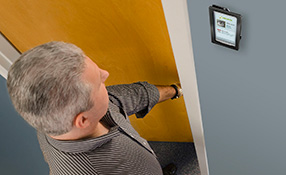
A biometrics-embedded tablet can tag a guard upon entering the building & feed videoof what’s happening beyond secure doors as he/she moves through the facility The best way to make the case for biometrics is to consider a physical and logical access control scenario, according to biometrics vendor SRI Identity, a program from SRI International, one biometrics company. With advances in security technology, access control systems have come to play a bigger role in organisational efficiency and strategies. Expanding role of access control systems Imagine an employee sitting at their desk after entering a facility. The organisation can tailor access and information to that employee across all devices and interfaces (access points, laptops, tablets, smartphones) in a way that not only improves security, but also enables the organisation to track time and attendance, manage inventory control, and, in effect, to integrate biometrics into a broader operational system. SRI Identity's (IOM) solutions offer an efficient, fast and non-invasive method of controlling physical and logical access, says Steve Perna, Executive Director, Products and Solutions Division, SRI International. “Enterprises can maintain high security without slowing things down,” he says. Consider the efficiency and productivity gains for a workforce with the use of biometrics. In hourly and shift-based businesses such as retail, hospitality and manufacturing, time and attendance becomes more accurate (no more “buddy punching”) and automated. It also becomes more convenient, eliminating all the extra steps between punching in, recording hours, processing payroll and performing analytics. SRI Identity technology The ability to push information out to the edge based on the individual’s access level, location and other factors is a powerful capability, says Perna. A biometrics-embedded tablet could, for example, tag a guard upon entering the building, and feed video of what’s happening beyond secure doors as he/she moves through the facility to better situational awareness. SRI’s recently launched a biometrics-embedded tablet – equipped with its (IOM) technology – combines the accuracy and convenience of iris biometrics with the functionality and customisation of the Android enterprise computing platform. This enables one device to support workflows including physical access control, time and attendance, inventory control, company messaging as well as addition customisable applications. Today, biometrics are seeing heavy use in mobile devices as well as banking applications, says Robert Fee, Director of sales, access control, Zwipe. Applications have seen the greatest uptick in replacement of passwords and log-ins, specifically in web and mobile based applications. Biometrics, as a form of security, has the potential to replace current forms of security, including physical, logical and web, he says. Therefore, considering the number of physical keys, access cards and credit/debit cards currently in the marketplace, the potential is excessively large. The primary value proposition of using biometrics over traditional security is that itdramatically enhances security by providing two-factor biometric authentication Enhanced security with biometric solutions Fee says the primary value proposition of using biometrics over traditional security (in the case of access control) is that it dramatically enhances security by providing two-factor biometric authentication: your fingerprint. The days of using a PIN for two-factor are gone since PINs can be passed on from employee to employee to non-employee. “The vast majority of electronic access control (EAC) systems in place today authenticate the badge, not the person holding the badge,” says Fee. “Where is the security in that?” Solutions such as Zwipe biometric credentials allow implementation of two-factor authentication without replacing a single reader. No database integration, protection, installation, wiring or maintenance agreements required. It provides more security without any additional steps. Taking the same amount of time to use a biometric product as a traditional PIN-based card or swipe card, a biometric solution will offer greater security and ease of use, according to Zwipe. Zwipe specifically addresses privacy concerns by never storing a person’s fingerprint. The company creates unique templates that, by themselves, have no value other than within a Zwipe-based solution. Plus, the biometric engine within a Zwipe device is independent of the RF transponder that communicates to an external device, such as a physical or logical access reader. There is no biometric data being communicated between a Zwipe device and reader. Zwipe is the biometric reader. Entering physical access control market “We have physical spaces and virtual spaces, and the differences between them are becoming fuzzy,” says Jason Chaikin, President of biometric company Vkansee, which specialises in fingerprint capture for payment, data and other sectors, including physical access control. He notes that biometrics might be used to control an entrance to a building as well as entry into a network on a computer in the building. Additional safeguards can include confirming that a person trying to access a network from a computer in the building is also on record as having entered the building. “It brings together silos of information so we don’t have the weak links we have now,” he says. Chaikin says physical security devices are on his company’s radar. “I think biometrics should be on a lot more doors than they are now. Our new smaller size sensors can add biometrics for an extra $20 or so per door. The ability to locate the sensor safely under glass opens the doors to outdoor applications in a variety of harsh environments.” “People are willing to give a new look to biometrics, but the physical access control market is more conservative, so it will take more time,” says Chaikin. “When you contact companies, they are willing to give it a shot. Agile companies will start adopting new biometrics that work quite well – you will see a quick rampup.”

Technology's role in securing banks and financial institutions
Download
Security technologies promote real-time awareness in K-12 schools
Download
Integrated systems enable critical and compliant security for transportation
Download
Modernising physical access control
Download
Access. Intrusion. One estate.
Download
