E2S - Experts & Thought Leaders


Latest E2S news & announcements

The GRP corrosion-resistant GNEx and the stainless steel STEx alarm sounder families from E2S have been further extended with the addition of new ultra-high output versions. In addition, all models in both families now feature upgraded electronics, which uses high-efficiency Class D amplifier technology to deliver a higher sound output at a lower current than the previous generation. Effective audible warning The new GNExS2H and STExS2H generate a maximum sound output level of 127dB(A) at 1 metre, offering a unique solution for harsh and hazardous environments with high ambient noise levels, or in quieter environments, generating an effective audible warning over larger areas. The GNExS2F and STExS2F long flare versions now feature two user-selectable power modes The other main variants in the GNEx and STEx families are the GNExS1F and STExS1F short flare horn versions producing up to 115dB(A) SPL with a maximum current consumption of only 221mA and the GNExS1R and STExS1R compact omnidirectional radial horn versions with a SPL of up to 113dB(A). The GNExS2F and STExS2F long flare versions now feature two user-selectable power modes, enabling a choice between the standard 120dB(A) SPL or the high output 123dB(A) SPL. Multiple alarm stages All versions feature 64 alarm tones and four alarm stages/channels that can be remotely activated via common positive or negative switching. New cabling configurations permit both reverse and standard polarity line monitoring across multiple alarm stages. All versions are now tropicalised, enabling them to be installed in up to 99% humidity, and all mounting brackets are now A4 316 stainless steel as standard. The GNEx range is approved to IECEx, ATEX, Ex EAC and INMETRO for all Zone 1 applications and the STEx range is IECEx, ATEX, Ex EAC, INMETRO and DNV approved for Zone 1, 2, 21, and 22 applications.
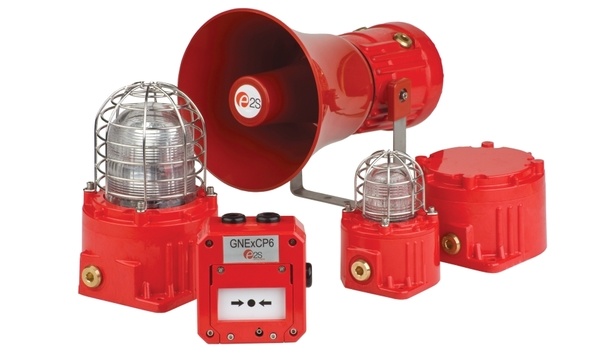
On Booth 1339 from 30 April to 03 May at OTC Houston, E2S Warning Signals, a global independent manufacturer of audible and visible warning devices, is featuring its market-leading LED beacons technology. Along with multiple operating modes, the LED units offer extended operating life of more than 60000 hours, lower current requirements and higher output levels. The typical light output level from the LED units is a very bright 338 candela, significantly higher than the 120 candela effective intensity of a 5J Xenon tube unit. The LED beacons have five flash rates for warning beacon applications: 1.0, 1.5 and 2.0 Hz and double and triple flashes. They also offer high and low steady outputs for status indicator use.The field-replaceability of the lens filters enables the reassignment of beacon function to be a simple and quick process Field-replaceable lens filters DC voltage versions feature three remotely selectable stages, enabling multiple warnings to be signalled from one device. The same light engines and control electronics are common across all different product families: the STEx 316L stainless steel, the GNEx and E2x GRP and BEx and D2x marine grade LM6 aluminium enclosures, which provide a variety of mechanical protection, corrosion resistance, weight and price to suit different environmental requirements and applications. For all families, the Amber, Blue, Clear, Green, Magenta, Red and Yellow Polycarbonate, UV stable lenses are available as separate items; whilst enhancing the light output, the lens filters are also field replaceable without disassembly, enabling the reassignment of beacon function to be a simple and quick process. ATEX and IECEx compliance Also, on show will be two manual call point families, the latest additions to E2S’s SIL2 capable products that meet the remote monitoring and testing requirements of SIL2 systems. The spark-resistant, corrosion-proof GRP GNExCP6 and the marine grade, copper free LM6 (A413) aluminium BExCP3 explosion-proof manual call points, which meet the design requirements of EN54-11, are available in break glass, push button or tool reset versions, are certified to ATEX and IECEx standards, carry many other local certifications and are approved for use in Zone 1, 2, 21 and 22 hazardous areas for the initiation of fire and gas alarm systems.

E2S’s device placed at 3 units per station, spaced at 120 degree intervals ensures all-round audibility The 26 December 2004 Indian Ocean Tsunami killed 230,000 people in 14 countries, and swamped coastal communities with waves up to 30 metres high. Following this tragic event, the UN set up the Indian Ocean Tsunami Warning System, and although not directly affected by the 2004 disaster, the Philippines have set up a similar early warning system. Areas on the west coast of the islands, which face the Manila trench located between The Philippines and Vietnam, are at particular risk and the project is being progressively rolled out from the densely populated coastal towns and cities to the rest of the region. The system includes detectors, a GSM data communication system, data visualisation, interpretation, local tsunami emergency decision tools and, the final public-facing element of the system, widely distributed local tsunami warning stations. Audible alarms to alert population The solar powered local tsunami warning station rely on E2S Warning Signals’ A121AX Appello 126 dB(A) output user-recordable alarm horns, which have a 300 metre effective range, to generate the audible alarms to alert the population to an impending emergency. Three units per station, spaced at 120 degree intervals, ensure all-round audibility, and the units generate warning alert tones followed by recorded messages to ensure that the warning is unambiguous. In the event of an emergency, people living in the affected coastal areas are given sufficient time to flee their homes and follow designated evacuation paths leading to higher grounds. The A121AX can store, in non-volatile permanent memory, up to 2 minutes (4 x 30 seconds) of user messages, with independent volume controls for the 45 embedded alarm tones and the recorded messages. It operates from 24 VDC and is environmentally sealed to NEMA 4/4X/3R/13 and IP66 standards.

One system, one card
Download
Aligning physical and cyber defence for total protection
Download
Understanding AI-powered video analytics
Download
Enhancing physical access control using a self-service model
Download
How to implement a physical security strategy with privacy in mind
Download

