


 |
| The integration of H.265 technology may be hindered by the availability of optimised H.264 best encoding for surveillance systems |
Video compression technology has been a crucial element in surveillance system design since the advent of Internet Protocol (IP) in the 1990s. Since that time, standards for video encoding have been explored in various capacities. Currently, the industry is all abuzz around H.265 High Efficiency Video Coding – the next iteration beyond H.264, which currently dominates IP video encoding technology.
What is H.265?
H.265 is a significant step forward. Specifically, H.265 doubles the compression efficiency of H.264. Therefore, when transmitting images of a given quality, H.265 uses only half the bit rate of the previous codec. This means that both bandwidth and storage requirements are drastically reduced – a great benefit for both hardware and software usage. Users essentially do more with less. Because of this, the majority of security hardware manufacturers support the introduction of the H.265 compression standard to video surveillance. So, for video applications, expect to see H.265 replacing H.264 as the next standard.
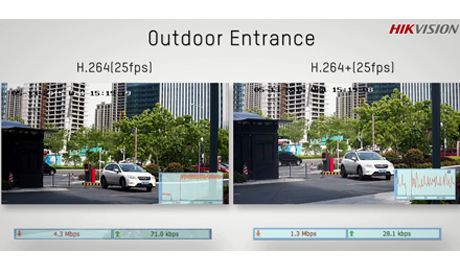
However, that being said, H.265 is still a way away from mass adoption. With the popularity of HD video that has been widely applied across the industry, do users have any other option to optimise HD image transmission and squeeze storage before that turnover happens in the surveillance realm? Recent advancements in the current H.264 codec are optimising bitrates, and doing it in three ways: predictive encoding, noise suppression, and “long-term” bitrate control. The result is a reduction of up to 75% in storage requirements within the H.264 paradigm. Thanks to these innovations (and a couple of other factors), it looks likely that in the next five or 10 years, the two standards will co-exist in the market.
Impediments to H.265 adoption
The integration of H.265 technology will likely be hindered by the availability of optimised H.264 encoding, as well as the cost of upgrading current systems to H.265 since all or most of the components in a system will need to be replaced by those that support this new standard. Other impediments include the industrial chain – changing manufacturing processes to produce H.265 equipment – and issues over patents (which we’ll address below). Basically, H.264 remains the viable and workable standard for a vast majority of security surveillance systems. It’s still getting the job done – and rather well, too.
 |
| With the higher cost, users will need to be convinced that the upgrade to H.265 is really worth it |
Limitations of laboratory testing
According to tests carried out by the Joint Collaborative Team on Video Coding (JCT-VC), the compression rate of H.265 has doubled from that of H.264. But as you’d expect, these tests were carried out in laboratory environments, away from the various complexities of real-world applications. What we’d like to see, in the development of H.265 products, is real-time encoding in action, balancing the algorithm’s complexity with its compression capability. As it exists right now, for industrial and surveillance applications, H.265’s compression capabilities may not reach the 100% improvement as claimed over H.264 in an actual application scenario.
It stands to note that H.264 has had 10+ years of industry integration in which to develop, with support from all chipset manufacturers and the widest variety of encoders and decoders available (not to mention decreased costs because of this wide availability and range of product designs). It’s tested and proven in real-world surveillance and industrial applications. H.265 tech has a lot of catching up to do here.
Higher patent cost
Another issue which may prevent widespread adoption of the H.265 standard is the issue of patents. The H.264 patent enjoys a wide variety of enterprise owners, while H.265, at this early stage of its existence, is not common in the industry, and the enterprises which own it are not unified on the matter. The result is a much higher patent cost – a major issue which security businesses need to consider seriously, as it affects manufacturing and, thereby, the price tag for the consumer. And the price tag, naturally, is critical when a new standard is introduced – especially if users have to replace both the frontend and backend of their system to take advantage of improved video compression. With a higher cost, they will need to be convinced that the upgrade is really worth it.
Optimised H.264 encoding technologies
The issues mentioned above notwithstanding, the primary reason we feel H.265 won’t become the dominant encoding solution any time soon is simply the lack of demand – a number of innovative manufacturers have introduced optimised H.264 encoding technologies so the need hasn’t arrived yet. It’s a “solution in search of a problem,” as the saying goes.
 |
| Optimised H.264 technologies use predictive encoding to reduce the bitrate being spent on an unchanging background image |
Since the launch of H.264 technology circa 2003, the security industry has been developing high performance video encoders in order to transmit higher quality video for surveillance applications. Add to that the increasing popularity of HD video and the subsequent bitrate and resolution demands, and it’s easy to see where the overall system and component cost has risen. The sheer amount of video data produced means users have had to invest in ever-expanding storage solutions.
Manufacturing capabilities have continually matured over this time; processing capabilities have flourished; algorithms have been optimised. The pervasive use of H.264 throughout the industry has both informed all of these developments and required major surveillance equipment manufacturers to commit to improving the range of available H.264 encoding solutions.
Predictive encoding
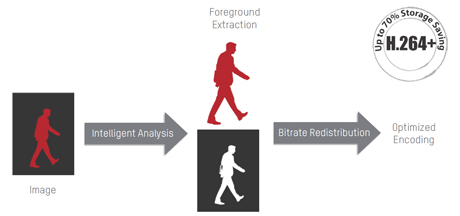
How are improvements to the H.264 codec being made? First, research in the way video compression is actually used at the ground level in various industries. For example, in any given surveillance video, users are primarily concerned with moving objects rather than the scene’s generally stagnant background. When the background doesn’t change, it can be encoded as a reference frame. Optimised H.264 technologies capitalise on this and use predictive encoding to reduce the bitrate being spent on an unchanging background image. By applying that predictive encoding across an entire system, users can reap big savings in both bandwidth and storage.
Noise suppression
Another important element of H.264 optimisation is its noise suppression. “Noise,” or unwanted electrical signal displaying in the video feed, is a potent foe of digital video bandwidth. It results in an image’s background appearing to be littered with extraneous pixels and is caused by fluctuations in light, temperature, or other various signals in the air. But optimised H.264 technologies, using intelligent analysis algorithms, suppress much of this noise by encoding the foreground subject of the image at a higher bitrate relative to the background image. The result: sharp images with accurate colour. Or, more of what you want to see, less of what you don’t.
 |
| Improvements over basic H.264 encoding currently exceed what the available H.265 encoding technology has to offer |
Long-term bitrate control
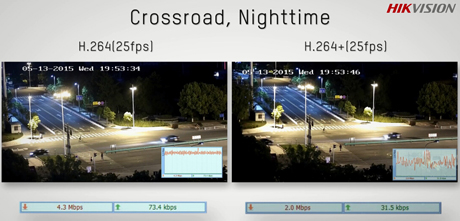
Lastly, bitrate requirements for any given scene can fluctuate over the course of a day. In a typical street scene, for example, there is little foreground movement at night so bitrate requirements remain low. During the day, however, those bitrate requirements increase dramatically, with both vehicles and pedestrians moving across the fore- and background of the scene. Advanced H.264 encoding technologies manage this hour-specific variance by calculating an overall average bitrate, then automatically allocating the required bitrate at the time of day when it is needed. This is done while still maintaining the average bitrate as the encoder’s set value. Known as long-term bitrate control, the major of advantage here is that users are able to accurately predict their video storage requirements, since the bitrate – and thus storage size – can be user-specified.
These improvements over basic H.264 encoding currently exceed what the available H.265 encoding technology has to offer. They also bring along other advantages: compatibility with existing systems, lower product costs, wider product variability, and lower current patent risk.
The 10-year compression itch
Video compression developments have tended to follow a (roughly) 10-year cycle. In 1994, MPEG2 was introduced. H.264 launched in 2003 and H.265 in 2013. The historical context is important here because video encoding standards react not just to technological changes, but to trends across the whole video industry.
When MPEG2 was the standard, the industry focused mainly on DVD players and standard definition televisions, where MPEG2 could be utilised. The advent of H.264 coincided with the introduction of HD technology, advanced IT technology, and the mobile internet, which meant that the more powerful compression standard was more fully exploited. These developments included HD digital television, Internet video, mobile video, video surveillance, Blu-ray, and others.
As H.265 makes its way onto the scene, we believe it will be used most widely in the development of ultra-HD technologies and in cloud storage applications, for example.
Beyond H.265
After the launch of H.265, the members of the Joint Collaborative Team on Video Coding (JCT-VC) began looking at what would come next. In 2015, they established the Joint Video Exploring Team (JVET), focusing on further improvements in compression capabilities. Their latest test data suggests they have achieved a 20% improvement on H.265’s compression performance. At the same time, another organisation – the Alliance for Open Media (AOM) – was set up by a number of internet-focused companies, including Microsoft, Google, Intel, and Amazon, aiming to offer a free standard for internet video. The plan is that this standard would accelerate technology updates to meet the manic speeds of development in the online world.
The competition to develop these standards is likely to be fierce – and it might also mean the 10-year compression cycle falls by the wayside, with a new standard appearing in a much shorter period this time around.
From facial recognition to LiDAR, explore the innovations redefining gaming surveillance