FUJIFILM Optical Devices Europe GmbH - Experts & Thought Leaders



Latest FUJIFILM Optical Devices Europe GmbH news & announcements

Fujifilm and Videotec announce a new collaboration, integrating top-performance products to supply an innovative solution for accurate long-range surveillance. This solution is ideal for protecting critical infrastructure and transportation networks, including airports, harbours, highways, borders and the environment. The combined system incorporates Fujifilm’s new high-end SX800 camera into Videotec’s ULISSE MAXI PTZ. Integrating the SX800 camera into the robust and precise ULISSE MAXI positioning unit is simple and fast, resulting in a first-class PTZ IP camera system for monitoring perimeters and extensive outdoor areas. Maximum resistance motors ULISSE MAXI is a powerful Full-IP PTZ for outdoor IP video surveillance, which can manage IP cameras with large-size lenses, with easy integration into a network system via ONVIF protocol. The sturdy mechanical structure and the powerful motors of the ULISSE MAXI PTZ are designed to guarantee maximum resistance to high operating stress, vibrations and to withstand harsh weather conditions. The unit is equipped with a wiper for removing rain and dust from the front glass. The SX800 camera lens offers a 40x optical zoom that covers a broad range of focal lengths from 20 mm on the wide-angle end to 800mm on the telephoto end, constantly providing sharp images and detailed closeups. It is complemented with 1.25x digital zoom to achieve long-range surveillance equivalent to 1000mm in focal length. The built-in image stabiliser accurately compensates for camera movement, typically caused by gusts of wind or structure vibrations. The system is particularly effective when shooting in the ultra-telephoto range, which is susceptible to even the smallest movement. Advanced de-fog function With a highly sensitive sensor and advanced noise reduction, the SX800 can shoot clear footage with minimal noise even in low-light conditions. The advanced de-fog function brings vivid clarity to hazy images caused by light diffusion due to mist and dust. Alessio Grotto, President of Videotec said: “Our ULISSE MAXI coupled with Fujifilm’s SX800 is the perfect solution when operating cameras in the most challenging environments, and to get the best possible image quality while meeting the needs of the most demanding long-range surveillance applications.”
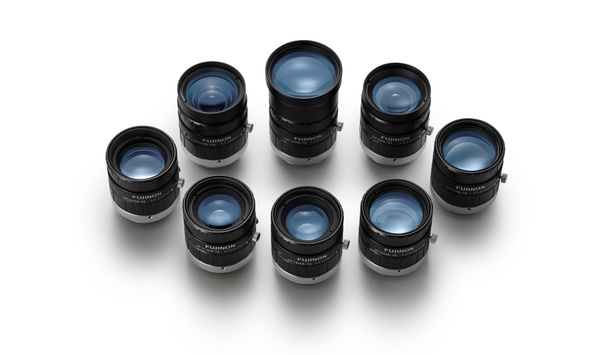
Fujifilm announces the update of its popular DF/HF-HA-1B series lenses to ruggedised versions equipped with the unique Fujinon ‘Anti-shock and Vibration’ technology. Demand for quality optics in ruggedised versions continues to increase and the designated DF/HF-HA-1S is designed to meet that demand. The Fujinon HF-HA-1B series lenses are already in wide use across a variety of manufacturing environments, from automotive to electronics to pharmaceutical. These applications often have strict space constraints, making the external diameter of only 29.8 mm an attractive feature. Reliable performance The Fujinon HF-HA-1S upgrade provides vibration mitigation and shock absorption within the existing design, so the compact form factor remains. “A ruggedised Fujinon HF-HA-1S provides mechanical robustness for reliable performance in machine vision applications such as automated assembly, quality inspection, and industrial robots. It expands the base to where quality optics are required but where ruggedised design is also a significant factor, such as unmanned aerial vehicles and mobile applications”, says Nina Kürten, Sales Manager at Fujifilm. These lenses are compatible with image sensors up to 2/3’ in a broad selection of focal lengths (6, 9, 12.5, 16, 25, 35, 50, and 75mm). The optical performance of the upgraded series is identical to that of the Fujinon HF-HA-1B. The Fujinon HF-HA-1S will be available from January and will become the new standard version, eventually replacing the Fujinon HF-HA-1B as current stocks are depleted. Pricing will remain the same.
Industrial imaging systems are frequently subject to strong accelerations, shocks, and vibrations. This is especially true for mobile systems, like robot-guided 3D scanners, but also for fixed installations. Fujifilm has investigated the impact of shocks and vibrations on industrial fixed focal lenses via a dedicated test procedure. In many cases, the procedure leads to a significant reduction of the resolution and to a shift of the optical axis. However, the intensity of the effects depends heavily on the mechanical design of a camera lens—a widely underestimated aspect at the selection of fixed focal lenses. Modern robot arms are so powerful they can move major loads with a multiple of the gravitational acceleration (unit G, 1 G = 9.81 m/s²). Robot-guided machine vision systems, as they are used with welding and assembly robots as well as with 3D scanning stations, need to withstand such accelerations. Additionally, they are exposed to the vibrations at the tip of the robot arms just like camera-lens setups at large machines with rotating elements, e.g. in large offset printing systems.Fujifilm has developed a testing procedure for such lenses to measure their robustness against shocks and vibrations. Shock testing on machine vision cameras Most industrial machine vision solutions utilise industrial cameras and c-mount lenses with fixed focal length, which need to provide constant image quality irrespective of harsh conditions. Therefore, Fujifilm has developed a testing procedure for such lenses to measure their robustness against shocks and vibrations. At first, 10 G shocks impact the lenses from 6 different directions orthogonal to the optical axis. Next, a special vibrating table exposes the lenses to various sinusoidal vibrations according to IEC 60068-2-6 (up to 500 Hz and 100 m/s²). Finally, the shock test is repeated. The results show a shift in the optical axis of a conventional lens by up to 26 µm which corresponds to approx. 7 pixels at Sony Pregius sensors of the second generation. Their resolution power, measured using a contrast chart, deteriorates dramatically (see false colour rendering). For most machine vision applications, where fast accelerations and strong vibrations may occur, these lenses are not suitable. On the other hand, all lenses of the Fujinon HF-12M series, as well as the lenses of the HF-5M series with 6 and 50 mm focal length, withstand the shocks and vibrations showing a shift of the optical axis of just between 4 and 10 µm. This is enabled by the Fujinon Anti-Shock & Vibration design, an elastic and patent pending fixation of the internal lens arrangement.The Anti-Shock & Vibration design of the Fujinon lenses minimises the dependency on adhesives and ensures a constant performance and image quality in the long run. Towards high image quality At conventional camera objectives, the lenses are fixed with adhesives, which does not withstand shocks and vibrations plus it is sensitive to changes in humidity and temperature. The Anti-Shock & Vibration design of the Fujinon lenses, however, minimises the dependency on adhesives and ensures a constant performance and image quality in the long run. Beyond the optical format, resolution power, and focal length, developers of mechanically stressed imaging systems should consider the robustness of their camera objectives against shocks and vibrations. The following lenses are already equipped with the Fujinon Anti-Shock & Vibration design: HF-12M series for pixel sizes from 2.1 µm and sensors up to 1“ HF-5M series for pixel sizes from 3.45 µm and sensors up to 1.1 (focal length: 6 and 50 mm)
Insights & Opinions from thought leaders at FUJIFILM Optical Devices Europe GmbH

There was another big trade show last week – the four-day Security Essen event in Germany. I didn’t attend, but several of my SourceSecurity.com colleagues report it was a busy show from start to finish, with the halls devoted to video/CCTV and access control dominating the show. The other halls were quieter, with smaller stands. Hot topics included big data, machine learning, mobile credentials, storage and an emphasis on solutions (rather than products). The exhibit hall was a bit of a maze, but attendees managed to find their way to the various stands. Three big companies – Bosch, Siemens and Honeywell – were conspicuously absent from their usual large role at Security Essen, and there was mixed feedback about the impact of their absence on the larger show. Without three gigantic stands to concentrate the footfall, attendees seemed more spread out than clustered. Hands-on, technical displays Hands-on displays with plenty of technical detail were the norm, encouraging attendees to interact with the products. The ASSA ABLOY stand, huge as always, reflected the continuing popularity of key systems in the German, Swiss and Austrian markets. ASSA ABLOY’s Yale also featured a home automation zone. Hands-on displays with plentyof technical detail were thenorm, encouraging attendeesto interact with the products Hikvision envisions cameras coming very soon with “deep learning” capabilities. These cameras, combined with big data applications, are the future of smart traffic systems, for example. Deep learning systems will replace traditional licence plate recognition (ANPR) and analyse electronic data about cars, rather than relying on number plates, says the company. Hikvision also highlighted multi-sensor cameras that can cover a large area and reduce the cost-per-channel – they have big projects in China and Southeast Asia. Hikvision’s privacy masking functionality is popular in Europe because of privacy regulations. Fujifilm demonstrated its impressive zoom lens series, featuring 60x zoom, long focal length and full HD quality, for use in airports and perimeter protection. Stabilisation is important with zoom because even slight movement can have a large effect, says the company. In Fujifilm lenses, the stabilisation is optical-based (in the lens), rather than software-based. Another stand that drew attention was Nedap, where a tiered seating area was provided for visitors to view video projected on a back wall. New laws in the Netherlands and France require that no information can go outside government buildings, thus requiring closed security systems, according to Nedap. It’s a trend likely to follow in the European Union, with similar laws potentially impacting hospitals and banking as well as government, says Nedap. This is why they are working with partner AET Europe to ensure that encrypted communications are secure between all elements of an IT-based access control system. Solutions – not just products The need to provide solutions rather than “just products” was a repeated theme. One solutions provider is MOBOTIX, which highlighted a new corporate design with fresher and more unified branding. The solutions approach includes analytics and people counting embedded for inventory optimisation and business intelligence. MOBOTIX is releasing new plug-and-play bundles to combat the perception that the company’s technology is not easy to use. There is also a 4K bundle with NAS (network attached) storage – all preconfigured; just power it up and it will run. MOBOTIX is releasing new plug-and-play bundles tocombat the perception thatthe company’s technologyis not easy to use Sony also offered solutions, including their intelligent approach to 4K, which they say overcomes traditional concerns with the higher-resolution technology. Sony also displayed “glass-to-glass” technology, streaming 4K cameras directly to a screen with no PC in between. Even with the company shifting to end-to-end solutions, their cameras are still at the core of the portfolio, including an accent on low-light and changing light conditions. Adding ROI was another hot topic for exhibitors. MOBOTIX emphasised its process monitoring capabilities, as did Geutebrück. VIVOTEK highlighted combining a people-counting solution with other retail data for business intelligence. Contrary to the focus on solutions was LTV Europe, a video company that keeps the attention on products. LTV emphasises personal service and a fresh approach rather than competing with bigger providers. Focus on storage and automation The themes my colleagues heard at Security Essen were not unlike those we heard recently at ASIS and earlier this year at IFSEC and even ISC West. More companies are looking to expand into non-traditional applications beyond security, such as asset tracking and logistics/delivery. Another example: Sony suggested using video to monitor rivers and lakes water levels for flood warnings. Quantum is keeping itsattention on storage, whileaddressing the IT department’sneed for data protection Quantum is keeping its attention on storage, while addressing the IT department’s need for data protection. The new StorNext scalable storage system, which can handle 4K, integrates various tiers of storage appropriate to varying workflows and business needs. For example, retrieval can be faster for more valuable data, thus maximising value while minimising the overall cost. Allegion is rolling out products that combine electronic and mechanical locks from subsidiary SimonsVoss and the Allegion portfolios. Allegion wants to position itself as electronic access control expert. Paxton highlighted a building automation system, Paxton net10, which is aimed at small and medium enterprises (SMEs) and works on mobile credentials as well as cards. They’re looking to build this kind of technology into future products. Another company, AxxonSoft, is pushing strongly to establish its brand in the United States – something to watch in 2017. SALTO also highlighted cloud-based mobile access control: They have developed a Keys as a Service system, SALTO KS, which allows businesses to grant access remotely while viewing a video of the door. Four busy days in Germany Security Essen is an international show, but the emphasis was on German, Austrian and Swiss companies and larger companies targeting those markets. There was more of a continental Europe “flavour” compared to IFSEC’s focus on the U.K. market. Four days is a long time for a trade show – my feet are shot after two and a half days! But my colleagues agree it was time well spent, if for nothing else than getting to watch an 8-foot-tall robot dance around Hall 3.

One system, one card
Download
Aligning physical and cyber defence for total protection
Download
Understanding AI-powered video analytics
Download
Enhancing physical access control using a self-service model
Download
How to implement a physical security strategy with privacy in mind
Download
Fujinon SX800: long range surveillance system

Fujinon Optical Image Stabilisation provides instant results without losing any frames

FUJIFILM Europe showcased wide range of Fujinon zoom lenses at IFSEC 2017


