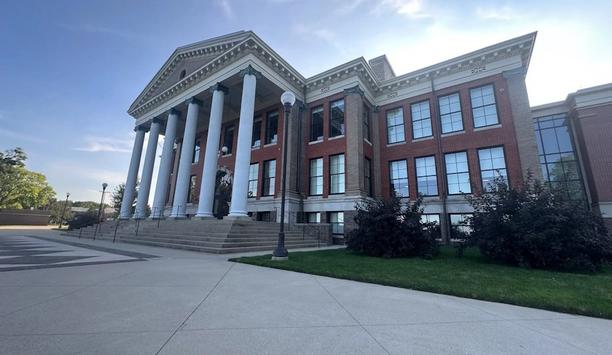
The Buffalo and Erie County Naval & Military Park, in Buffalo, N.Y., has a clear mission based on four pillars: to honour all veterans, educate the public about the sacrifices made by those who serve, inspire a sense of patriotism and appreciation for those protecting Americans’ rights and freedoms, and preserve the artefacts entrusted to the Park’s care.
The Park regularly hosts events and takes visitors inside America’s military history with in-depth tours of decommissioned naval vessels, exhibits, and displays. The team’s goal is to highlight its monuments and artefacts while providing a welcoming and secure environment for visitors. A key challenge was the Park’s large open and unfenced grounds, allowing the public access to the facilities at any time of the day or night.
Hanwha Vision’s AI-equipped cameras
Design and install a surveillance system based on Hanwha Vision’s multi-directional cameras
“We had begun to notice an increased rate of delinquent incidents happening during the day and off hours, including graffiti placed on the artefacts and monuments,” said Paul Marzello, Sr., President & CEO, Buffalo and Erie County Naval & Military Park.
The Park engaged Mario Rodriguez, president of Forseti Protection Group, and Erik Schiefer, account executive at Seibold Security, to design and install a surveillance system based on Hanwha Vision’s multi-directional and AI-equipped cameras. “When we did our research, we found that Hanwha Vision certainly was a pioneer in the industry,” said Marzello.
Risk and public safety perspective
“We conducted a site survey, considering line of sight, the cameras’ capabilities, the density of groups of visitors and where they tend to gravitate, and criminal history in the Park,” said Bill Abbott, Director of Operations, Buffalo and Erie County Naval & Military Park. “Those were all factors in how we determined the layout. We wanted to make sure that we had the right coverage.”
From a risk and public safety perspective, the goal from the start was maintaining an open and welcoming environment while keeping public safety top-of-mind.
Extensive experience with Hanwha cameras
Schiefer has extensive experience with Hanwha cameras from previous projects
Schiefer has extensive experience with Hanwha cameras from previous projects. “Their new 4K multi-sensor cameras are first class and as far as 360° coverage, with the ability to monitor several areas, Hanwha was the first choice,” he said.
The ability to view 360° coverage from one camera that essentially is divided into multiple sectors was significant. “That gives us full visibility and lets us be open and welcoming while keeping out of the public’s way without being imposing or intimidating,” Rodriguez said.
Benefit of using the Hanwha 360° cameras
Schiefer added that one key benefit of using the Hanwha 360° cameras to cover such a large area is the ease of playing back footage and monitoring activity after the fact.
“They are broken out into four sensors, so you don’t necessarily have to go back and look through a large amount of footage,” he said. “You can pick the area you're looking for, go directly to that sensor within the camera that we have in that area, and you can pull footage much easier that way.” One challenge the team encountered during the design phase was running a cable for a project of this scale.
Incorporated wireless network cards
The Park’s priorities included the use of NDAA-compliant solutions and more streamlined communication
“The cost to run buried cable at such long distances with switches would have rendered this project almost completely impossible,” Schiefer said. “We incorporated wireless network cards into the poles around the park and all the cameras feed directly back to the Hanwha NVR without using any sort of cabling.”
The Park’s priorities included the use of National Defense Authorisation Act (NDAA) compliant solutions and having more streamlined communication with law enforcement.
Supply law enforcement
“We wanted to make sure that the cameras themselves were secure,” said Abbott. “The cameras also needed to be used to positively identify someone who had done something, either damage or acts of violence."
"In the past, we had no capacity to effectively supply law enforcement with usable information to identify a suspect. We've now changed that with the quality of cameras that we're using. We can share footage and data to produce an outcome that's satisfying to everybody as far as finding a culprit and holding them accountable."
Greater sense of security
The Hanwha cameras’ use of AI plays a key role in delivering those capabilities. “You can use key identifiers, whether it's the colour of someone's shirt, if they're wearing a backpack, or there's some physical feature that we can then go through and locate that person through the system,” Abbott said. “We absolutely would see an increase in the value and number of cameras that we use.”
Marzello added, “From an operations standpoint, we feel a greater sense of security knowing the cameras are there and will help us identify activities that we can hopefully prevent. This system meets our needs today and will also be able to grow with us.”