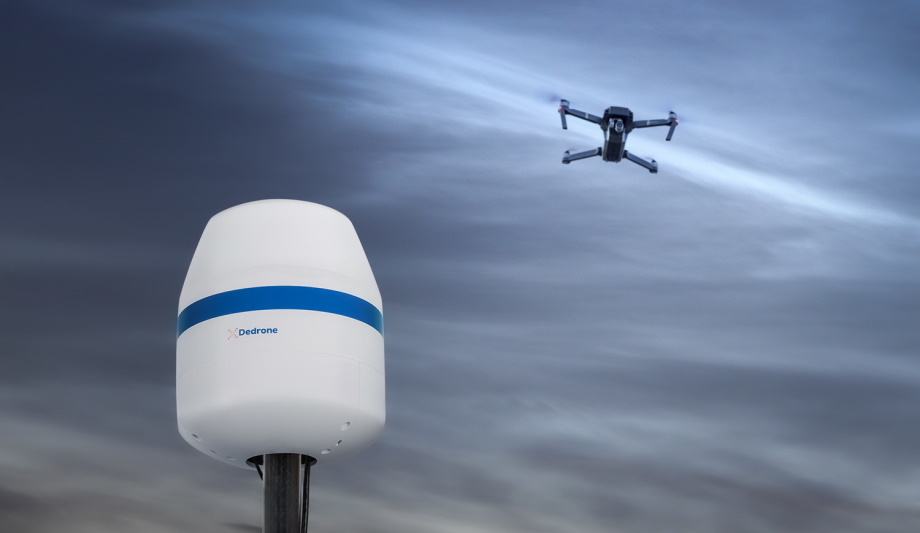

Dedrone, a provider of counter-sUAS capabilities, announces the release of their newest radio frequency sensors, the Dedrone RF-160. The RF-160 is an upgraded version of the company’s existing foundational RF sensor, the RF-100, and includes new and advanced features such as increased detection range, streamlined installation process, and integrated LTE.
The RF-160 quantifies how many drones are in the user’s airspace, providing early detection of drones, before they even take off. Dedrone also manufactures a separate sensor, the RF-300, which provides localisation and tracking of sUAS.
Comprehensive data for drone risk analysis
The RF-160 is available for order and will begin delivery in March 2020. New features of the RF-160 include:
The RF-160 can be installed within a few minutes and without any specialised IT knowledge
Integrates LTE for simple installation, fast startup, and access to comprehensive data for drone risk analysis: The RF-160 can be installed within a few minutes and without any specialised IT knowledge. Only needing power supply and a pole, it automatically connects to the Dedrone Cloud via LTE and immediately starts to detect drones. An on-premise server is not required. Users can assess their drone risk quickly and use these insights to act upon drone threats.
Provides detection range of up to 5 km: The RF-160 stands alone to achieve a baseline of drone activity for users and provide early warning and classification of sUAS. A single RF-160 has an average detection range of 1.6 km, and under ideal conditions, up to 5 km for certain drones. This range extends when one or more RF-160s are working together, and even more information on drone activity can be generated when layering with other detection technologies, including the RF-300, radar, and PTZ-cameras.
Advanced antenna configuration
The RF-160 features a high-performance processor, enabling rapid data processing and analytics
Incorporates an advanced design for urban environments: Urban areas have more radio frequency activity from radio communication, televisions, cell phones, GPS, and other technologies. The RF-160 meets the needs of organisations in such environments a with higher potential of RF interference.
Includes expanded RF band detection range for the detection of commercial, consumer, and home-built sUAS: Radio frequency spectrum operates on a wide range depending on the types of communication technology used. Commercial, off the shelf drones typically operate on the 2.4 and/or 5.8 ghz sub-band. The RF-160 comes with an advanced antenna configuration to ensure that drones that may operate outside the typical spectrum are reliably identified.
Features increased computing power and data processing: The RF-160 features a high-performance processor, enabling rapid data processing and analytics and allows even more timely responses to sUAS incursions.
Creating a baseline risk assessment
“The RF-160 joins the Dedrone suite of products at a time when the global sUAS market is growing at a rapid pace, and organisations are looking to see what the social and economic impact of the rise of drones will have on our day-to-day lives,” shares Joerg Lamprecht, CEO and co-founder of Dedrone.
The RF-160 is the most advanced product to provide our customers with the analytics"
“The RF-160 can be installed quickly and easily for users to easily create a baseline risk assessment on all airspace activity, regardless of the type of manufacturer, or even if it is a home-made drone. Lower airspace security starts with detection, and the RF-160 is the most advanced product to provide our customers with the analytics they need to act upon sUAS threats to their airspace.”
Unmanned aerial systems
Dedrone’s multi-sensor system enables security providers to match the best-in-class sUAS (small Unmanned Aerial Systems) detection hardware with DroneTracker, Dedrone’s software.
The RF-160 detects and classifies drones using radio signals and is ideal for creating a first risk analysis. Dedrone’s multi-sensor platform allows the RF-160 to be supplemented with additional sensors such as the RF-300, which provides localisation information, PTZ cameras, and radar systems.