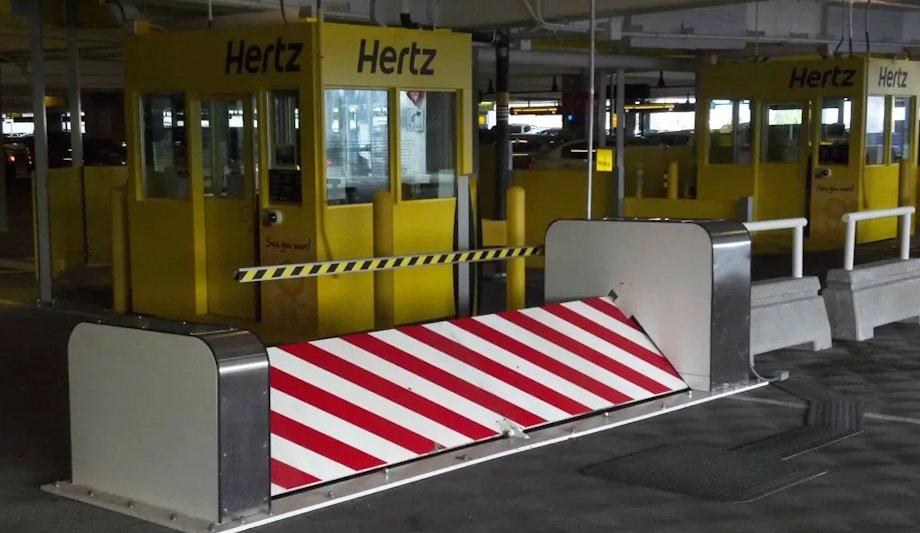
Organisations in both public and private sectors are increasingly employing a layered approach to physical security. This strategy often includes implementing various perimeter barriers to prevent unauthorised access. Anti-ram barriers are a crucial component in this setup, serving as a foundational element in many security plans.
These barriers are designed to halt vehicles travelling at high speeds, thereby preventing potential collisions with buildings or pedestrian areas that could lead to significant property damage, injuries, or even fatalities.
Understanding anti-ram vehicle barriers
Active barriers feature movable parts that can be adjusted to permit the passage of authorised vehicles
Anti-ram vehicle barriers can be divided into two types: active and passive. Active barriers feature movable parts that can be adjusted to permit the passage of authorised vehicles.
A common example of an active barrier is a beam barricade. On the other hand, passive barriers are fixed structures that do not allow any vehicle access, exemplified by fixed bollards. However, it's important to note that moveable bollards are also available and serve as active barriers.
The role of crash ratings
Crash ratings are vital for evaluating and conveying the effectiveness of a barrier in stopping a speeding vehicle. A prominent standard, ASTM F2656, is met by many of Delta Scientific's anti-ram barriers. This standard requires the barrier to stop a vehicle weighing up to 15,000 pounds effectively. The system includes M-ratings and P-ratings, where the M-rating indicates the highest vehicle speed the barrier can safely stop.
For instance, an M30 rating corresponds to stopping a vehicle at 30 mph, and M40 at 40 mph, with M50 being the highest rating, for 50 mph. The P-rating measures how much of the vehicle protrudes beyond the barrier after impact, with P1 indicating less than one foot of penetration, P2 between one and four feet, and more than four feet marking a failed penetration test.
Importance of anti-ram barriers
The necessity for anti-ram vehicle barriers arises from the increasing frequency of vehicle-ramming attacks
The necessity for anti-ram vehicle barriers arises from the increasing frequency of vehicle-ramming attacks, which are methods used by assailants to inflict mass harm.
Such attacks can be catastrophic, especially when vehicles ram into buildings or crowded areas. These attacks are concerning as they require minimal expertise, relying primarily on the perpetrator's ability to obtain and operate a vehicle.
Applications of anti-ram vehicle barriers
Anti-ram barriers are prevalent at high-security facilities such as law enforcement buildings, government and military sites, airports, and border checkpoints.
Furthermore, places that may be soft targets for terrorism, including stadiums, parking structures, and schools, could also benefit from the protection these barriers offer. It's essential for vehicle-ramming prevention measures to be customised to meet the specific security needs and functions of a facility.
Many organisations in the public and private sectors have adopted a tiered approach to physical security. Where there is a tiered approach, there are several perimeter barriers in place to prevent access by unauthorised personnel.
Anti-ram barriers are examples of these perimeter barriers. If they are unfamiliar with physical security concepts, they offer this introduction to anti-ram vehicle barriers.
What is an anti-ram vehicle barrier?
An anti-ram barrier is one that can stop a vehicle travelling at high speeds so that it doesn’t crash into buildings or pedestrian areas, which can result in property damage, injuries, and even loss of life.
Anti-ram vehicle barriers can be either active or passive. An active barrier has moveable parts that can allow authorised vehicles to pass. A beam barricade is an example of an active barrier. Other barriers are passive, meaning that they have no moveable parts and don’t allow access to any vehicles. Fixed bollards are an example of a passive barrier, but keep in mind that there are also moveable bollards that present active barriers.
What are crash ratings?
Crash ratings are a way of assessing and communicating how effective a barrier is at stopping a speeding vehicle. At Delta Scientific, they make anti-ram barriers that meet the ASTM F2656 standard. To meet this standard, a barrier has to be effective at stopping a vehicle weighing up to 15,000 pounds.
According to the ASTM standard, anti-ram vehicle barriers receive both an M-rating and a P-rating. The M-rating reflects the speed at which the barrier is effective at stopping a 15,000-pound vehicle. A vehicle with an M30 rating is effective at stopping a vehicle travelling at 30 miles per hour, while an M40 rating is effective at stopping a vehicle travelling at 40 miles per hour. The highest M-rating available is M50, which is effective at stopping a vehicle travelling up to 50 miles per hour.
The P-rating reflects how much of the vehicle extends past the barrier after it has stopped. The barrier receives a P1 rating if the body of the vehicle extends less than one foot past it. If the vehicle penetrates between one foot and four feet past the barrier, the barrier receives a P2 rating. If the penetration is greater than four feet, the barrier has failed the penetration test and doesn’t receive a P-rating.
Why are anti-ram vehicle barriers necessary?
Vehicle ramming attacks are increasingly popular with people who wish to cause harm to others on a large scale. The effects of such an attack can be devastating, especially if the vehicle crashes into a building or a large crowd of people.
The perpetrator of such an attack also doesn’t need a lot of specialised knowledge or training. The ability to acquire and operate a vehicle is all that is necessary.
Where are anti-ram vehicle barriers used?
Anti-ram vehicle barriers are common at facilities that require high levels of security, such as law enforcement facilities, government or military installations, airports, or entry points at borders. However, venues that present a soft target for terroristic attacks, such as stadiums, parking garages, or schools, could potentially benefit from anti-ram vehicle barriers as well.
Vehicle-ramming mitigation has to be tailored to the functional and operational needs of the facility. Contact them to start customising a solution for your unique security challenges.