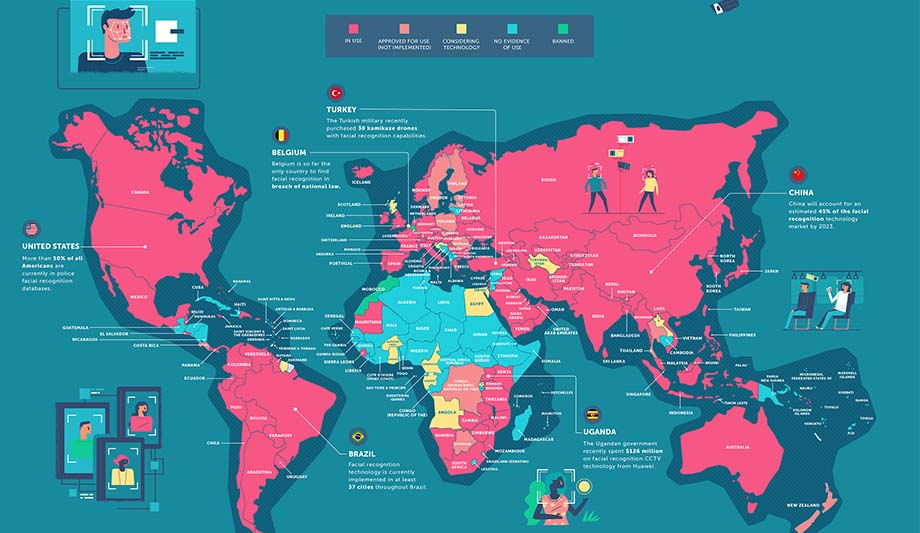


Governments around the world use facial recognition for applications such as identifying persons on public video feeds. The technology is also used by police for internal databases and as a component of ID verification for elections and/or airport security. In fact, the use of facial recognition technology is increasing globally.
Surfshark, provider of virtual private networks (VPNs), collated the latest data on face surveillance around the world and distilled it into a map that shows which countries currently use facial recognition, which have approved it but have not yet implemented its use, countries that are considering the technology, and countries that have banned it.
Only one country, Palestine – where the government of Israel is using facial recognition technology to monitor Palestinians in the West Bank – did not fit these categories.
Facial recognition for surveillance purposes
There are 109 countries today that are either using or have approved the use of facial recognition technology for surveillance purposes.
Surfshark’s main data sources for this project were the Carnegie Endowment for International Peace, Electronic Frontier Foundation and AlgorithmWatch.
Some 26% of Americans believe the government should restrict the use of facial recognition technology. In 2019, San Francisco became the first U.S. city to ban the police use of facial recognition. The U.S. Department of Homeland Security expects to conduct facial recognition scans on 97% of all air travellers by 2023. More than 50% of all Americans are currently in police facial recognition databases.
Humanising protection tools
Belgium is so far the only country to find facial recognition in breach of national law. Moscow used facial recognition technology to monitor whether potential carriers of coronavirus were obeying the rules of their quarantines.
One study found that the facial recognition technology used by London police was inaccurate in 96% of cases. The first arrest to result from facial recognition CCTV in the UK took place on February 27, 2020.
Surfshark’s mission is to humanise protection tools so that everyone can be in control of their privacy and security. NeoMam Studios created the map. The studio seeks to create digital content that online audiences will want to share for months and years to come.
You can find more information about the map here.