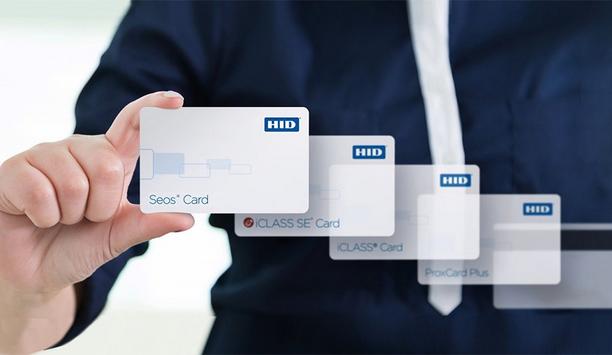

HID Global®, a worldwide leader in secure identity solutions, recently announced that the U.S. Patent and Trademark Office granted several patents for the company's innovation related to gesture-based methods of using three-dimensional (3-D) motion sequences to increase privacy, security and convenience when using RFID-based devices such as smart cards and NFC-enabled smartphones for a broad range of applications. These patent additions strengthen HID Global’s IP portfolio of over 1,000 pending and issued patents and protect the company’s intellectual capital.
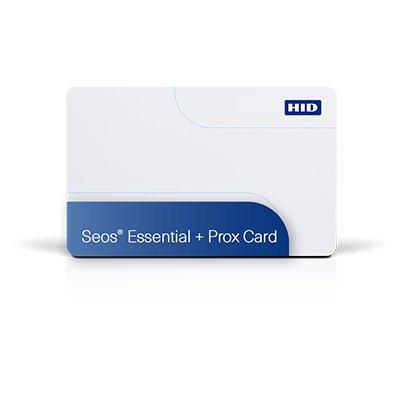
HID Global’s latest inventions allow a user to define a series of hand motion sequences or gestures to be used to control operation of an RFID-based device, introducing the notion of a new authentication factor. For example, when incorporated into a RFID smart card, a user can present the card to a reader, rotate the card 90 degrees to the right and then back to the original position to enable the card to be read. This greatly minimises the possibility of a rogue device surreptitiously stealing the user’s RFID credential in a “bump and clone” attack.
“We are excited to see these patents issued as they confirm the industry’s recognition of HID Global as an innovator of secure identity technologies," said Dr. Tam Hulusi, senior vice president of strategic innovation and intellectual property with HID Global. “HID Global invites partners to contact us for information on licensing these and other HID Global patents to develop new and innovative solutions.”
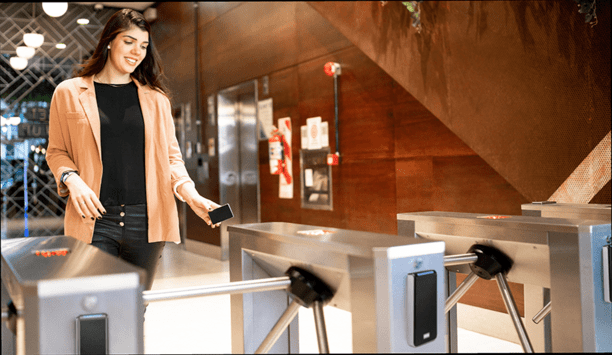
The invention opens up a new field of gesture-based authentication and is particularly pertinent when incorporated into an NFC-enabled mobile phone. Apart from the benefits of convenience and speed, the user can define gesture-based passwords to easily add an additional factor of authentication (e.g., something you know in addition to something you have) to the phone-based transaction. These user-defined, gesture-based passwords can also work in a two-dimensional mode similar to a combination lock, or they can also include 3-D motions such as moving to the left, right, forward and backward.
HID Global’s invention can also be utilised to unlock Apps as well as to lock and unlock a door, similar to the way a mechanical key is used to lock and unlock a door. Additionally, it can allow the user to secretly signal that he is using his card or phone to gain access but is under duress.
New patents granted to HID Global for this invention are US 8,427,320 and US 8,232,879, and the company has received notification that the European Patent Office has indicated their intention to grant a patent.