

 |
| Bluetooth Smart creates new ways to open doors and gates |
The latest generation of access control systems offers more secure and sophisticated credentials, and new credential form factors including mobile devices that offer a more secure and convenient way to open doors and parking gates. Mobile access control also delivers a simple and user-friendly secure identity management process, and a platform for integrated, multi-layered physical access control (PACS) and IT security solutions in the future.
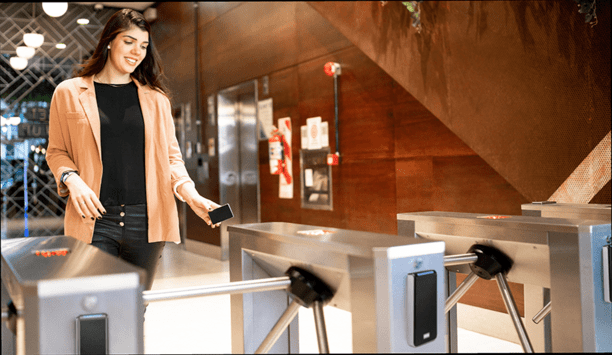
One of the most exciting opportunities for access control solutions on mobile devices involves the use of Bluetooth Smart short-range connectivity technology. Bluetooth combined with gesture technology will offer an additional benefit for access control -- the ability for users to open doors from a distance by rotating their smartphone as they approach a mobile-enabled reader. In this article, John Fenske, Vice President of Product Marketing at HID Global, discusses how this new gesture-based technology capability offers a new user experience, creates new ways to open doors and gates, and will enable many additional future applications.
Making the connection
There are two choices for short-range communications technology that enables smart cards and smartphones to “present” credentials to a reader: NFC and Bluetooth Smart. NFC technology has taken the lead for tap-in strong authentication use cases, enabling users to gain access to resources by simply tapping a smart card to a tablet or laptop for authenticating to a network or application. This capability may be possible in the future with smartphones, as well. It is convenient because there is no need to enter a password on touch-screen devices, and there are no additional devices to issue and manage. Users can tap-in to facilities, VPNs, wireless networks, corporate Intranets and cloud- and web-based applications, as well as SSO clients.
Organisations will need to take a technology-agnostic approach to short-range communication technology, especially to support physical access control applications such as opening doors and parking gates. In these applications, the industry is looking to Bluetooth Smart because of its broad availability on both Apple and Android device platforms.
Another advantage of Bluetooth Smart is its longer reach, which enables smartphones to incorporate gesture technology so they can simply be rotated as the user walks up to a mobile-enabled reader. This new gesture technology capability will offer an additional layer of authentication and new ways to open doors and parking gates.
 |
| Bluetooth and NFC will provide more convenient ways to open doors and gates |
Rolling out mobile access control solutions
Mobile access control will be supported by a user-friendly and highly intuitive identity deployment and management experience. Ideally, administrators will simply send users invitations to download an App directly to their phones. Once the invitation is accepted and the app is activated, mobile IDs can be immediately issued, provisioned or revoked over the air. This will be done via an administrative portal that provides numerous convenience features, including the ability to create user profiles on an individual basis or in groups using a batch upload feature.
Doing more with mobileThe benefits of access control using mobile devices are also driving many companies and organisations to seriously consider incorporating a combination of secure mobile physical and logical access into their facilities and IT access strategies. In addition to receiving digital credentials and “presenting” them to readers at doors and parking gates, smartphones will also be capable of generating one -time passwords for accessing network or cloud- and web-based applications. In other words, the same phone used for building access will also be used in conjunction with a personal tablet or laptop to authenticate to a VPN, wireless network, corporate intranet, cloud- and web-based applications, single-sign-on (SSO) clients and other IT resources. In some cases phones will replace cards, but in many others they will supplement cards to deliver a more secure and user-friendly experience. The objective is not simply to substitute one credential form factor for another across isolated use cases, but rather to leverage mobile platforms and associated technologies to build unified solutions for ensuring secure access to the door, to data and to cloud applications.
The potential for accelerated adoption of mobile access solutions is one of the most important industry developments in the coming years. Evolving mobile technologies such as NFC and Bluetooth are an important ingredient as smartphones become an integral part of the ecosystem for the creation, management and use of secure identities, and will help offer an improved user experience along with new and more convenient ways to open doors and gates.
Discover how AI, biometrics, and analytics are transforming casino security